The short answer
Yes, and grades do not settle it under either law. Under the Individuals with Disabilities Education Act (IDEA), ADHD is named inside other health impairment (34 CFR 300.8(c)(9)(i)), and the group weighs many sources beyond scores (300.306(c)(1)). Under Section 504, the question is asked without the help of medication or extra effort.
How many children this touches
The sentence lands in a lot of meetings. His grades are fine, so he does not qualify. It sounds like a rule. It is not one.
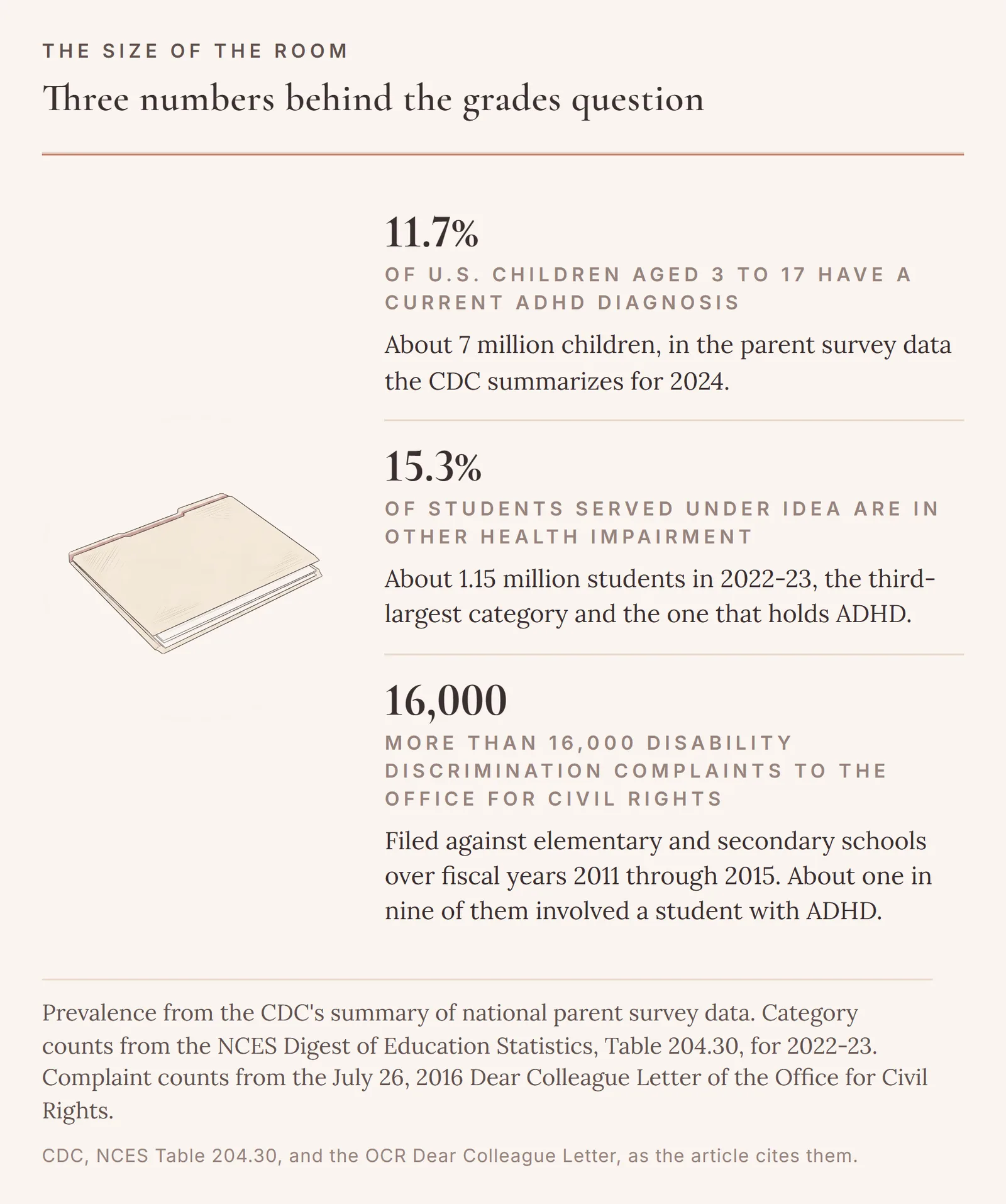
About 11.7% of U.S. children aged 3 to 17 have a current ADHD diagnosis, roughly 7 million, in parent survey data the CDC summarizes for 2024. The IDEA category that holds ADHD is other health impairment, and in 2022-23 it covered about 1.15 million students, 15.3% of everyone served under IDEA (NCES Digest of Education Statistics, Table 204.30).
The disagreement is common too. Over fiscal years 2011 through 2015 the Department of Education's Office for Civil Rights (OCR) received more than 16,000 complaints alleging disability discrimination in elementary and secondary schools. About one in nine involved a student with ADHD (OCR Dear Colleague Letter, July 26, 2016).
How each law decides
What does IDEA actually ask about a child with ADHD
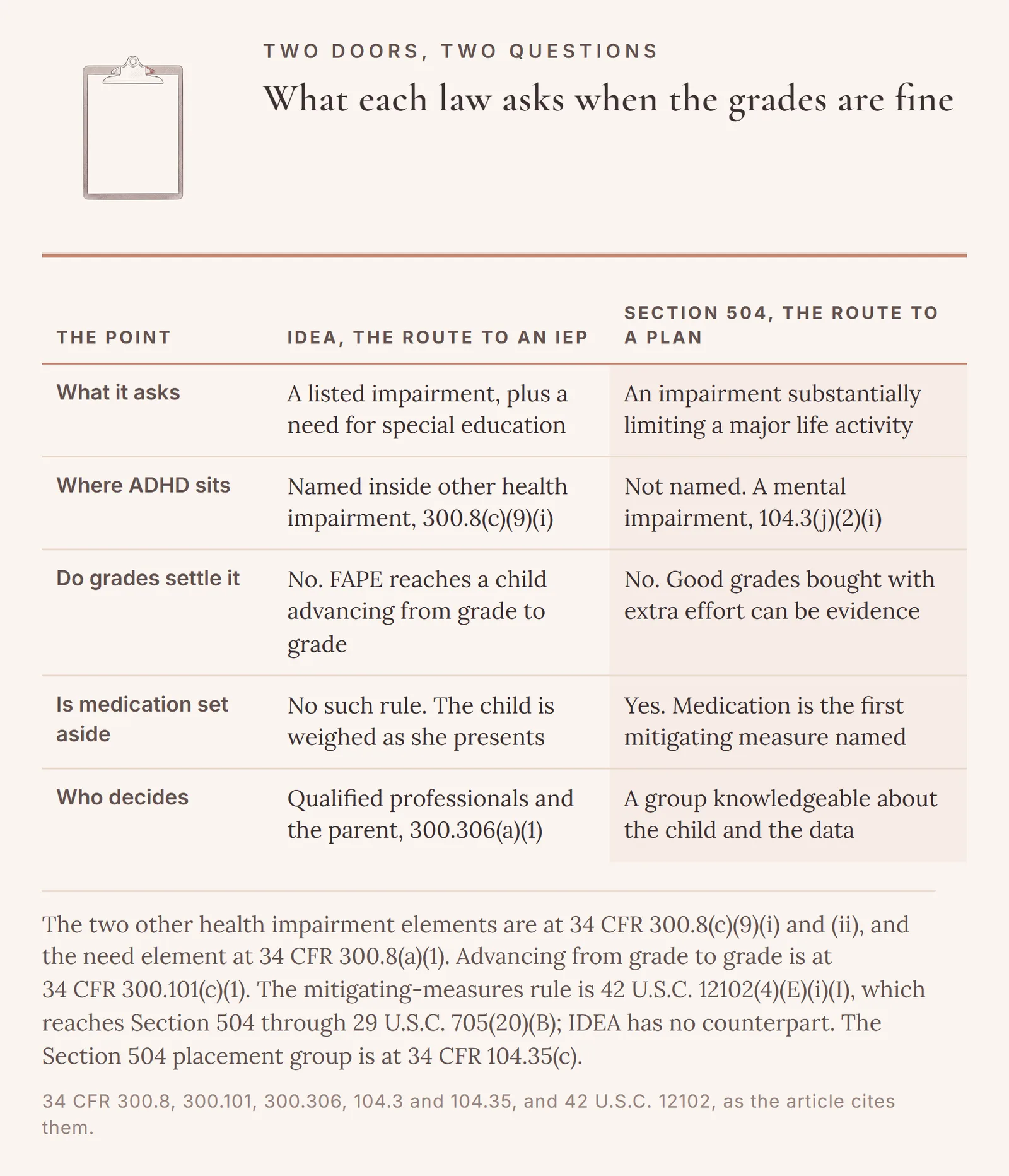
IDEA has no ADHD category, and what it produces is an Individualized Education Program (IEP). The category built for chronic health conditions is other health impairment, and it names attention deficit hyperactivity disorder inside it (34 CFR 300.8(c)(9)(i)). That definition asks two things: limited alertness in the educational environment from a chronic or acute health problem, and an adverse effect on educational performance. A third question sits above both, because a child with a disability under IDEA is one who, by reason of the impairment, needs special education (34 CFR 300.8(a)(1)).
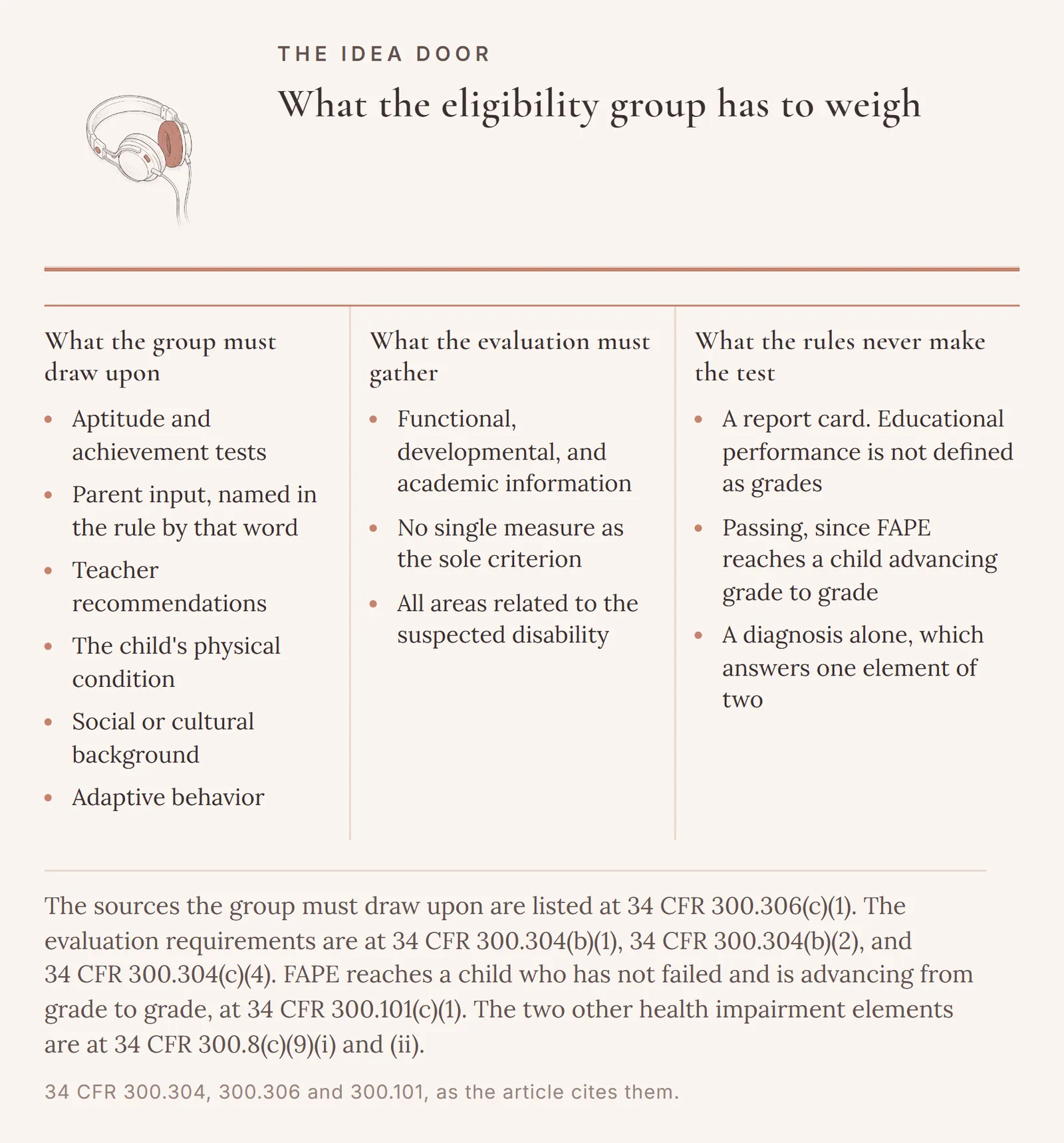
Grades answer none of the three. The eligibility rule tells the group to draw on aptitude and achievement tests, parent input, teacher recommendations, physical condition, social or cultural background, and adaptive behavior (34 CFR 300.306(c)(1)). The evaluation gathers functional, developmental, and academic information (34 CFR 300.304(b)(1)). No single measure may be the sole criterion (34 CFR 300.304(b)(2)), and the child is assessed in every area related to the suspected disability (34 CFR 300.304(c)(4)).
Then the sentence most parents are never shown. FAPE is a free appropriate public education, the schooling and services both laws guarantee at no cost. It must be available to a child with a disability who needs special education and related services even though the child is advancing from grade to grade (34 CFR 300.101(c)(1)). That does not say a passing child qualifies. It says passing is not the answer.
How much weight non-academic effects carry varies by state, since several states define adverse effect in their own regulations. Ask which criteria your district applies.
What does Section 504 ask instead
Section 504 of the Rehabilitation Act is the civil rights law protecting students with disabilities at school. Its question is whether a child has an impairment that substantially limits a major life activity (34 CFR 104.3(j)(1)). The Rehabilitation Act borrows the Americans with Disabilities Act definition here (29 U.S.C. 705(20)(B)), and that list includes learning, reading, concentrating and thinking (42 U.S.C. 12102(2)(A)-(B)). Learning is one activity on the list. It is not the list.
Here is the rule that decides most of these conversations. Whether an impairment substantially limits a major life activity is determined without regard to the ameliorative effects of mitigating measures, and medication is the first one the statute names (42 U.S.C. 12102(4)(E)(i)(I)). OCR applies that to ADHD directly. The impact is considered in the student's unmitigated state, and medication's effects are not counted in deciding whether a disability exists (OCR Resource Guide on ADHD, July 26, 2016, at 5).
OCR goes one step further on the report card itself. A student may receive good grades, but only through extra time on exams, help at home, or studying for extraordinarily long periods. The need for those measures could be evidence of a substantially limiting impairment (OCR Resource Guide, at 22). The placement decision belongs to a group knowledgeable about the child, the data, and the options (34 CFR 104.35(c)).
IDEA has no counterpart to that rule, which is one honest reason a child can be protected under Section 504 and still not qualify under IDEA.
How the question gets answered in practice
- Put the request in writing and date it. Either a parent or the school may ask for an initial evaluation (34 CFR 300.301(b)), and it creates the date the rest is measured from.
- Describe the school day, not the plan you want. Attention, organization, work completion, and how long homework takes are what the group has to weigh (34 CFR 300.306(c)(1)).
- Name both laws. A district that says no under IDEA still has a Section 504 duty to evaluate a student it believes may need special education or related services (34 CFR 104.35(a)).
- If the answer is no, ask for it in writing. A refusal requires Prior Written Notice, the written explanation a school owes when it refuses to act, plus a copy of the procedural safeguards, the written notice of a parent's rights (34 CFR 300.503(a)-(b)).
- Ask for the evaluation report and the eligibility documentation. Both come at no cost (34 CFR 300.306(a)(2)), and the parent is a member of the group that determines eligibility (34 CFR 300.306(a)(1)).
Mistakes and edge cases
Treating the diagnosis as the whole answer. A diagnosis satisfies the health-problem half of the other health impairment definition and nothing else. The adverse-effect and need elements are separate findings the group still has to make (34 CFR 300.8(c)(9)(i)-(ii); 300.8(a)(1)).
Letting the medication answer the 504 question. OCR reads the mitigating-measures rule onto the school's own supports too, so improved grades from an intervention the district is running are not evidence against a disability (OCR Resource Guide, at 17).
Assuming a prescription can be a condition of anything. Federal law requires each state to prohibit school personnel from requiring a child to obtain a prescription for a controlled substance as a condition of attending school, being evaluated, or receiving services (20 U.S.C. 1412(a)(25)(A)). Teachers may still share classroom observations and talk with parents about the need for an evaluation (20 U.S.C. 1412(a)(25)(B)).
Every state has a free, federally funded Parent Training and Information Center, and sitting down with a parent before an eligibility meeting is ordinary work for them. Find yours at parentcenterhub.org.
FAQ
Does a doctor's diagnosis mean the school has to write a plan?
No. A private evaluation is information the school must review as part of an evaluation (34 CFR 300.305(a)(1)), and OCR has said it will presume, absent evidence to the contrary, that a student diagnosed with ADHD is substantially limited in a major life activity (OCR Resource Guide, at 10). That is OCR's enforcement posture, and it is rebuttable.
Can a school refuse to evaluate because a child is passing?
Child find reaches children who are advancing from grade to grade and are suspected of having a disability (34 CFR 300.111(a), (c)(1)). A refusal has to arrive as Prior Written Notice explaining the basis (34 CFR 300.503(a)-(b)). Passing is a fact the group weighs, not a door it closes.
What if a child takes medication and is doing well on it?
Under Section 504 the disability question is asked without the effect of the medication (42 U.S.C. 12102(4)(E)(i)(I)). IDEA has no parallel rule, so the team looks at the child as she presents and asks whether the condition adversely affects educational performance and whether she needs special education and related services (34 CFR 300.8(c)(9)(ii); 300.8(a)(1)).
Sources
- eCFR, 34 CFR 300.8, other health impairment (https://www.ecfr.gov/current/title-34/subtitle-B/chapter-III/part-300/subpart-A/subject-group-ECFR0ec59c730ac278e/section-300.8)
- eCFR, 34 CFR 300.101, FAPE (https://www.ecfr.gov/current/title-34/subtitle-B/chapter-III/part-300/subpart-B/subject-group-ECFR4c69ab8d340f516/section-300.101)
- eCFR, 34 CFR 300.301, initial evaluations (https://www.ecfr.gov/current/title-34/subtitle-B/chapter-III/part-300/subpart-D/subject-group-ECFRcdd53b28839f370/section-300.301)
- eCFR, 34 CFR 300.306, eligibility (https://www.ecfr.gov/current/title-34/subtitle-B/chapter-III/part-300/subpart-D/subject-group-ECFRcdd53b28839f370/section-300.306)
- Cornell LII, 34 CFR 300.111, child find (https://www.law.cornell.edu/cfr/text/34/300.111)
- Cornell LII, 34 CFR 300.304, evaluation (https://www.law.cornell.edu/cfr/text/34/300.304)
- Cornell LII, 34 CFR 300.305, existing data (https://www.law.cornell.edu/cfr/text/34/300.305)
- Cornell LII, 34 CFR 300.503, prior written notice (https://www.law.cornell.edu/cfr/text/34/300.503)
- eCFR, 34 CFR 104.3, definitions (https://www.ecfr.gov/current/title-34/subtitle-B/chapter-I/part-104/subpart-A/section-104.3)
- eCFR, 34 CFR 104.35, placement (https://www.ecfr.gov/current/title-34/subtitle-B/chapter-I/part-104/subpart-D/section-104.35)
- Cornell LII, 42 U.S.C. 12102, mitigating measures (https://www.law.cornell.edu/uscode/text/42/12102)
- Cornell LII, 29 U.S.C. 705, disability definition (https://www.law.cornell.edu/uscode/text/29/705)
- Cornell LII, 20 U.S.C. 1412, no required medication (https://www.law.cornell.edu/uscode/text/20/1412)
- OCR, Dear Colleague Letter and Resource Guide on ADHD, 2016 (https://www.ed.gov/about/offices/list/ocr/letters/colleague-201607-504-adhd.pdf)
- CDC, Data on ADHD in Children (https://www.cdc.gov/adhd/data/index.html)
- NCES, Digest of Education Statistics, Table 204.30 (https://nces.ed.gov/programs/digest/d23/tables/dt23_204.30.asp)
- Center for Parent Information and Resources, state PTI directory (https://www.parentcenterhub.org/find-your-center/)