The short answer
Yes. Federal special education law does not stop a school from holding back a child with an IEP (Individualized Education Program). It says only that a child need not fail or be held back to get services (34 CFR 300.101(c)(1)). Who decides is your state's law and your district's policy. You can ask the IEP team to meet now.
Why the answer depends on where you live
Perhaps you heard it at a fall conference, in words like "he may be held back" or "he may repeat the grade." The rules' word for being held back is retained. Moving up is promotion.
It is a decision about a whole school year. Whether a retention rule exists depends on the state. As of September 2026, the Education Commission of the States, an education policy organization, counted 17 states that require holding back third graders who do not meet proficiency benchmarks. It counted 12 more states plus the District of Columbia that allow it as determined locally.
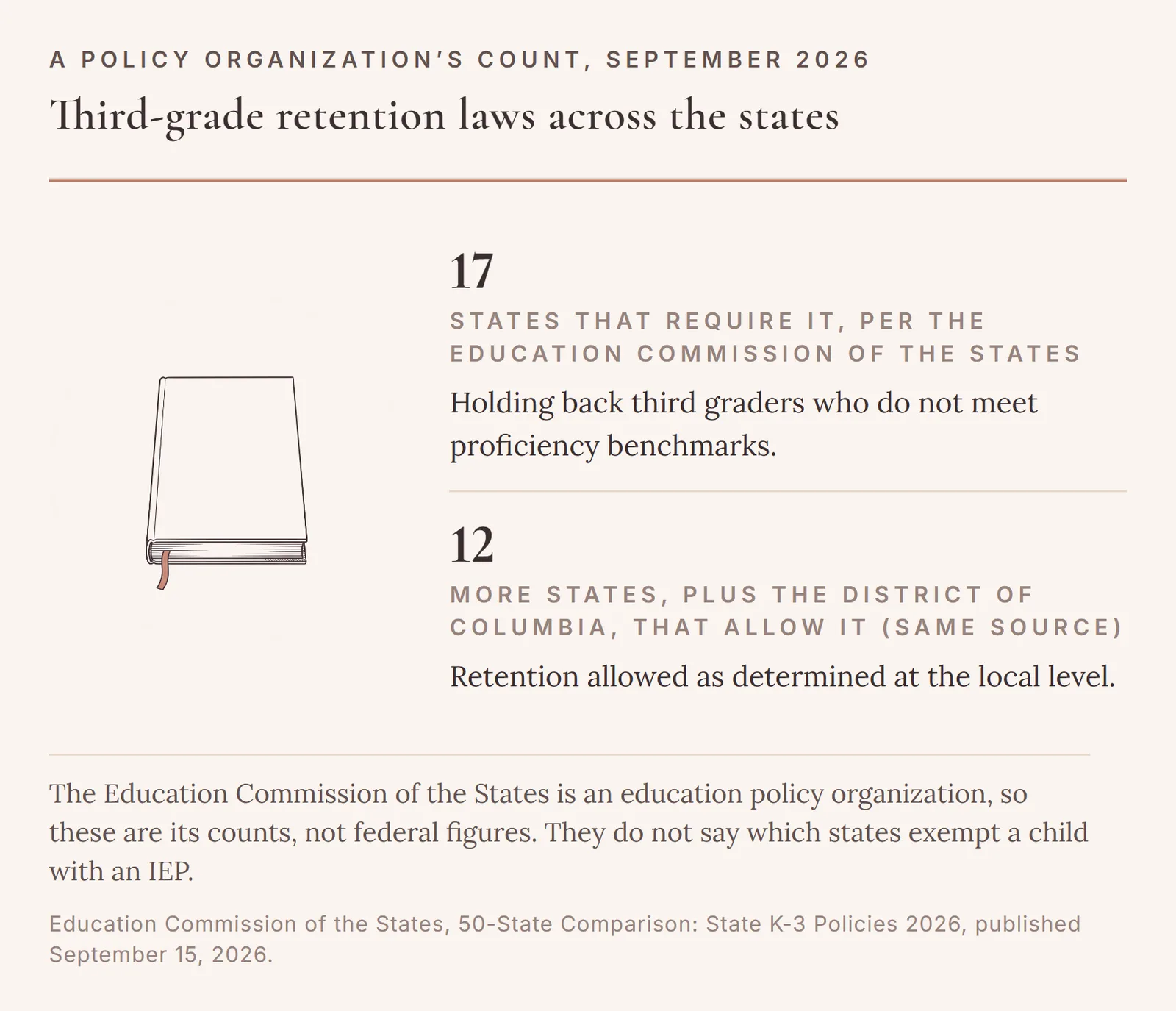
Those counts do not say whether your state exempts a child with an IEP; only its own law does.
This article does not advise for or against holding a child back. That judgment belongs to your family, within the role your state and district give you.
How the decision gets made
What does federal law say about holding a child back?
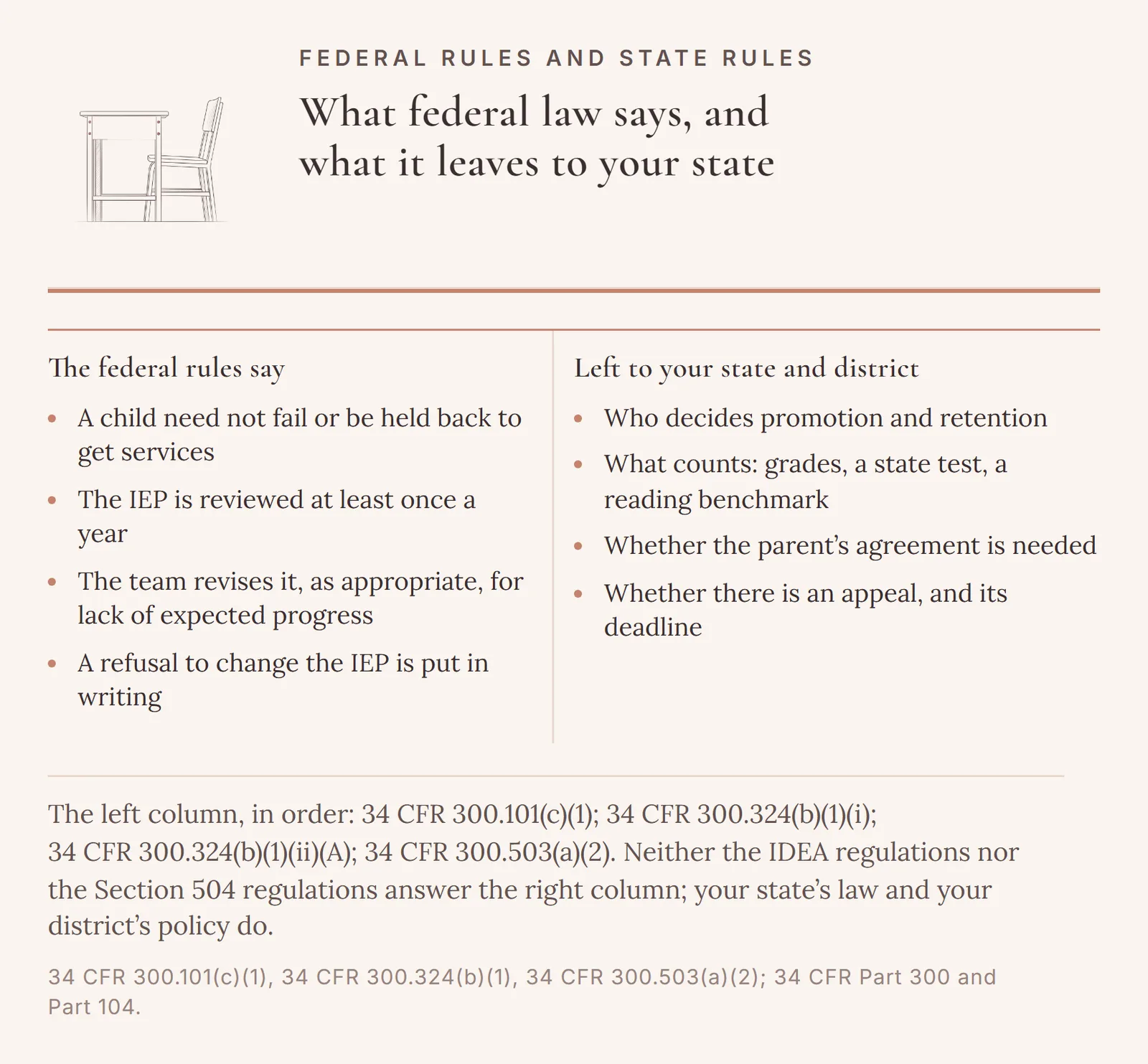
The regulations under the Individuals with Disabilities Education Act (IDEA) mention a child being retained once, and that sentence is about getting services, not about holding a child back. Each State "must ensure that FAPE is available to any individual child with a disability who needs special education and related services, even though the child has not failed or been retained in a course or grade, and is advancing from grade to grade" (34 CFR 300.101(c)(1)). FAPE, a free appropriate public education, is special education and related services at public expense, in conformity with the IEP.
In 2006 the Department of Education explained that a child "should not have to fail a course or be retained in a grade in order to be considered" for special education (71 FR 46580). The sentence protects the child who is passing. It does not bar a school from retaining a child with an IEP.
Nothing in the IDEA regulations (34 CFR Part 300) or the Section 504 regulations behind 504 plans (34 CFR Part 104) says who decides promotion. Nothing there rules out retaining a child with an IEP, or requires the agreement of the IEP team or the parent.
Who decides, then?
Your state's law and your district's written policy. States answer differently.
In California, a pupil below the standard "shall be retained" unless the regular classroom teacher determines in writing that retention is not the appropriate intervention, and on appeal "the burden shall be on the appealing party" (Cal. Educ. Code 48070.5(d)(1), (f)).
In Washington, if principal and parent disagree on the placement of a third grader reading below grade level, "the parent's request will be honored" (RCW 28A.655.230(6)). Students whose IEP includes specially designed instruction in reading or English language arts "are exempt" from that procedure, and their parents are consulted through the IEP process (RCW 28A.655.230(9)).
In Ohio, no district "shall promote" a third grader below the reading cut score without an exemption, such as an IEP that "exempts the student from retention" or a parent's request (Ohio Rev. Code 3313.608(A)(2)(b), (A)(2)(f)).
What can the IEP team do about a held-back warning?
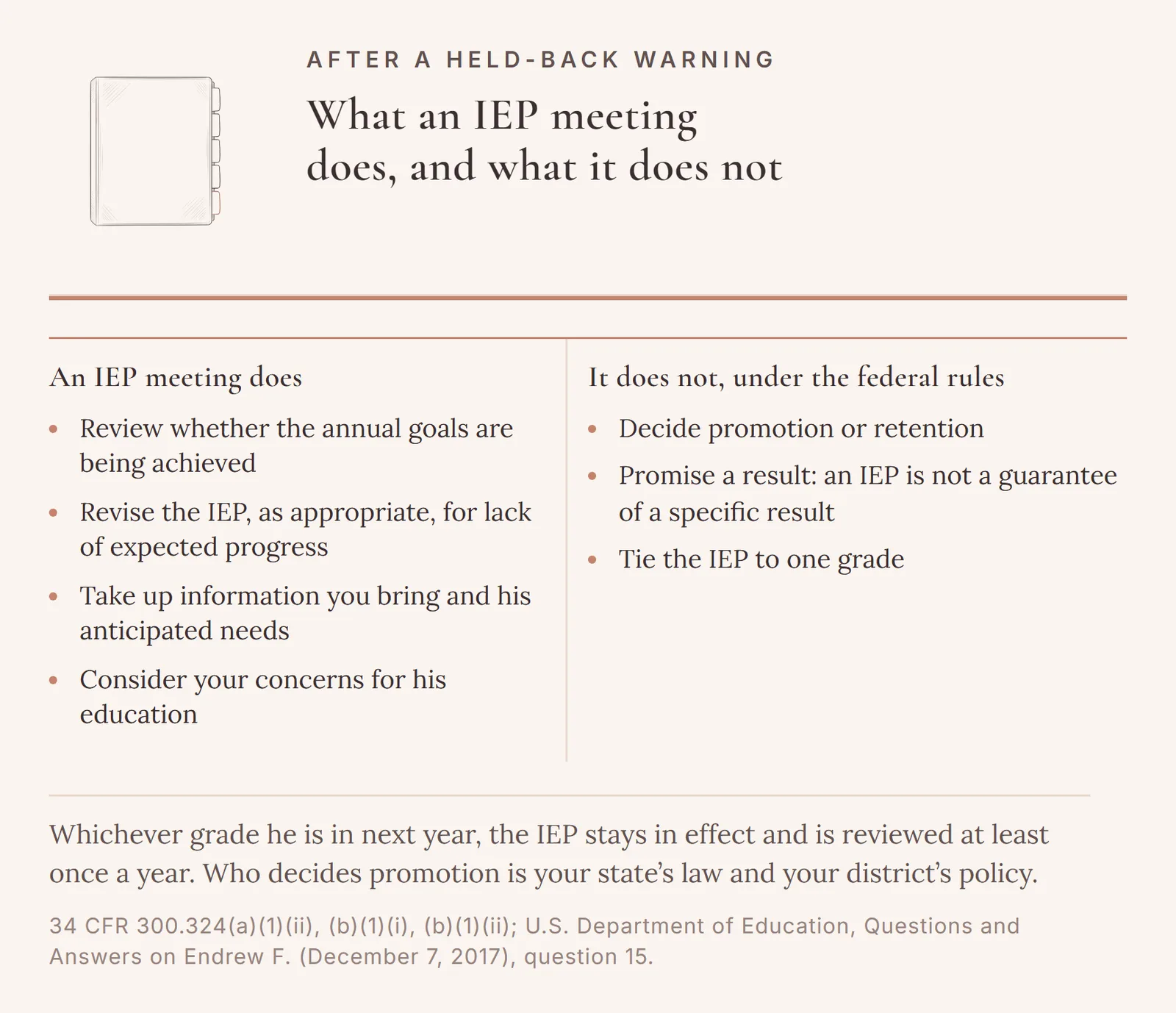
Its federal job is the IEP, not the grade placement. The team reviews the IEP periodically, but not less than annually, to determine whether the annual goals are being achieved (34 CFR 300.324(b)(1)(i)). It revises the IEP, as appropriate, to address any lack of expected progress toward the annual goals and in the general education curriculum, if appropriate (34 CFR 300.324(b)(1)(ii)(A)). Annual goals are the IEP's measurable goals for the year; the general education curriculum is what classmates without disabilities are taught.
The team also revises the IEP, as appropriate, to address information the parents provide and the child's anticipated needs (34 CFR 300.324(b)(1)(ii)(C), (b)(1)(ii)(D)). A held-back warning you bring can be raised under either.
The Department's questions and answers on Endrew F. (December 7, 2017, question 15) say an IEP is not a guarantee of a specific educational or functional result. They also say that if a child is not making progress at the level the IEP team expected, despite receiving all the services and supports in the IEP, the team must meet to review and revise the IEP if necessary, and that parents may request an IEP meeting at any time.
What to do after a held-back warning, step by step
- Write down what you heard. Who said it, when, where, and the exact words.
- Ask for the rule in writing. Ask the district for its written promotion and retention policy: who decides, what counts (grades, a state test, a reading benchmark), the decision dates, and any appeal and its deadline. Ask which state law the policy follows.
- See the records behind the warning. The school must let you inspect his education records before any meeting regarding an IEP, and in no case more than 45 days after you ask (34 CFR 300.613(a)).
- Ask for an IEP meeting now, in writing. Ask the team to look at his progress and at next year's needs, two of the things it revises the IEP, as appropriate, to address (34 CFR 300.324(b)(1)(ii)).
- Bring your concerns on paper. When it develops the IEP, the team must consider the concerns of the parents for enhancing their child's education (34 CFR 300.324(a)(1)(ii)).
- If nobody can say why he is behind, ask about new data. A reevaluation, a fresh round of school assessments for a child who already has an IEP, is conducted if the parent or teacher requests one (34 CFR 300.303(a)(2)), but not more than once a year unless you and the school agree otherwise (34 CFR 300.303(b)(1)).
- Get the answers in writing. If the school refuses a change to the IEP that you ask for, the refusal is owed to you in writing (34 CFR 300.503(a)(2)). If your state or district offers an appeal, note its deadline.
Mistakes and edge cases
Assuming the IEP rules out retention. The federal rules do not, and the state exemptions above are narrow: one law, one grade, and only some IEPs.
Treating the IEP meeting as the promotion decision. No federal rule makes it the place promotion is decided. Where a state gives the IEP a role, as Ohio's reading law does, that role comes from the state's own law (Ohio Rev. Code 3313.608(A)(2)(b)).
Waiting for the annual review. "Not less than annually" is a floor, not a schedule (34 CFR 300.324(b)(1)(i)). A fall warning is a reason to ask now.
Every state has a free, federally funded Parent Training and Information Center that gives parents of children with disabilities training and information. Find yours at parentcenterhub.org.
FAQ
Can a child with an IEP get a failing grade?
Yes. In its October 2008 questions and answers on report cards and transcripts, the Office for Civil Rights said that, generally, Section 504 and Title II of the Americans with Disabilities Act "would require that students with and without disabilities in the same regular education classes in the general education curriculum be graded using the same standards" (question 6).
Can I stop the school from holding my child back?
That depends on your state and sometimes the grade. The federal special education rules do not address it; your state's law and your district's policy do. In Washington, when principal and parent disagree about the placement of a third grader reading below grade level, the parent's request will be honored, unless his IEP includes specially designed instruction in reading or English language arts (RCW 28A.655.230(6), (9)). In California, the parent can appeal the teacher's decision but carries the burden (Cal. Educ. Code 48070.5(f)).
Does the IEP end if he repeats the grade?
No federal rule ties the IEP to a grade. In either grade next year, the IEP stays in effect and is reviewed periodically, but not less than annually (34 CFR 300.324(b)(1)(i)), and the team revises it, as appropriate, to address his anticipated needs (34 CFR 300.324(b)(1)(ii)(D)).
Sources
- eCFR, 34 CFR 300.101, FAPE (https://www.ecfr.gov/current/title-34/section-300.101)
- eCFR, 34 CFR 300.303, reevaluations (https://www.ecfr.gov/current/title-34/section-300.303)
- eCFR, 34 CFR 300.324, IEP review (https://www.ecfr.gov/current/title-34/section-300.324)
- eCFR, 34 CFR 300.503, written notice (https://www.ecfr.gov/current/title-34/section-300.503)
- eCFR, 34 CFR 300.613, records (https://www.ecfr.gov/current/title-34/section-300.613)
- eCFR, 34 CFR Part 104, Section 504 (https://www.ecfr.gov/current/title-34/part-104)
- Department of Education, 71 FR 46580, 2006 (https://www.govinfo.gov/content/pkg/FR-2006-08-14/pdf/06-6656.pdf)
- Department of Education, Questions and Answers on Endrew F., December 7, 2017, question 15 (https://sites.ed.gov/idea/files/qa-endrewcase-12-07-2017.pdf)
- Office for Civil Rights, FAQs on Report Cards and Transcripts, October 2008, question 6 (https://www.ed.gov/laws-and-policy/individuals-disabilities/special-education-laws/faqs-report-cards-and-transcripts-students-disabilities)
- California Education Code 48070.5 (https://leginfo.legislature.ca.gov/faces/codes_displaySection.xhtml?lawCode=EDC§ionNum=48070.5)
- Revised Code of Washington 28A.655.230 (https://app.leg.wa.gov/RCW/default.aspx?cite=28A.655.230)
- Ohio Revised Code 3313.608 (https://codes.ohio.gov/ohio-revised-code/section-3313.608)
- Education Commission of the States, 50-State Comparison: State K-3 Policies 2026, September 15, 2026 (https://www.ecs.org/50-state-comparison-state-k-3-policies-2026/)
- Center for Parent Information and Resources (https://www.parentcenterhub.org/find-your-center/)