The short answer
Yes, at either door. An IEP (Individualized Education Program) reaches anxiety through emotional disturbance or other health impairment, and the child must also need special education because of the condition (34 CFR 300.8(a)(1)). A 504 plan asks whether a mental impairment substantially limits one or more major life activities, learning among them (34 CFR 104.3(j)).
The letters are about attendance, the question is about eligibility
The mail that arrives when a child stops going to school is about attendance. A count of days, a warning, a meeting with someone from the office. That machine runs on state rules and is not asking about disability at all.
A second question runs alongside it, and nobody sends a letter about that one: whether the absences are a sign of a disability the school must look at.
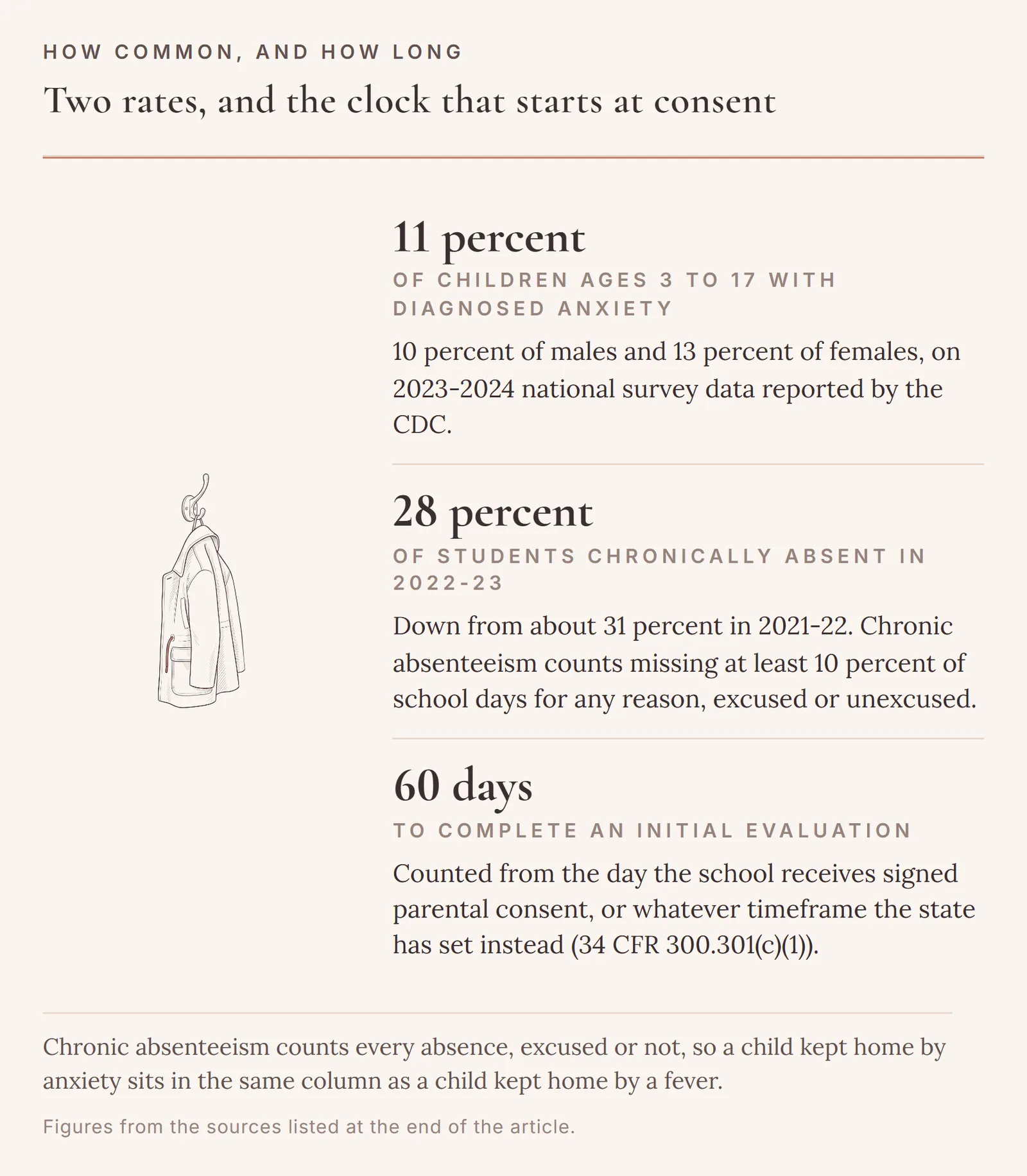
About 11 percent of children ages 3 to 17 had current, diagnosed anxiety, 10 percent of males and 13 percent of females, on 2023-2024 survey data (CDC, Data and Statistics on Children's Mental Health). The national chronic absenteeism rate was about 31 percent in 2021-22 and 28 percent in 2022-23 (U.S. Department of Education, Chronic Absenteeism). Chronic absenteeism counts missing at least 10 percent of school days for any reason, excused or unexcused.
The eligibility question carries its own clock. Once a school receives signed parental consent, it has 60 days to complete an initial evaluation, or whatever timeframe the state has set instead (34 CFR 300.301(c)(1)).
What each law asks
What does IDEA actually require
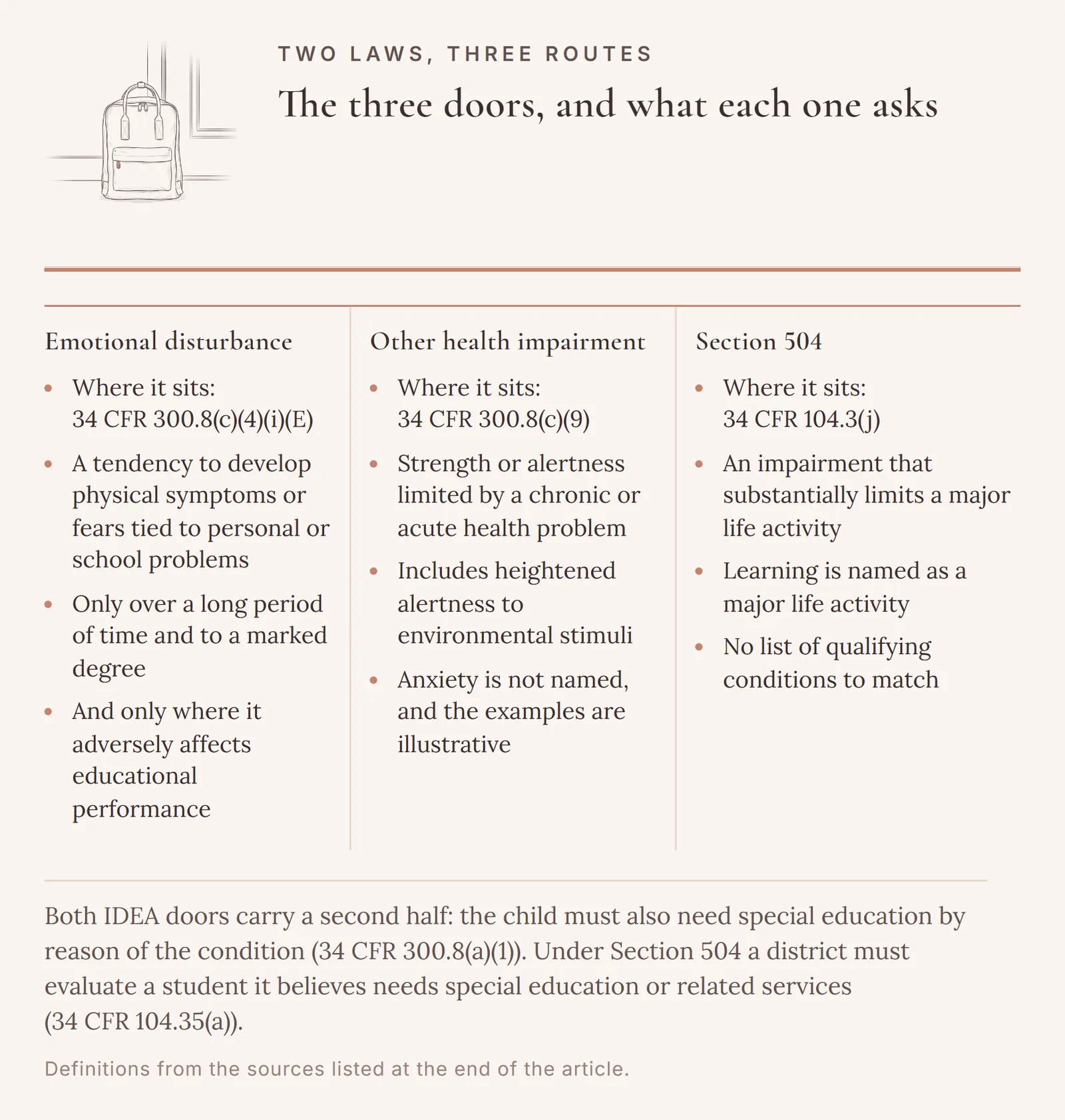
The Individuals with Disabilities Education Act (IDEA) works from a list of disability categories, and anxiety is not one of them by name. Two categories on that list reach it anyway.
The first is emotional disturbance. The definition carries five characteristics, and the fifth is a tendency to develop physical symptoms or fears associated with personal or school problems (34 CFR 300.8(c)(4)(i)(E)). That is a plain description of a stomach ache every school morning. The qualifier standing in front of all five does real work. The condition has to be exhibited over a long period of time and to a marked degree, and it has to adversely affect educational performance. A hard month is not the test.
The second is other health impairment. It reaches a child whose strength or alertness is limited by a chronic or acute health problem (34 CFR 300.8(c)(9)). The definition counts a heightened alertness to environmental stimuli that leaves limited alertness with respect to the educational environment. Anxiety is not among the regulation's examples, and that list is illustrative rather than closed.
Eligibility has a second half, and it is the one that surprises parents. The child must have one of the listed conditions and, by reason of it, need special education and related services (34 CFR 300.8(a)(1)).
Where does Section 504 draw its line
Section 504 of the Rehabilitation Act is a civil rights law rather than a funding program, and its gate is wider. It protects a student with a physical or mental impairment that substantially limits one or more major life activities, and the regulation names learning among those activities (34 CFR 104.3(j)). There is no roster of approved conditions to match. The question is effect.
A district must evaluate a student who, because of disability, needs or is believed to need special education or related services, before any action on an initial placement (34 CFR 104.35(a)).
What can a plan actually hold
Eligibility opens a door; the team decides what comes through it. Three services that reach an anxious child are defined by name in the regulation: counseling services, psychological services, and social work services in schools (34 CFR 300.34(c)). Asking for one by its regulatory name, in the document rather than the hallway, is the practical difference.
Home instruction is one option on the required continuum of placements, and the least restrictive environment rule (LRE) keeps the regular classroom the default (34 CFR 300.115(b)(1); 34 CFR 300.114(a)(2)).
How the question gets asked
- Put the request in writing. A parent may initiate a request for an initial evaluation (34 CFR 300.301(b)), and a dated letter makes the record legible.
- Describe what you have seen, not what you suspect. Times, dates, the shape of a morning. Parent input is one of the sources the group is required to draw on (34 CFR 300.306(c)(1)).
- Name both doors in one letter. Asking about IDEA eligibility and Section 504 together keeps the second question alive.
- Read the consent form before signing. Consent to evaluate and consent to the first delivery of services are two separate decisions (34 CFR 300.300(a) and (b)).
- Write down the date consent was received. That is where the 60-day count starts, not the day you asked (34 CFR 300.301(c)(1)).
- Ask for the evaluation report before the eligibility meeting. The copy is yours at no cost (34 CFR 300.306(a)(2)).
- Take the seat. The parent is a member of the group that decides eligibility (34 CFR 300.306(a)(1)).
Mistakes and edge cases
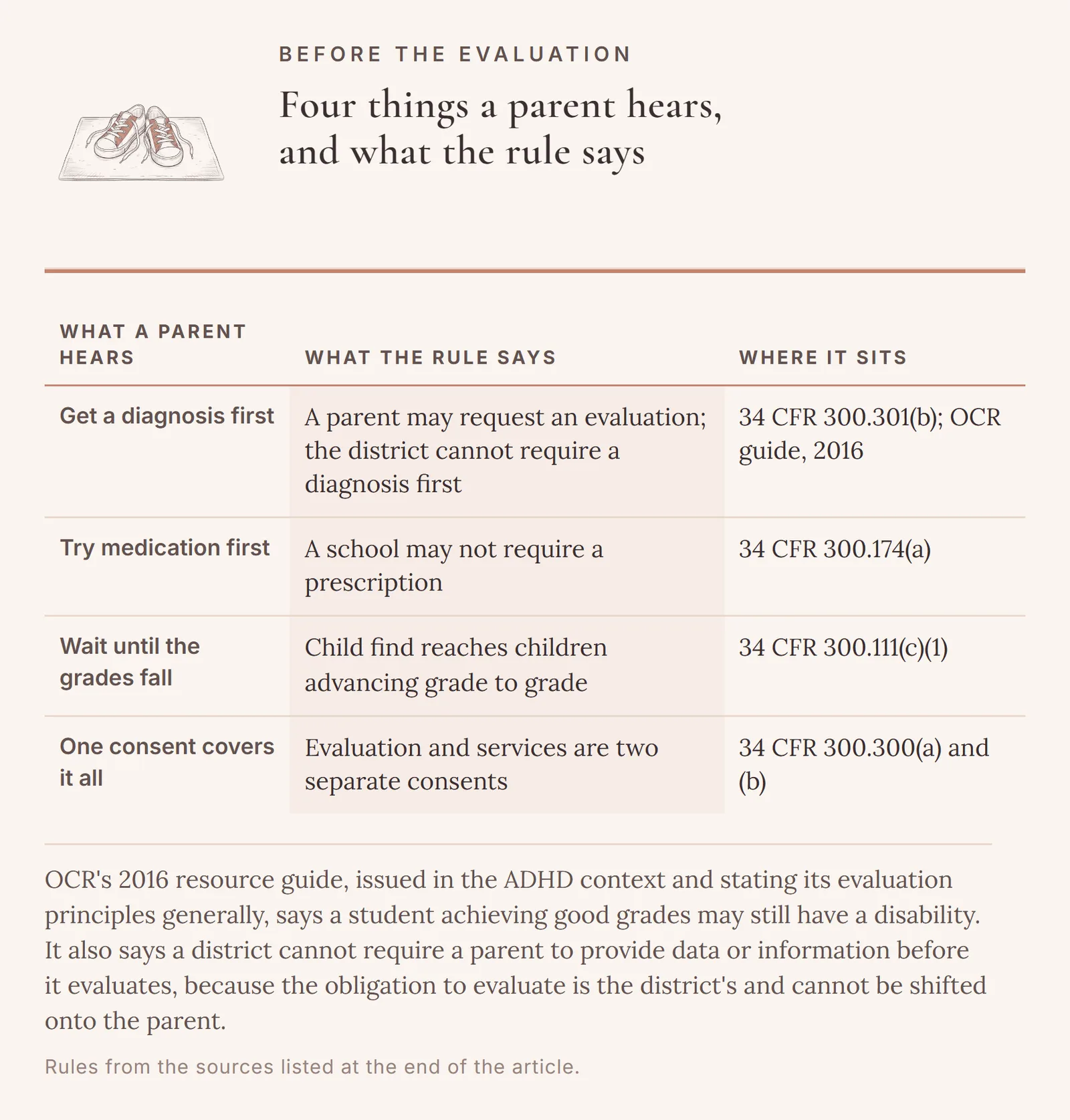
Waiting for a diagnosis. IDEA does not make a medical diagnosis the criterion, and the answer belongs to a group of qualified professionals and the parent of the child rather than to a doctor (34 CFR 300.306(a)(1)). Colorado's guidance on other health impairment says the same plainly: a medical diagnosis is not a necessary, nor by itself a sufficient, criterion for that category. Where the district requires a medical assessment, the district and not the parent pays for it (Colorado Department of Education). That is one state's guidance, and your state's is the one to confirm.
Being told to try medication first. School personnel may not require a parent to obtain a prescription for a controlled substance as a condition of attending school, of being evaluated, or of receiving services (34 CFR 300.174(a)).
Being told the grades are fine. The district has a standing duty to identify, locate, and evaluate children who may have a disability (34 CFR 300.111). That duty, called child find, reaches children suspected of having one even though they are advancing from grade to grade (34 CFR 300.111(c)(1)). OCR's 2016 resource guide, issued in the ADHD context and stating its evaluation principles generally, says a student achieving good grades may still have a disability. It also says a district cannot require a parent to provide data or information before it evaluates, because the obligation to evaluate is the district's and cannot be shifted onto the parent.
Every state has a free, federally funded Parent Training and Information Center, and sitting with a parent over an evaluation request is ordinary work for them. Find yours at parentcenterhub.org.
FAQ
Is emotional disturbance the only category anxiety fits
No. Other health impairment reaches a child whose alertness is limited by a chronic health problem (34 CFR 300.8(c)(9)), and teams use both routes. Nothing in IDEA requires that children be classified by their disability, so long as a child who needs special education by reason of a listed disability is regarded as a child with a disability (34 CFR 300.111(d)).
Can a child get a 504 plan if the IEP answer is no
Often, yes. IDEA's second prong asks whether the child needs special education (34 CFR 300.8(a)(1)). Section 504 asks whether an impairment substantially limits a major life activity such as learning (34 CFR 104.3(j)), which is a wider question. Accepting a plan now does not close the IDEA question either.
Does the school have to evaluate because I asked
The request starts the process rather than finishing it. A parent may initiate a request for an initial evaluation (34 CFR 300.301(b)), and under Section 504 a district must evaluate a student it believes needs services (34 CFR 104.35(a)).
Sources
- eCFR, 34 CFR 300.8, disability categories (https://www.ecfr.gov/current/title-34/subtitle-B/chapter-III/part-300/subpart-A/section-300.8)
- eCFR, 34 CFR 300.34, related services (https://www.ecfr.gov/current/title-34/subtitle-B/chapter-III/part-300/subpart-A/section-300.34)
- eCFR, 34 CFR 300.111, child find (https://www.ecfr.gov/current/title-34/subtitle-B/chapter-III/part-300/subpart-B/section-300.111)
- eCFR, 34 CFR 300.114, least restrictive environment (https://www.ecfr.gov/current/title-34/subtitle-B/chapter-III/part-300/subpart-B/section-300.114)
- eCFR, 34 CFR 300.115, placement continuum (https://www.ecfr.gov/current/title-34/subtitle-B/chapter-III/part-300/subpart-B/section-300.115)
- eCFR, 34 CFR 300.174, medication (https://www.ecfr.gov/current/title-34/subtitle-B/chapter-III/part-300/subpart-B/section-300.174)
- eCFR, 34 CFR 300.300, parental consent (https://www.ecfr.gov/current/title-34/subtitle-B/chapter-III/part-300/subpart-D/section-300.300)
- eCFR, 34 CFR 300.301, evaluation timeframes (https://www.ecfr.gov/current/title-34/subtitle-B/chapter-III/part-300/subpart-D/section-300.301)
- eCFR, 34 CFR 300.306, eligibility (https://www.ecfr.gov/current/title-34/subtitle-B/chapter-III/part-300/subpart-D/section-300.306)
- eCFR, 34 CFR 104.3, Section 504 definitions (https://www.ecfr.gov/current/title-34/subtitle-B/chapter-I/part-104/subpart-A/section-104.3)
- eCFR, 34 CFR 104.35, Section 504 evaluation (https://www.ecfr.gov/current/title-34/subtitle-B/chapter-I/part-104/subpart-D/section-104.35)
- U.S. Department of Education, Office for Civil Rights, Students with ADHD resource guide (https://www.ed.gov/sites/ed/files/about/offices/list/ocr/letters/colleague-201607-504-adhd.pdf)
- U.S. Department of Education, Chronic Absenteeism (https://www.ed.gov/teaching-and-administration/supporting-students/chronic-absenteeism)
- CDC, children's mental health data and statistics (https://www.cdc.gov/children-mental-health/data-research/index.html)
- Colorado Department of Education, other health impairment eligibility (https://www.cde.state.co.us/cdesped/guidance_determiningeligibility_sped_students_ohi)
- Center for Parent Information and Resources, parent centers (https://www.parentcenterhub.org/find-your-center/)