The short answer
Yes, and the diagnosis decides neither. An IEP (Individualized Education Program) can come through emotional disturbance, whose fourth characteristic is "a general pervasive mood of unhappiness or depression," if the child also needs special education (34 CFR 300.8(a)(1), (c)(4)(i)(D)). A 504 plan asks whether a mental impairment substantially limits a major life activity (34 CFR 104.3(j)(1)(i)). An evaluation decides.
A common condition, a smaller school category
An estimated 5.0 million adolescents aged 12 to 17, or 20.1 percent, had at least one major depressive episode in the past year (National Institute of Mental Health, 2021 National Survey on Drug Use and Health).
Under the Individuals with Disabilities Education Act (IDEA), 327 thousand children ages 3 to 21 were served for emotional disturbance in 2022-23, 4.3 percent of all children served (Digest of Education Statistics 2023, Table 204.30, "Number of children served (in thousands)" and "Percentage distribution of children served"). The two come from different sources and do not compare; neither describes one child.
Three doors, the evaluation, and the plan
Does IDEA name depression as a disability?
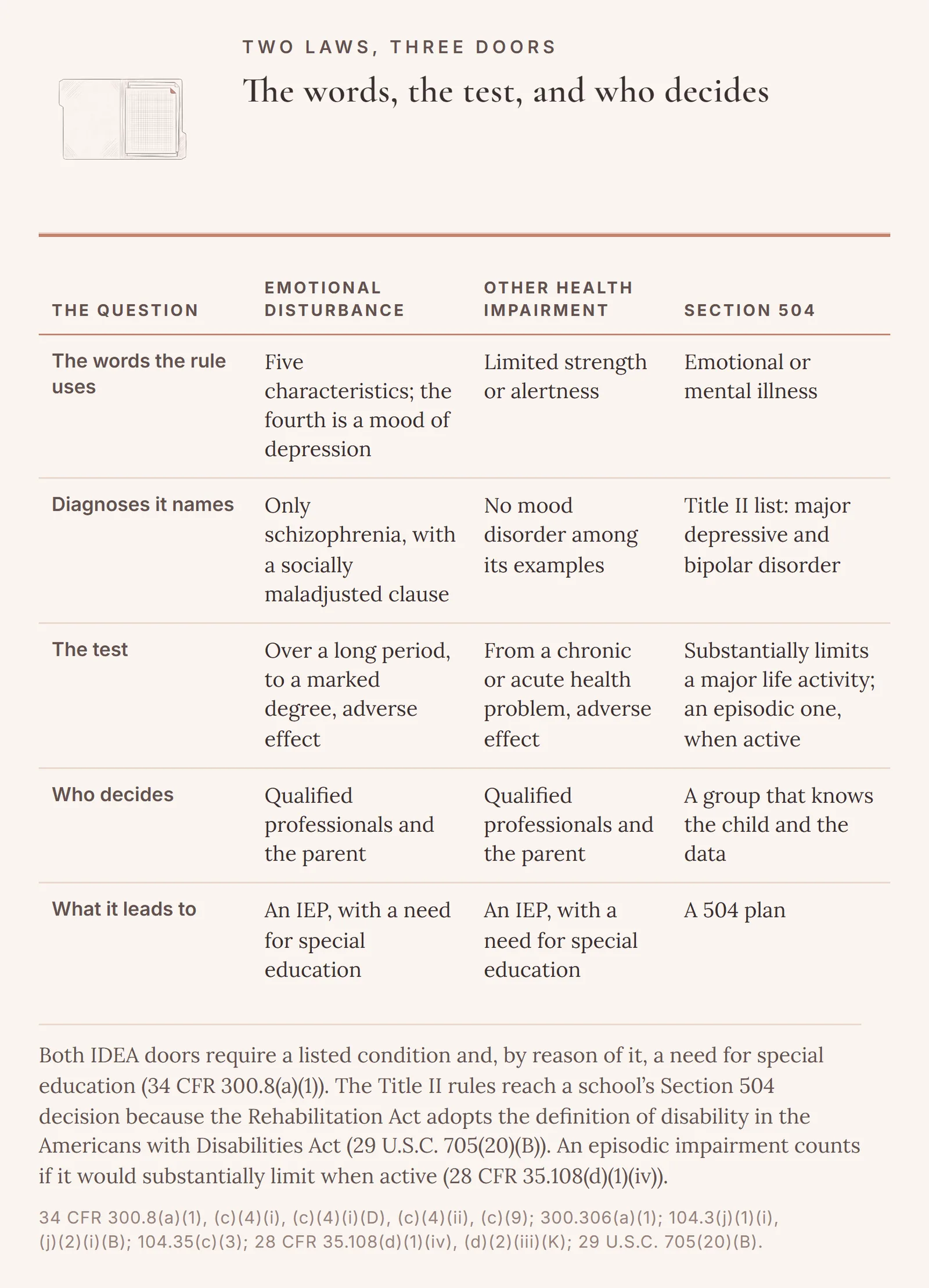
Not as a diagnosis. IDEA's list includes emotional disturbance and other health impairment, and a child qualifies only if, "by reason thereof," the child "needs special education and related services" (34 CFR 300.8(a)(1)): a two-part test.
Emotional disturbance means a condition exhibiting one or more of five characteristics "over a long period of time and to a marked degree that adversely affects a child's educational performance" (34 CFR 300.8(c)(4)(i)). No federal number stands behind those qualifiers. The fourth characteristic is "a general pervasive mood of unhappiness or depression" (34 CFR 300.8(c)(4)(i)(D)): a mood, not a diagnosis.
The definition "includes schizophrenia," its only named diagnosis, and "does not apply to children who are socially maladjusted, unless it is determined that they have an emotional disturbance" (34 CFR 300.8(c)(4)(ii)). The term is undefined. Asked in 2006 to define or drop it, the U.S. Department of Education (the Department) left the definition alone, saying it "has remained unchanged since 1977" (71 FR 46549, 46550). Because of the "unless," a child can be both.
Can other health impairment fit instead?
It is the second door: limited strength or alertness from a chronic or acute health problem that adversely affects educational performance (34 CFR 300.8(c)(9), (c)(9)(i), (c)(9)(ii)). Its examples name no mood disorder. In 2006 the Department explained that the list "is not exhaustive, but rather provides examples," and declined to add "dysphagia, FAS, bipolar disorders, and other organic neurological disorders" because "these conditions are commonly understood to be health impairments" (71 FR 46550). It is not a rule that bipolar disorder qualifies.
What does Section 504 ask?
Section 504 of the Rehabilitation Act asks whether a student has "a physical or mental impairment which substantially limits one or more major life activities" (34 CFR 104.3(j)(1)(i)). Its regulation counts "emotional or mental illness" as a mental impairment (34 CFR 104.3(j)(2)(i)(B)).
The Rehabilitation Act adopts the definition of disability in the Americans with Disabilities Act (29 U.S.C. 705(20)(B)), and with it the rules of that Act's Title II regulation. An impairment that is episodic or in remission counts "if it would substantially limit a major life activity when active" (28 CFR 35.108(d)(1)(iv)). Measures that lessen an impairment's effects, called mitigating measures, medication and "psychotherapy, behavioral therapy, or physical therapy" among them, are set aside (28 CFR 35.108(d)(1)(viii), (d)(4)(i), (d)(4)(v)).
The regulation also lists impairments whose assessment will, "in virtually all cases," find a disability, and it names major depressive disorder and bipolar disorder as substantially limiting brain function (28 CFR 35.108(d)(2)(ii), (d)(2)(iii)(K)). That list speaks to disability, not to what a 504 plan holds.
What does the evaluation have to look at?
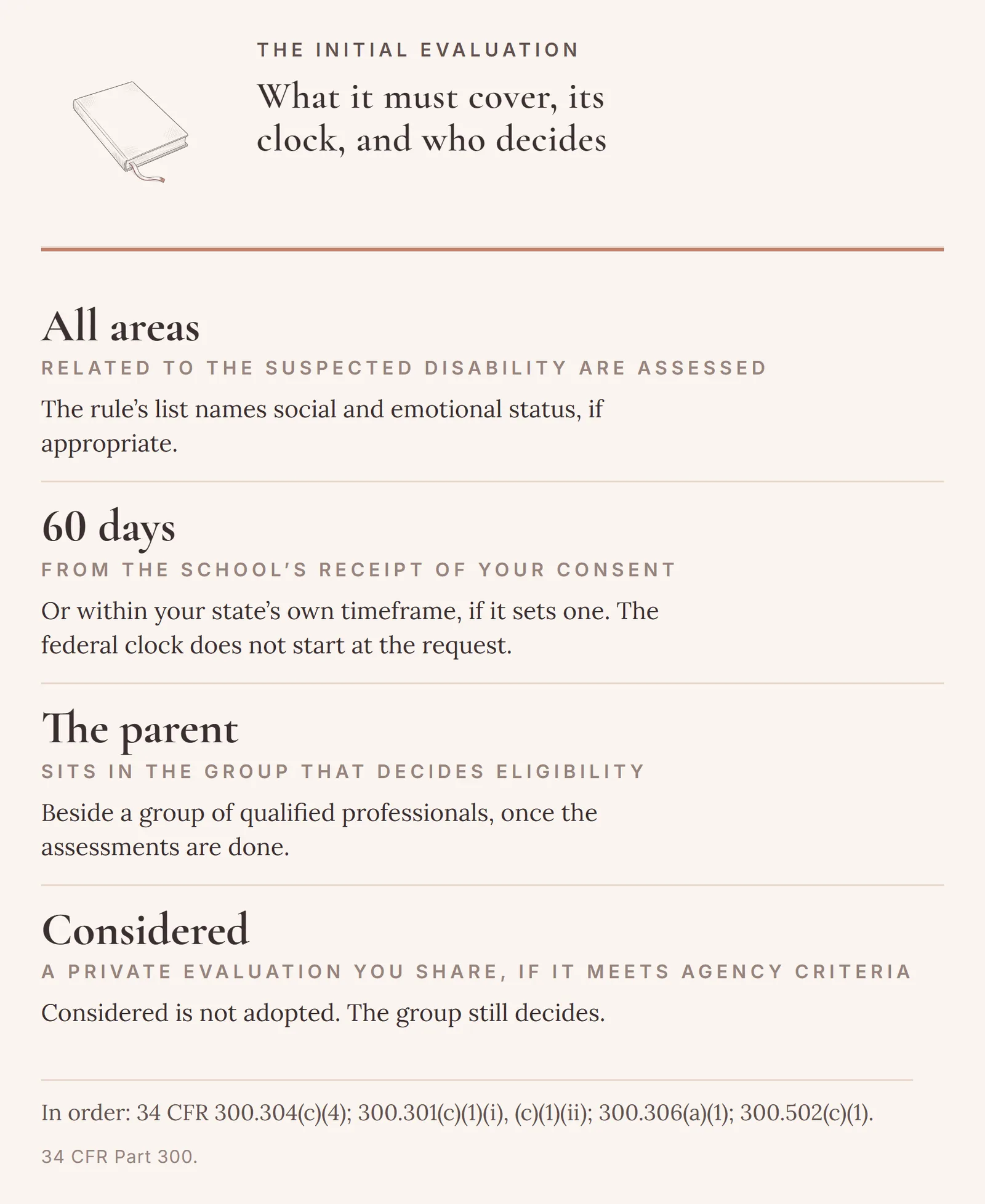
The evaluation is the school's assessment of disability and need. The child is assessed "in all areas related to the suspected disability," and the rule's list of areas names "social and emotional status," "if appropriate" (34 CFR 300.304(c)(4)). The initial evaluation must be conducted within 60 days of the school receiving your consent, or within your state's timeframe if it sets one (34 CFR 300.301(c)(1)(i), (c)(1)(ii)).
Eligibility, the decision on the two-part test, belongs to "a group of qualified professionals and the parent of the child" (34 CFR 300.306(a)(1)). A private evaluation you share "must be considered" if it meets agency criteria (34 CFR 300.502(c)(1)). Considered is not adopted.
What can a plan hold?
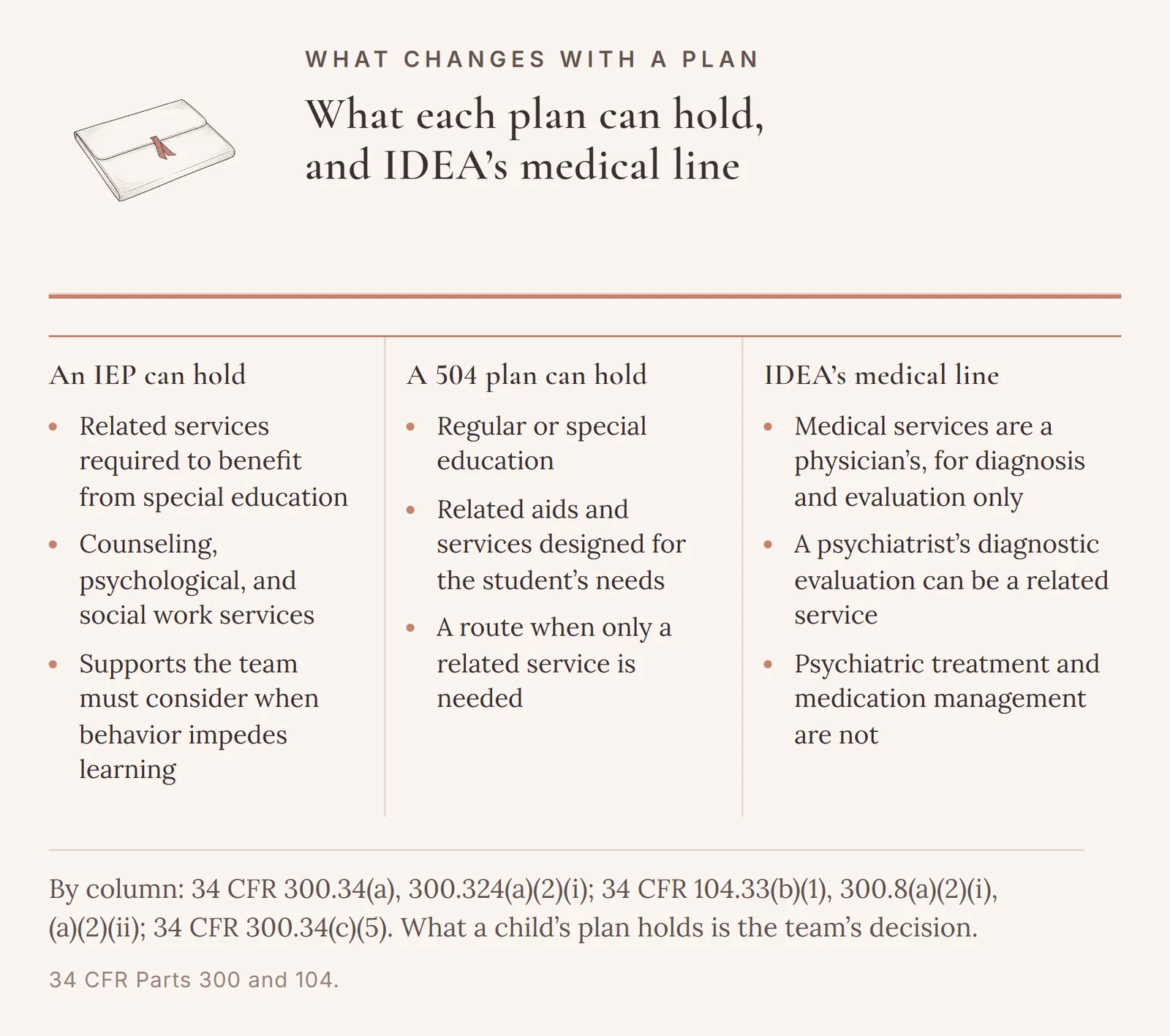
An IEP can hold special education and the related services "required to assist a child with a disability to benefit from special education," counseling services, psychological services, and social work services in schools among them (34 CFR 300.34(a)).
Where behavior impedes learning, the IEP team (the group that writes the IEP) must "consider the use of positive behavioral interventions and supports" (34 CFR 300.324(a)(2)(i)). That can include a withdrawn child: in 2006 the Department said the factor reaches "children with internalizing and externalizing behaviors" (71 FR 46683).
A child who "only needs a related service and not special education" is not eligible under IDEA unless the State counts that service as special education (34 CFR 300.8(a)(2)(i), (a)(2)(ii)). That child's question is Section 504, where a plan can provide "regular or special education and related aids and services" (34 CFR 104.33(b)(1)).
Step by step, from a diagnosis to a decision
- Ask in writing. A parent may request an initial evaluation (34 CFR 300.301(b)).
- Name the area. Ask for social and emotional status (34 CFR 300.304(c)(4)).
- Note when the school received your consent. The federal clock runs from that day (34 CFR 300.301(c)(1)(i)).
- Take your seat in the group that decides eligibility (34 CFR 300.306(a)(1)).
- If the answer is no, ask for prior written notice, the school's written explanation of what it refused and why (34 CFR 300.503(a)(2), (b)(1), (b)(2)).
- Then ask for a Section 504 evaluation, which a district owes a student who, because of a disability, needs or is believed to need services (34 CFR 104.35(a)).
Mistakes and edge cases
Hearing that the grades are fine. Child find, the duty to locate and evaluate children with disabilities, reaches those "advancing from grade to grade" (34 CFR 300.111(c)(1)).
Keeping the concern spoken. Writing matters if a child not yet eligible is disciplined. The school "must be deemed to have knowledge" of a disability if, before the behavior, the parent "expressed concern in writing" to an administrator, a supervisor, or a teacher that the child needs special education and related services, or requested an evaluation (34 CFR 300.534(b)(1), (b)(2)). The rule has exceptions, which the guide covers.
Every state has a free, federally funded Parent Training and Information Center; find yours at parentcenterhub.org. Outside the school process, the 988 Suicide and Crisis Lifeline is available 24/7/365 by call, text, or chat.
FAQ
Does bipolar disorder or oppositional defiant disorder (ODD) follow the same rules?
Yes, with one difference. The IDEA regulation names neither, and its socially maladjusted clause names no diagnosis, so the same categories and two-part test apply (34 CFR 300.8(a)(1), (c)(4)(ii)). Under Section 504, the Title II list names bipolar disorder but not ODD, so a child with ODD is assessed individually without the list (28 CFR 35.108(d)(2)(ii), (d)(2)(iii)(K)).
Does the school have to provide therapy or psychiatric care?
Counseling can be; psychiatric treatment is not. Counseling services and psychological services, which include "psychological counseling for children and parents," are related services when the IEP team finds them required to benefit from special education (34 CFR 300.34(a), (c)(10)(v)). Medical services are only a licensed physician's services "to determine a child's medically related disability" (34 CFR 300.34(c)(5)). A psychiatrist's diagnostic evaluation can be a related service; psychiatric treatment and medication management are not.
Is there a deadline for a Section 504 evaluation?
Not a federal one. The Department's Office for Civil Rights (OCR) says in its 2016 Section 504 resource guide that Section 504 "does not provide a specific amount of time" for an evaluation, and that OCR generally looks to the IDEA timeline, or to State requirements or local district policy where they apply, to judge whether the time taken is reasonable (Scenario 5, printed page 17).
Sources
- eCFR, 34 CFR 300.8, disability categories (https://www.ecfr.gov/current/title-34/section-300.8)
- eCFR, 34 CFR 300.34, related services (https://www.ecfr.gov/current/title-34/section-300.34)
- eCFR, 34 CFR 300.111, child find (https://www.ecfr.gov/current/title-34/section-300.111)
- eCFR, 34 CFR 300.301, initial evaluations (https://www.ecfr.gov/current/title-34/section-300.301)
- eCFR, 34 CFR 300.304, evaluation procedures (https://www.ecfr.gov/current/title-34/section-300.304)
- eCFR, 34 CFR 300.306, eligibility (https://www.ecfr.gov/current/title-34/section-300.306)
- eCFR, 34 CFR 300.324, special factors (https://www.ecfr.gov/current/title-34/section-300.324)
- eCFR, 34 CFR 300.502, private evaluations (https://www.ecfr.gov/current/title-34/section-300.502)
- eCFR, 34 CFR 300.503, prior written notice (https://www.ecfr.gov/current/title-34/section-300.503)
- eCFR, 34 CFR 300.534, basis of knowledge (https://www.ecfr.gov/current/title-34/section-300.534)
- eCFR, 34 CFR Part 104, Section 504 (https://www.ecfr.gov/current/title-34/part-104)
- eCFR, 28 CFR 35.108, Title II definitions (https://www.ecfr.gov/current/title-28/section-35.108)
- U.S. Code, 29 U.S.C. 705, Rehabilitation Act definitions (https://www.law.cornell.edu/uscode/text/29/705)
- Federal Register, 71 FR 46540, August 14, 2006 (https://www.govinfo.gov/content/pkg/FR-2006-08-14/pdf/06-6656.pdf)
- OCR, Section 504 resource guide, December 2016 (https://www.ed.gov/sites/ed/files/about/offices/list/ocr/docs/504-resource-guide-201612.pdf)
- NCES, Digest of Education Statistics 2023, Table 204.30 (https://nces.ed.gov/programs/digest/d23/tables/dt23_204.30.asp)
- NIMH, Major Depression statistics (https://www.nimh.nih.gov/health/statistics/major-depression)
- 988 Suicide and Crisis Lifeline (https://988lifeline.org/)
- Center for Parent Information and Resources, Parent Center directory (https://www.parentcenterhub.org/find-your-center/)