The short answer
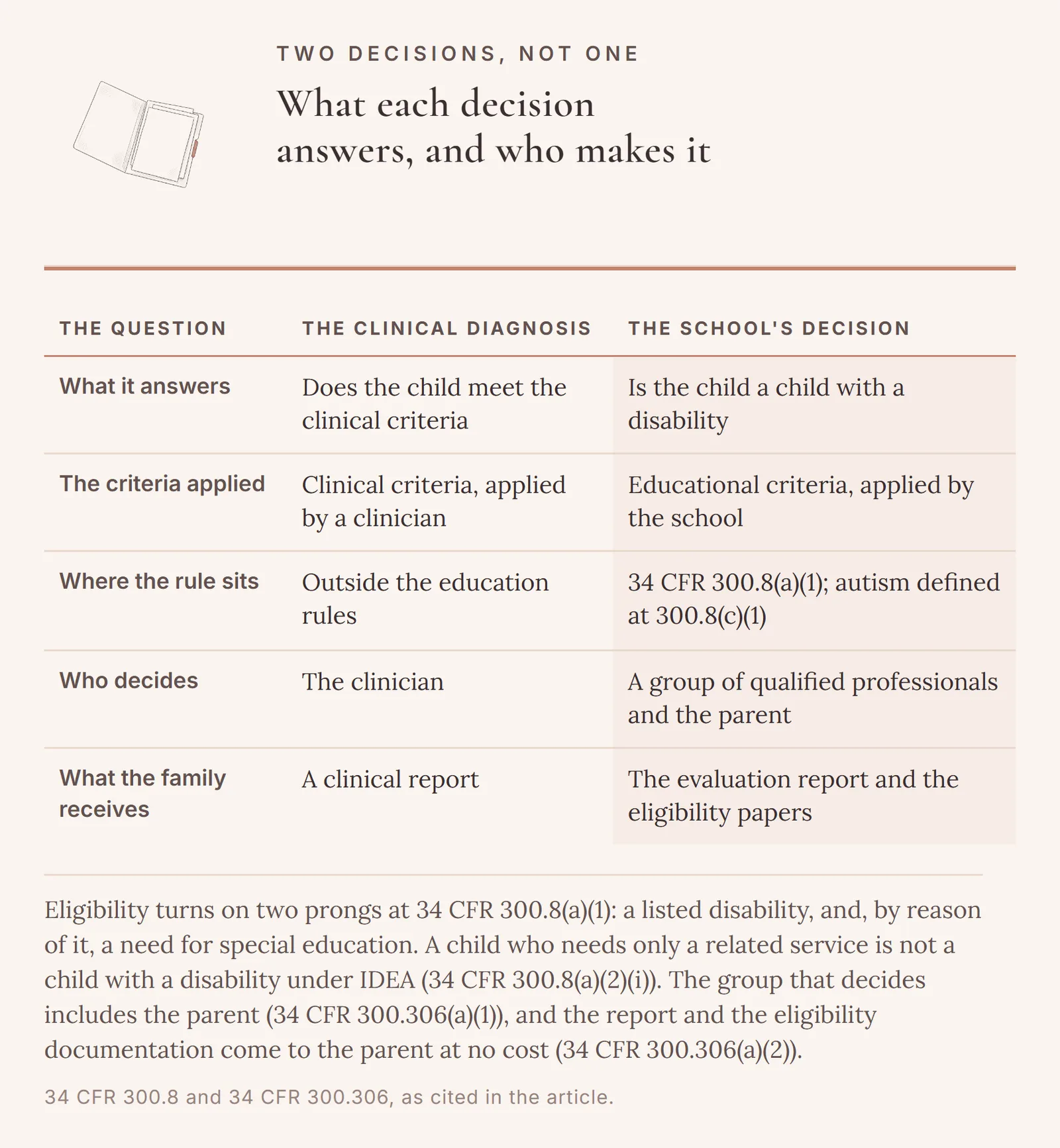
Not by itself. A clinical diagnosis answers a medical question. An IEP (Individualized Education Program) turns on the school's own two-part test at 34 CFR 300.8(a)(1): a listed disability, and, because of that disability, a need for special education. The federal autism definition names no doctor, and the school still runs its own evaluation.
Why so many families end up asking this
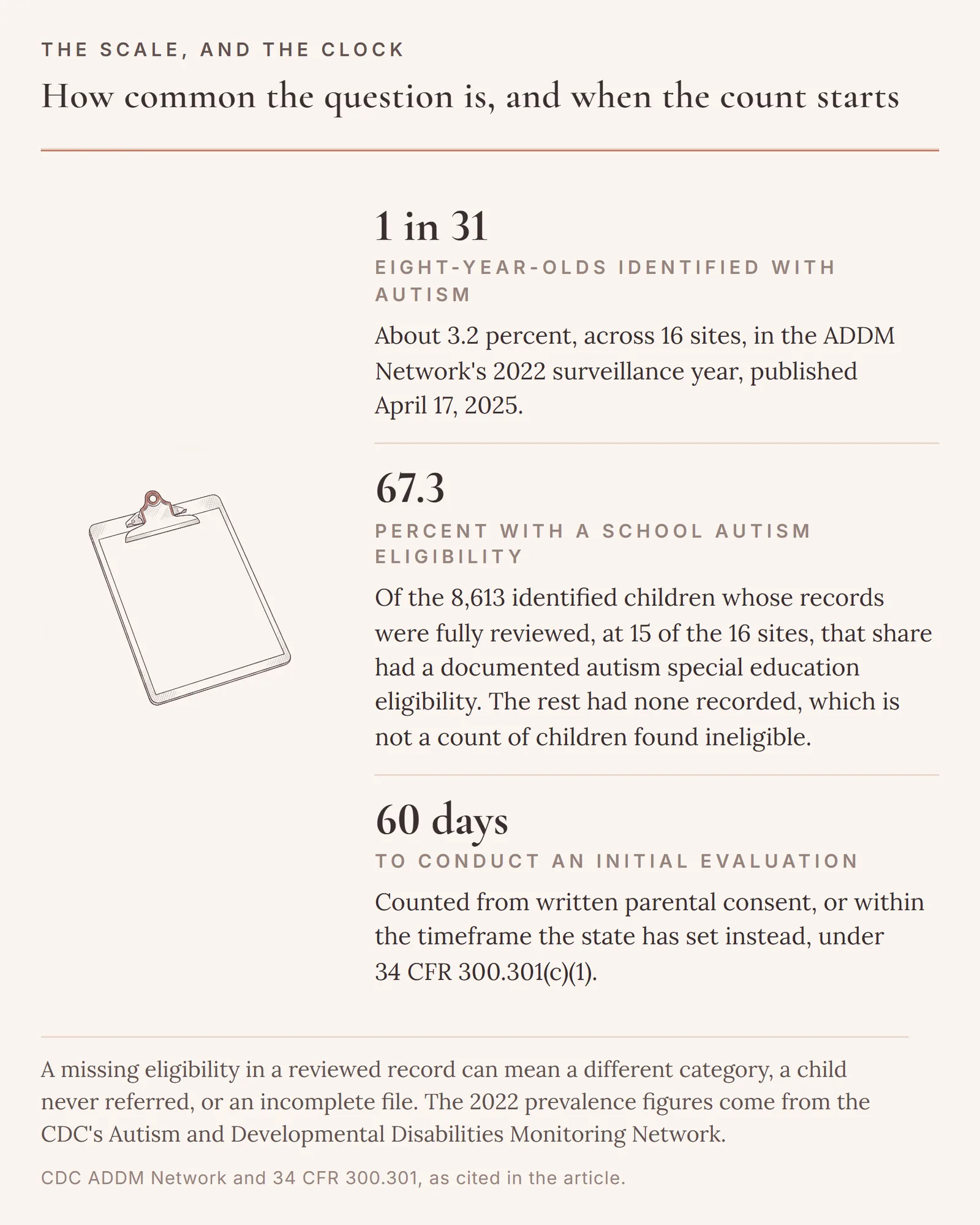
This question reaches a lot of kitchen tables. In its 2022 surveillance year, published April 17, 2025, the CDC's Autism and Developmental Disabilities Monitoring Network identified about 1 in 31 eight-year-olds with autism, 3.2 percent, across 16 sites.
Of the 8,613 identified children whose records were fully reviewed, at 15 of the 16 sites, 67.3 percent had a documented autism special education eligibility. The rest had none on record, and that is all the number says: some are served under a different category, some were never referred, some files were incomplete. It is not a count of children turned down.
The other number is the clock. Once the school has your written consent, it has 60 days to conduct an initial evaluation, or the timeframe your state set instead (34 CFR 300.301(c)(1)). A state timeframe replaces the federal 60 days rather than adding to them.
How the school's decision works
What is the school actually deciding
IDEA, the Individuals with Disabilities Education Act, defines a child with a disability in two parts, and both have to hold. First, one of the listed disabilities, autism among them. Second, by reason of that disability, a need for special education and related services (34 CFR 300.8(a)(1)).
The autism category sits at 34 CFR 300.8(c)(1): a developmental disability significantly affecting verbal and nonverbal communication and social interaction, generally evident before age three, that adversely affects educational performance. Read it and notice what is not there. No manual, no physician, no clinical diagnosis. The criteria are educational, and school professionals apply them.
So a diagnosis and an eligibility decision can point in different directions without either being wrong.
What does your private report do once the school has it
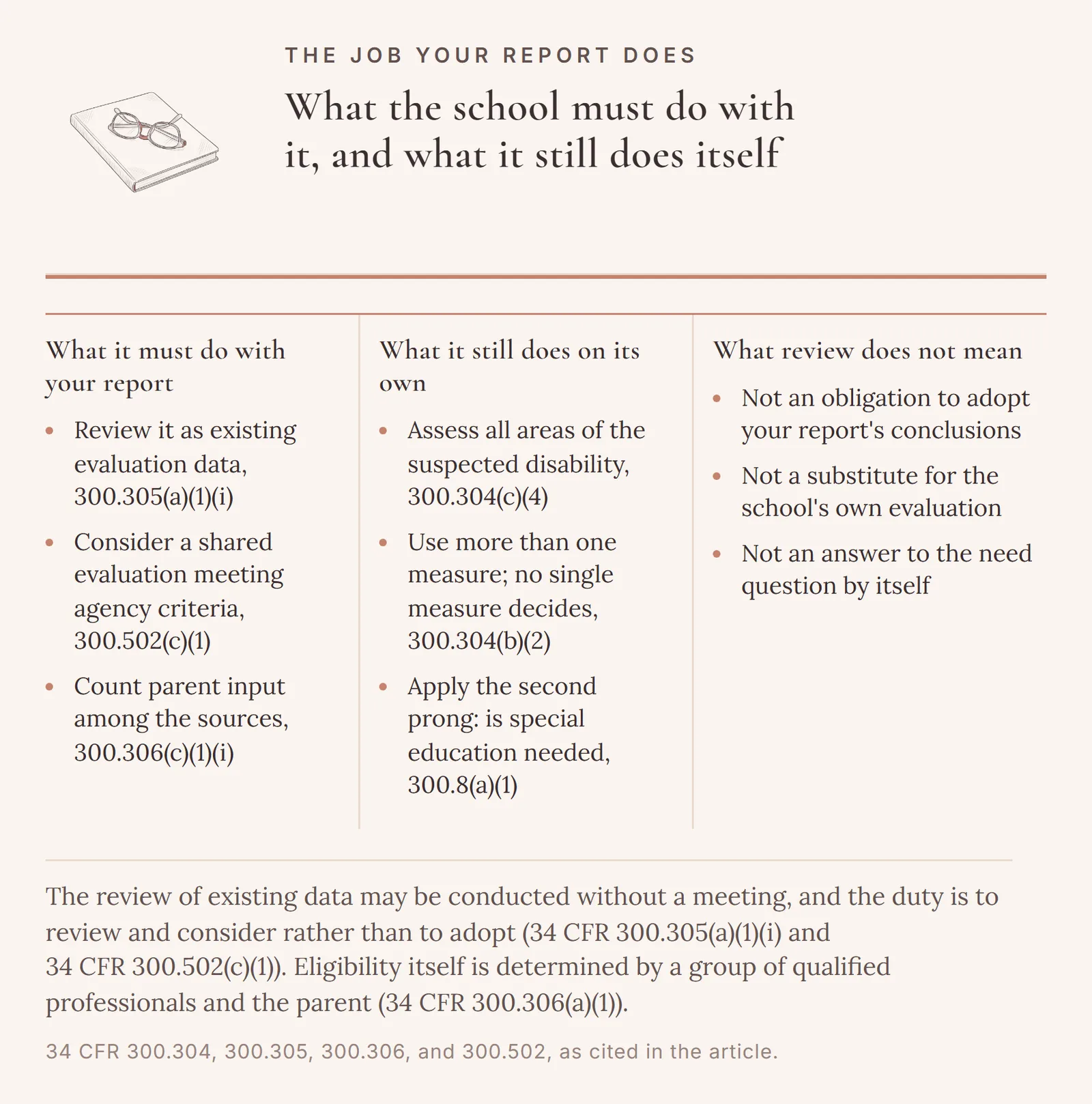
It has a specific job. As part of any evaluation, the team and other qualified professionals, as appropriate, must review existing evaluation data on the child, including evaluations and information provided by the parents (34 CFR 300.305(a)(1)(i)). That is the hook your report hangs on. An independent educational evaluation you share must also be considered, if it meets the agency's criteria, in any decision about a free appropriate public education, the schooling a district owes your child at no cost to you (34 CFR 300.502(c)(1)).
Consider is not adopt. The team has to look at what you sent and address it, not reach the same conclusion. It still runs an evaluation of its own. No single measure may be the sole criterion for that decision (34 CFR 300.304(b)(2)). The child is assessed in all areas related to the suspected disability (34 CFR 300.304(c)(4)). Parent input is one of the sources the group draws on when it interprets the evaluation data (34 CFR 300.306(c)(1)(i)).
Can a state require a medical diagnosis
Some states write their own eligibility rules on top of the federal floor, and a few mention a diagnosis. The Office of Special Education Programs addressed that in a policy letter dated May 22, 2017. A requirement of that kind exceeds Part B of IDEA. The state has to identify it in writing to its districts and to the Secretary, as a state-imposed requirement (34 CFR 300.199(a)(2)). The diagnosis has to be obtained at public expense, and it cannot be the sole criterion for determining the child's program.
What your state says is a short lookup on its education agency's site.
What the process looks like from here
- Put the request in writing and date it. Either a parent or the school may start an initial evaluation (34 CFR 300.301(b)).
- Read the notice that comes back. A school that proposes or refuses to evaluate owes the parent prior written notice: the action, the reason, and the records it relied on (34 CFR 300.503(b)).
- Keep the date you signed consent. The school must have informed parental consent before an initial evaluation (34 CFR 300.300(a)), and that signature is what the 60 days runs from.
- Send the private report so it lands in the file, not just in a conversation. It is existing data the group must review (34 CFR 300.305(a)(1)(i)).
- Go to the eligibility meeting as a member of the group (34 CFR 300.306(a)(1)). You get the evaluation report and the eligibility documentation at no cost (34 CFR 300.306(a)(2)).
- Read whichever answer arrives. If your child is eligible, the IEP meeting is held within 30 days of that determination (34 CFR 300.323(c)(1)). If not, the written answer names what the group relied on, and Section 504 is the next door.
Mistakes and edge cases
Treating the diagnosis as the whole test. A child who has a listed disability but needs only a related service, not special education, is not a child with a disability under IDEA (34 CFR 300.8(a)(2)(i)). The exception is a state that counts that service as special education under its own standards.
Reading a different category as a smaller answer. Developmental delay is an optional category a state may adopt for children aged three through nine (34 CFR 300.8(b)). Speech or language impairment is a category of its own (34 CFR 300.8(c)(11)). The label is not the point: nothing requires children to be classified by disability, so long as each child who has a listed disability and needs special education is regarded as a child with a disability (34 CFR 300.111(d)).
Assuming a later diagnosis is too late. Autism is generally evident before age three, and the same section adds that a child who shows the characteristics later may still be identified under the category (34 CFR 300.8(c)(1)(iii)).
Hearing not eligible as nothing. Section 504 protects a student with a physical or mental impairment that substantially limits a major life activity (34 CFR 104.3(j)(1)), a broader gate than IDEA's category-plus-need test.
Every state has a free, federally funded Parent Training and Information Center, and looking up what your state has published is ordinary work for them. Yours is listed at parentcenterhub.org.
FAQ
Does the school have to accept my child's diagnosis
The group has to review it. Evaluations and information provided by the parents are existing data the team and other qualified professionals, as appropriate, review as part of any evaluation (34 CFR 300.305(a)(1)(i)). An independent educational evaluation you share carries a condition: it is weighed in any decision about a free appropriate public education if it meets the agency's criteria (34 CFR 300.502(c)(1)). Reviewing and adopting are different obligations.
If my state requires a medical diagnosis, who pays for it
The school does, and the rule depends on whose requirement it is. Where a state requires a medical diagnosis as part of determining a disability category, the Office of Special Education Programs has said it must be obtained at public expense, at no cost to the parents (OSEP letter, May 22, 2017). A district that wants a medical assessment as part of its own evaluation must likewise provide it as part of the evaluation, at no cost.
What happens if the school evaluates and decides no
You get the paperwork. A refusal to identify a child carries prior written notice with the reasons and the data behind it (34 CFR 300.503(b)), and the evaluation report and the eligibility documentation still come to you at no cost (34 CFR 300.306(a)(2)).
Sources
- eCFR, 34 CFR 300.8, child with a disability (https://www.ecfr.gov/current/title-34/subtitle-B/chapter-III/part-300/subpart-A/subject-group-ECFR0ec59c730ac278e/section-300.8)
- eCFR, 34 CFR 300.111, child find (https://www.ecfr.gov/current/title-34/subtitle-B/chapter-III/part-300/subpart-B/section-300.111)
- eCFR, 34 CFR 300.199, state-imposed requirements (https://www.ecfr.gov/current/title-34/subtitle-B/chapter-III/part-300/subpart-B/section-300.199)
- eCFR, 34 CFR 300.300, parental consent (https://www.ecfr.gov/current/title-34/subtitle-B/chapter-III/part-300/subpart-D/section-300.300)
- eCFR, 34 CFR 300.301, initial evaluations (https://www.ecfr.gov/current/title-34/subtitle-B/chapter-III/part-300/subpart-D/section-300.301)
- eCFR, 34 CFR 300.304, evaluation procedures (https://www.ecfr.gov/current/title-34/subtitle-B/chapter-III/part-300/subpart-D/section-300.304)
- eCFR, 34 CFR 300.305, existing evaluation data (https://www.ecfr.gov/current/title-34/subtitle-B/chapter-III/part-300/subpart-D/section-300.305)
- eCFR, 34 CFR 300.306, determination of eligibility (https://www.ecfr.gov/current/title-34/subtitle-B/chapter-III/part-300/subpart-D/section-300.306)
- eCFR, 34 CFR 300.323, when IEPs must be in effect (https://www.ecfr.gov/current/title-34/subtitle-B/chapter-III/part-300/subpart-D/section-300.323)
- eCFR, 34 CFR 300.502, independent educational evaluation (https://www.ecfr.gov/current/title-34/subtitle-B/chapter-III/part-300/subpart-E/section-300.502)
- eCFR, 34 CFR 300.503, prior written notice (https://www.ecfr.gov/current/title-34/subtitle-B/chapter-III/part-300/subpart-E/section-300.503)
- eCFR, 34 CFR 104.3, Section 504 definitions (https://www.ecfr.gov/current/title-34/subtitle-B/chapter-I/part-104/subpart-A/section-104.3)
- U.S. Department of Education, OSEP Letter on Visual Impairment, May 22, 2017 (https://sites.ed.gov/idea/files/letter-on-visual-impairment-5-22-17.pdf)
- CDC, MMWR, ADDM Network prevalence, 2022 (https://www.cdc.gov/mmwr/volumes/74/ss/ss7402a1.htm)
- Center for Parent Information and Resources, Parent Training and Information Centers (https://www.parentcenterhub.org/find-your-center/)