The short answer
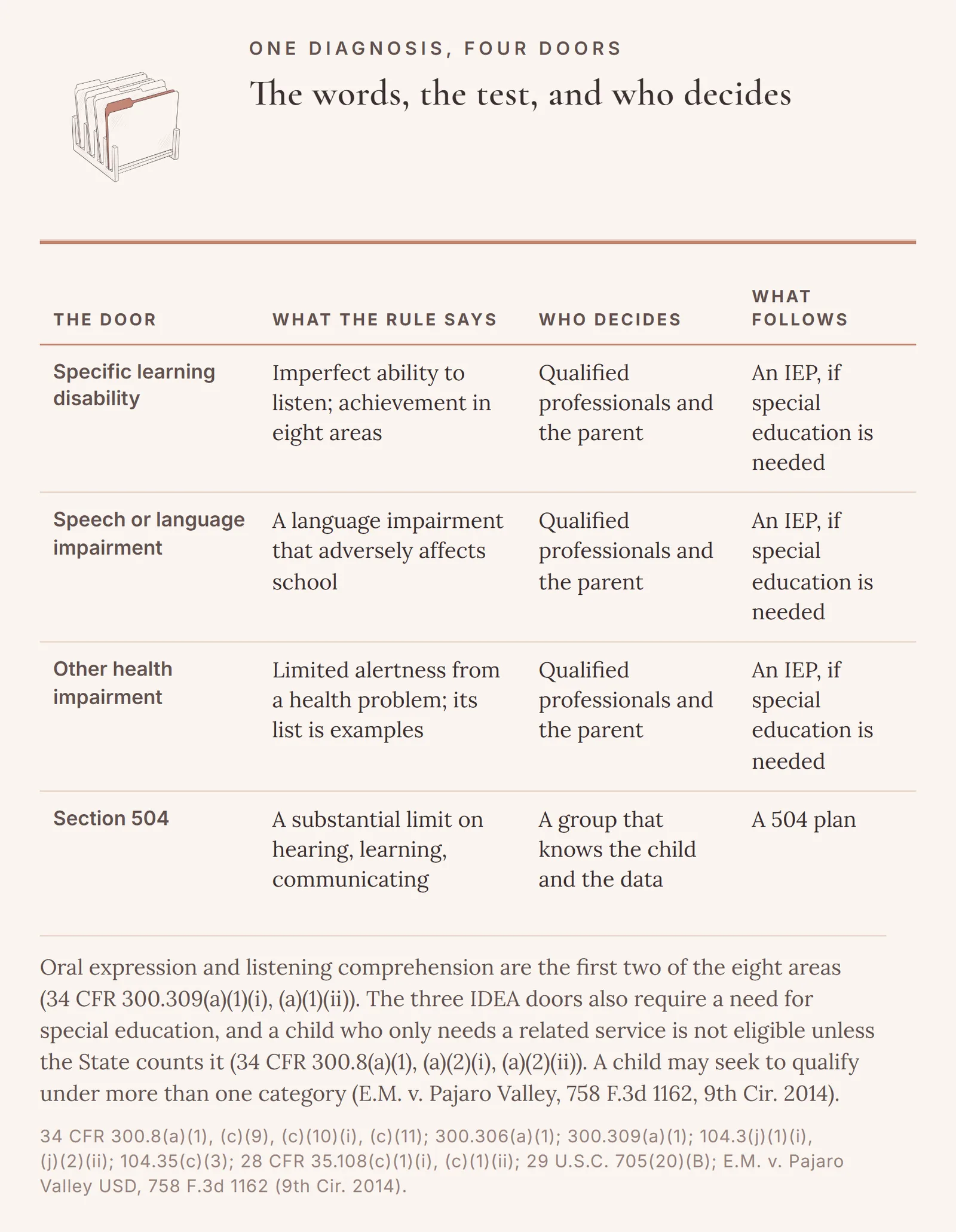
An auditory processing disorder diagnosis alone does not qualify a child for an IEP (Individualized Education Program) or a 504 plan, or rule either out. The regulation's category list never names it (34 CFR 300.8(a)(1)). Four doors: specific learning disability, speech or language impairment, other health impairment, and Section 504. A group decides, after an evaluation, which fits, if any.
A normal hearing test, and a count with no row for it
The audiologist's report says auditory processing disorder (APD), and the school says the hearing test came back fine. The American Speech-Language-Hearing Association (ASHA) says CAPD, its term for the diagnosis, "is not due to peripheral hearing loss," so both can be true.
The federal count has no APD row either. Table 204.30 of the Digest of Education Statistics 2023 counts children ages 3 to 21 served under IDEA (the Individuals with Disabilities Education Act) Part B. In 2022-23 it counted 2,408 thousand children under specific learning disability, 32.0 percent of all children served (the table's headings "Number of children served (in thousands)" and "Percentage distribution of children served"). A child is counted under the category for which services are received, so a child with APD who is served appears under whichever IDEA category the group found.
Four doors, and the words each one uses
Does federal law name auditory processing disorder?
No. Under IDEA, eligibility for an IEP rests on a two-part test: a listed category, "and who, by reason thereof, needs special education and related services" (34 CFR 300.8(a)(1)). APD is not on the list, and the words auditory processing appear nowhere in 34 CFR Part 300.
In 2006 the U.S. Department of Education (the Department) declined to add "auditory processing disorders" to the definition of specific learning disability: "Children with many types of disabilities or disorders may also have a specific learning disability" (71 FR 46551). Not a ruling either way.
Hearing impairment and deafness describe an impairment in hearing itself (34 CFR 300.8(c)(5), (c)(3)), so neither fits a child whose hearing test came back fine.
What do the learning and language doors ask?
A specific learning disability is a disorder in the basic psychological processes of understanding or using language that may show up as "the imperfect ability to listen, think, speak, read, write, spell," or calculate (34 CFR 300.8(c)(10)(i)). Among its findings, the group asks whether the child achieves adequately in eight areas, the first two oral expression and listening comprehension (34 CFR 300.309(a)(1), (a)(1)(i), (a)(1)(ii)).
That door turns on achievement and your state's criteria (34 CFR 300.307(a)), not on the report's processing finding. In 2006 the Department said it "does not believe that an assessment of psychological or cognitive processing should be required" (71 FR 46651).
A speech or language impairment is a communication disorder, "a language impairment" among the examples, that adversely affects educational performance (34 CFR 300.8(c)(11)).
What has been said about other health impairment?
Other health impairment means limited strength or alertness, "including a heightened alertness to environmental stimuli," that results in limited alertness at school, is due to a chronic or acute health problem, and adversely affects educational performance (34 CFR 300.8(c)(9), (c)(9)(i), (c)(9)(ii)). No auditory condition is among its examples.
In 2006 commenters worried about eligibility under this category "based on conditions that are not medically determined health problems, such as 'central auditory processing disorders,'" and one asked to limit it to health problems "universally recognized by the medical profession." The Department answered that it "cannot make the change requested": eligibility "is made by a team of qualified professionals and the parent of the child," and a State may require a medical evaluation, at no cost to the parent (71 FR 46550-46551).
In E.M. v. Pajaro Valley Unified School District, 758 F.3d 1162 (9th Cir. 2014), the Ninth Circuit said the Department's position that a central auditory processing disorder "is eligible for consideration" under this category "merits deference." It recognized that "a child with an auditory processing disorder may qualify," then ruled against E.M. on his record, finding "a dearth of any evidence" that his disorder limited his alertness.
What does Section 504 ask instead?
Section 504 of the Rehabilitation Act asks whether "a physical or mental impairment" substantially limits "one or more major life activities" (34 CFR 104.3(j)(1)(i)), and its regulation names "hearing, speaking" and "learning" (34 CFR 104.3(j)(2)(ii)). The Rehabilitation Act adopts the Americans with Disabilities Act's definition of disability (29 U.S.C. 705(20)(B)), and the regulation under Title II of the Americans with Disabilities Act adds "communicating" and "brain" function (28 CFR 35.108(c)(1)(i), (c)(1)(ii)).
That regulation answers the question "without regard to the ameliorative effects of mitigating measures," including "use of assistive technology" and "learned behavioral or adaptive neurological modifications" (28 CFR 35.108(d)(1)(viii), (d)(4)(ii), (d)(4)(iv)). A group of persons knowledgeable about the child, the evaluation data, and the placement options decides (34 CFR 104.35(c)(3)).
What must the evaluation look at?
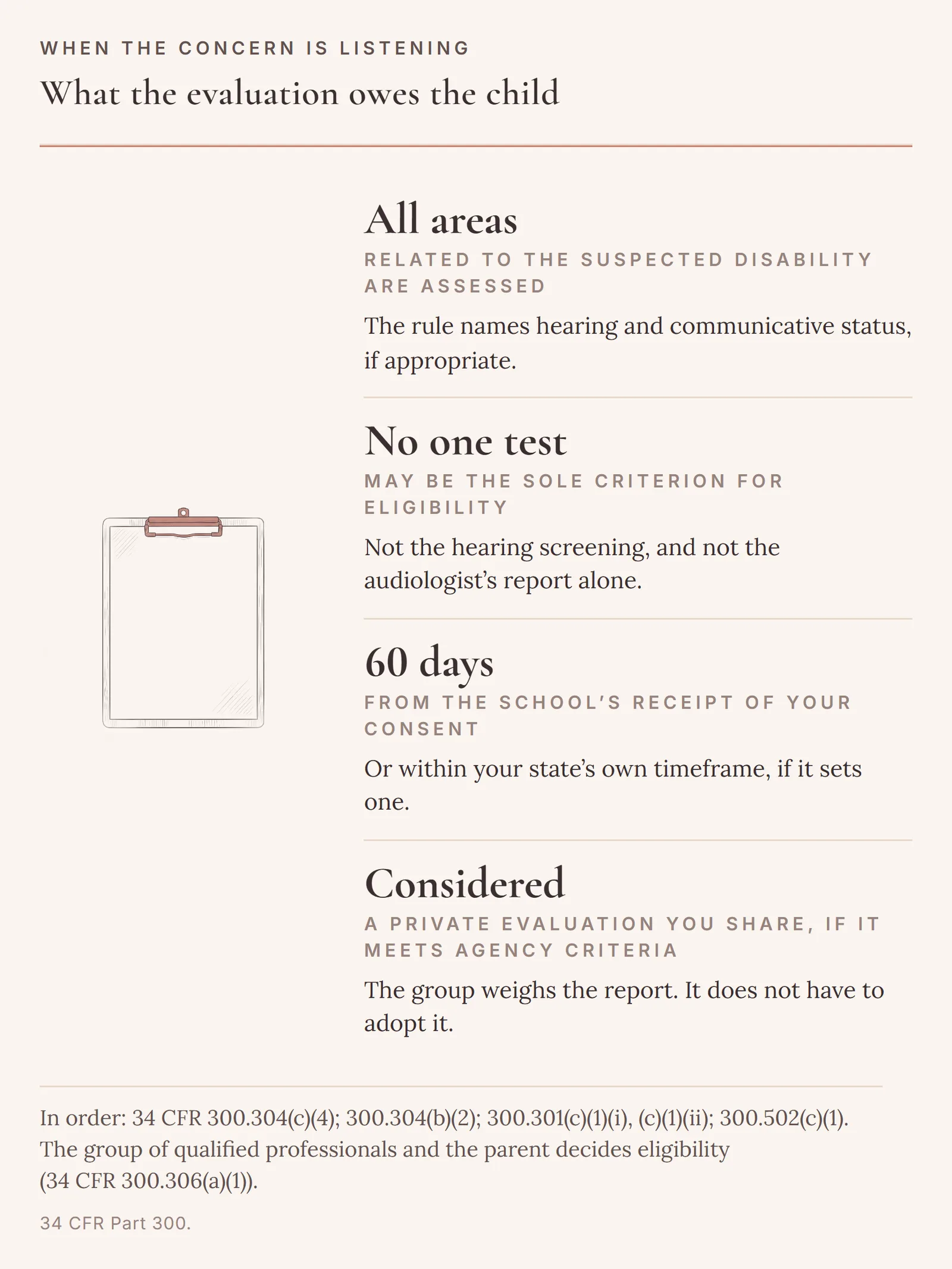
The evaluation determines whether a child has a disability and what the child's educational needs are (34 CFR 300.301(c)(2)(i), (c)(2)(ii)). A parent may request one (34 CFR 300.301(b)), and it must be conducted within 60 days of the school receiving your consent, or within your state's timeframe if it sets one (34 CFR 300.301(c)(1)(i), (c)(1)(ii)).
The child is assessed "in all areas related to the suspected disability, including, if appropriate," hearing and "communicative status" (34 CFR 300.304(c)(4)). No single measure may be "the sole criterion" (34 CFR 300.304(b)(2)): not the hearing screening, and not the audiologist's report alone. Eligibility belongs to "a group of qualified professionals and the parent of the child" (34 CFR 300.306(a)(1)).
Where does an FM system fit?
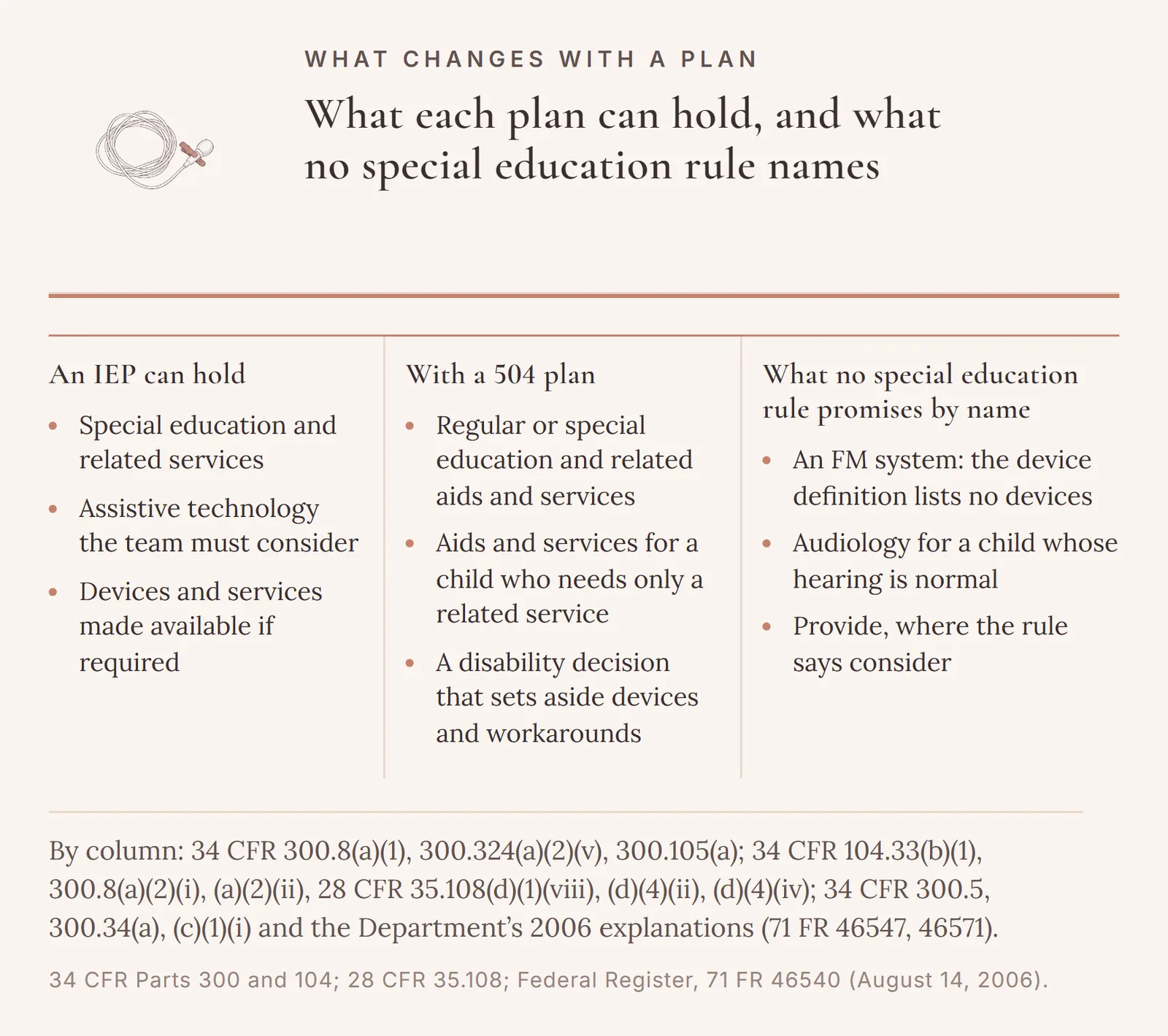
The special education regulations never name an FM or remote-microphone system; the Department said the definition "does not list specific devices" (71 FR 46547). An assistive technology device is anything used to "increase, maintain, or improve the functional capabilities of a child with a disability" (34 CFR 300.5). With an IEP, the team must "consider whether the child needs assistive technology devices and services" (34 CFR 300.324(a)(2)(v)), made available "if required" (34 CFR 300.105(a)). Consider is not provide.
Audiology, a related service, starts from "identification of children with hearing loss" (34 CFR 300.34(a), (c)(1)(i)), and the Department said it "focuses on identifying and serving children who are deaf or hard of hearing" (71 FR 46571). In the same analysis it called the definition "sufficiently broad to enable audiologists to be involved" in the services a commenter sought for children with auditory-related disorders (71 FR 46571).
A child who "only needs a related service and not special education" is not eligible under IDEA unless the State counts that service as special education (34 CFR 300.8(a)(2)(i), (a)(2)(ii)). A 504 plan can provide "regular or special education and related aids and services" (34 CFR 104.33(b)(1)).
Step by step, from the report to a decision
- Ask in writing for an initial evaluation (34 CFR 300.301(b)), attaching the audiologist's report.
- Ask that hearing and communicative status be assessed (34 CFR 300.304(c)(4)).
- Take your seat in the eligibility group (34 CFR 300.306(a)(1)), and ask which doors it considered.
- If the group finds no door fits, ask for prior written notice, the school's written explanation of what it refused and why (34 CFR 300.503(a)(2), (b)(2)).
- Ask about a Section 504 evaluation, owed to a student who needs or is believed to need services because of a disability (34 CFR 104.35(a)).
Mistakes and edge cases
Treating the report as the decision. A private evaluation you share "must be considered" by the school, "if it meets agency criteria," in any decision about the education it provides your child (34 CFR 300.502(c)(1)). Considered, not adopted.
Relying on a summary of the court case. Some professional summaries date E.M. to 2012 and describe it more broadly than the court's 2014 opinion did; the opinion's words are "may qualify."
Every state has at least one free, federally funded Parent Training and Information Center. Find yours at parentcenterhub.org.
FAQ
Can a child qualify through more than one door?
The Ninth Circuit held in E.M. that a "child with a disability" may seek to qualify for special education benefits "under more than one of the categories" (758 F.3d 1162). The holding binds courts in that circuit and persuades courts elsewhere.
What if the school thinks it is attention, not listening?
ASHA says CAPD "may co-occur with (and necessitate differentiation from)" attention-deficit/hyperactivity disorder, language delay or disorder, and learning disability. The evaluation must use instruments that can weigh "cognitive and behavioral factors" (34 CFR 300.304(b)(3)), and the group decides.
Does the school have to look at the audiologist's findings?
Yes. The group draws on a variety of sources, parent input and the child's "physical condition" among them, and that information must be "documented and carefully considered" (34 CFR 300.306(c)(1)(i), (c)(1)(ii)).
Sources
- eCFR, 34 CFR 300.5 (https://www.ecfr.gov/current/title-34/section-300.5)
- eCFR, 34 CFR 300.8 (https://www.ecfr.gov/current/title-34/section-300.8)
- eCFR, 34 CFR 300.34 (https://www.ecfr.gov/current/title-34/section-300.34)
- eCFR, 34 CFR 300.105 (https://www.ecfr.gov/current/title-34/section-300.105)
- eCFR, 34 CFR 300.301 (https://www.ecfr.gov/current/title-34/section-300.301)
- eCFR, 34 CFR 300.304 (https://www.ecfr.gov/current/title-34/section-300.304)
- eCFR, 34 CFR 300.306 (https://www.ecfr.gov/current/title-34/section-300.306)
- eCFR, 34 CFR 300.307 (https://www.ecfr.gov/current/title-34/section-300.307)
- eCFR, 34 CFR 300.309 (https://www.ecfr.gov/current/title-34/section-300.309)
- eCFR, 34 CFR 300.324 (https://www.ecfr.gov/current/title-34/section-300.324)
- eCFR, 34 CFR 300.502 (https://www.ecfr.gov/current/title-34/section-300.502)
- eCFR, 34 CFR 300.503 (https://www.ecfr.gov/current/title-34/section-300.503)
- eCFR, 34 CFR Part 104 (https://www.ecfr.gov/current/title-34/part-104)
- eCFR, 28 CFR 35.108 (https://www.ecfr.gov/current/title-28/section-35.108)
- U.S. Code, 29 U.S.C. 705 (https://www.law.cornell.edu/uscode/text/29/705)
- Federal Register, 71 FR 46540, August 14, 2006 (https://www.govinfo.gov/content/pkg/FR-2006-08-14/pdf/06-6656.pdf)
- Ninth Circuit, E.M. v. Pajaro Valley Unified School District, 758 F.3d 1162, 2014 (https://cdn.ca9.uscourts.gov/datastore/opinions/2014/07/15/12-15743.pdf)
- NCES, Digest of Education Statistics 2023, Table 204.30 (https://nces.ed.gov/programs/digest/d23/tables/dt23_204.30.asp)
- ASHA Practice Portal, central auditory processing disorder (https://www.asha.org/practice-portal/clinical-topics/central-auditory-processing-disorder/)
- Center for Parent Information and Resources, find your Parent Center (https://www.parentcenterhub.org/find-your-center/)