The short answer
A dyscalculia diagnosis does not by itself qualify a child for an IEP (Individualized Education Program), and it does not rule one out. The federal category is specific learning disability, and two of its eight areas are math. A child qualifies when an evaluation finds that disability and, because of it, a need for special education (34 CFR 300.8(a)(1)).
What the numbers can and cannot tell you
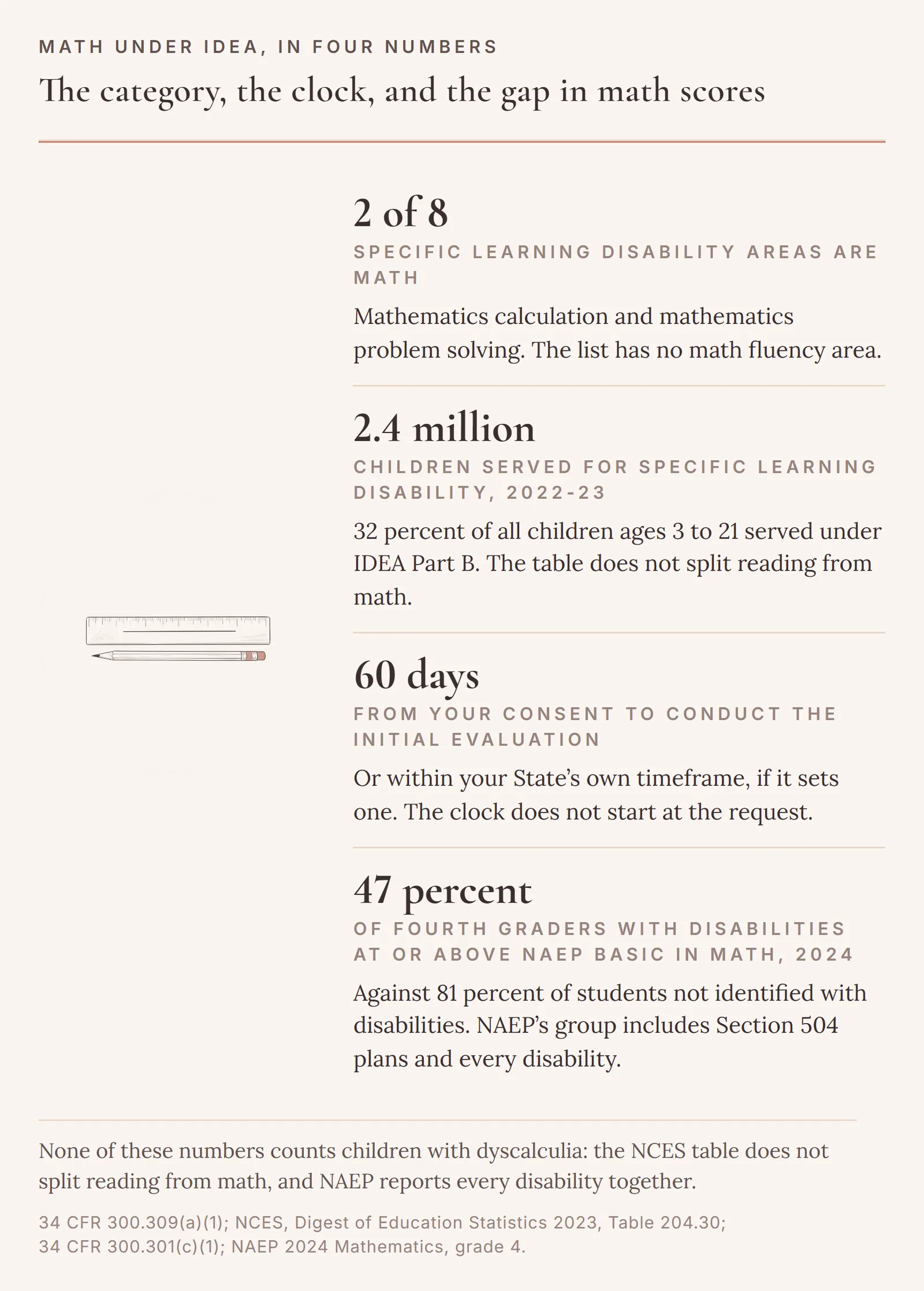
Dyscalculia is an everyday word for a specific learning disability in math. About 2.4 million children ages 3 to 21 were served under specific learning disability, reading and math together, in 2022-23, 32 percent of all children served under IDEA (the Individuals with Disabilities Education Act) Part B (Digest of Education Statistics 2023, Table 204.30). The table does not split reading from math.
On the 2024 National Assessment of Educational Progress (NAEP) in mathematics, 47 percent of fourth graders with disabilities scored at or above NAEP Basic, against 81 percent of students not identified with disabilities. In eighth grade it was 26 percent against 66 percent. NAEP's group includes students with Section 504 plans, only those assessed, and every disability, so these are not dyscalculia numbers.
The deadline that matters is the evaluation's. An evaluation is the school's procedures for deciding whether a child has a disability and what the child needs (34 CFR 300.301(c)(2)(i), (c)(2)(ii)). It must be conducted within 60 days of the school receiving your consent, or within your state's own timeframe (34 CFR 300.301(c)(1)(i), (c)(1)(ii)).
How the law answers the question
Does federal law name dyscalculia?
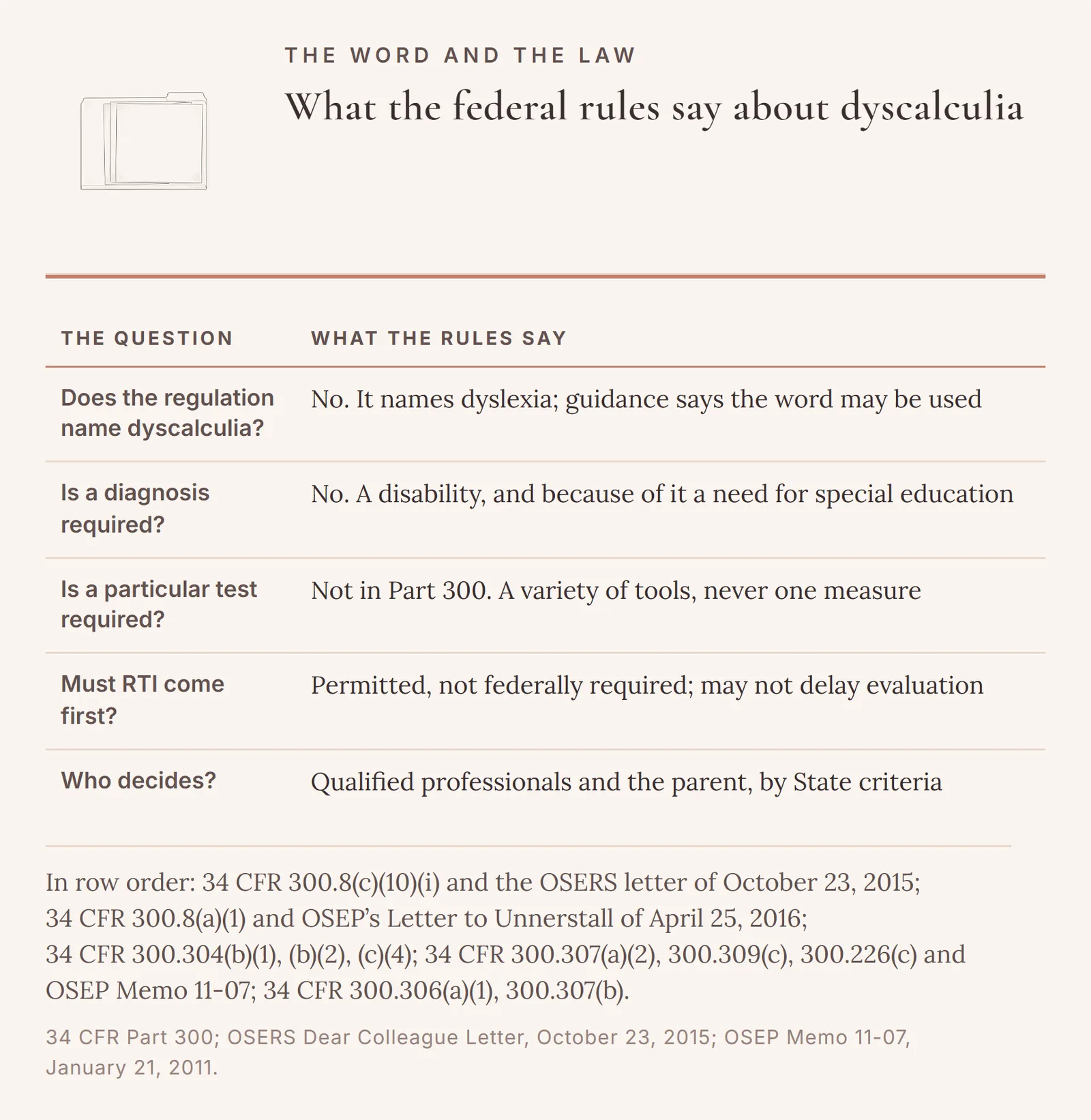
Not in the regulation. Its definition of a specific learning disability covers a disorder that "may manifest itself in the imperfect ability to listen, think, speak, read, write, spell, or to do mathematical calculations." The conditions it lists include dyslexia, not dyscalculia (34 CFR 300.8(c)(10)(i)).
The word appears in Department of Education guidance. In a Dear Colleague Letter of October 23, 2015, the Office of Special Education and Rehabilitative Services (OSERS) called dyscalculia a condition that "could qualify" a child as a child with a specific learning disability. It said nothing in IDEA prohibits the term in evaluations, eligibility determinations, or IEP documents.
What does qualify a child, then?
A two-part test: one of the listed disabilities, specific learning disability among them, "and who, by reason thereof, needs special education and related services" (34 CFR 300.8(a)(1)). Special education is specially designed instruction (34 CFR 300.39(a)(1)), meaning instruction adapted in content, methodology, or delivery to the child's needs (34 CFR 300.39(b)(3)).
Eligibility, the decision whether a child meets that test, belongs to a group of qualified professionals and the parent (34 CFR 300.306(a)(1)), under the State's criteria (34 CFR 300.307(b)). The two math areas are mathematics calculation and mathematics problem solving (34 CFR 300.309(a)(1)(vii), (a)(1)(viii)); there is no math fluency area. The rest, including the two routes to a finding (response to intervention, called RTI, or a pattern of strengths and weaknesses), is the specific learning disability process used for reading (34 CFR 300.309(a)(2)(i), (a)(2)(ii)).
The special rule for eligibility names math instruction directly. A child must not be found eligible if the determinant factor is "lack of appropriate instruction in math" (34 CFR 300.306(b)(1)(ii)) and the child does not otherwise meet the criteria (34 CFR 300.306(b)(2)). Weak teaching alone cannot make a child eligible, or rule out one who otherwise qualifies. When a school answers a math worry with "practice the facts," this is the question underneath it. The group must consider data on appropriate instruction and on repeated assessments of achievement "which was provided to the child's parents" (34 CFR 300.309(b), (b)(1), (b)(2)).
What happens if the answer is no?
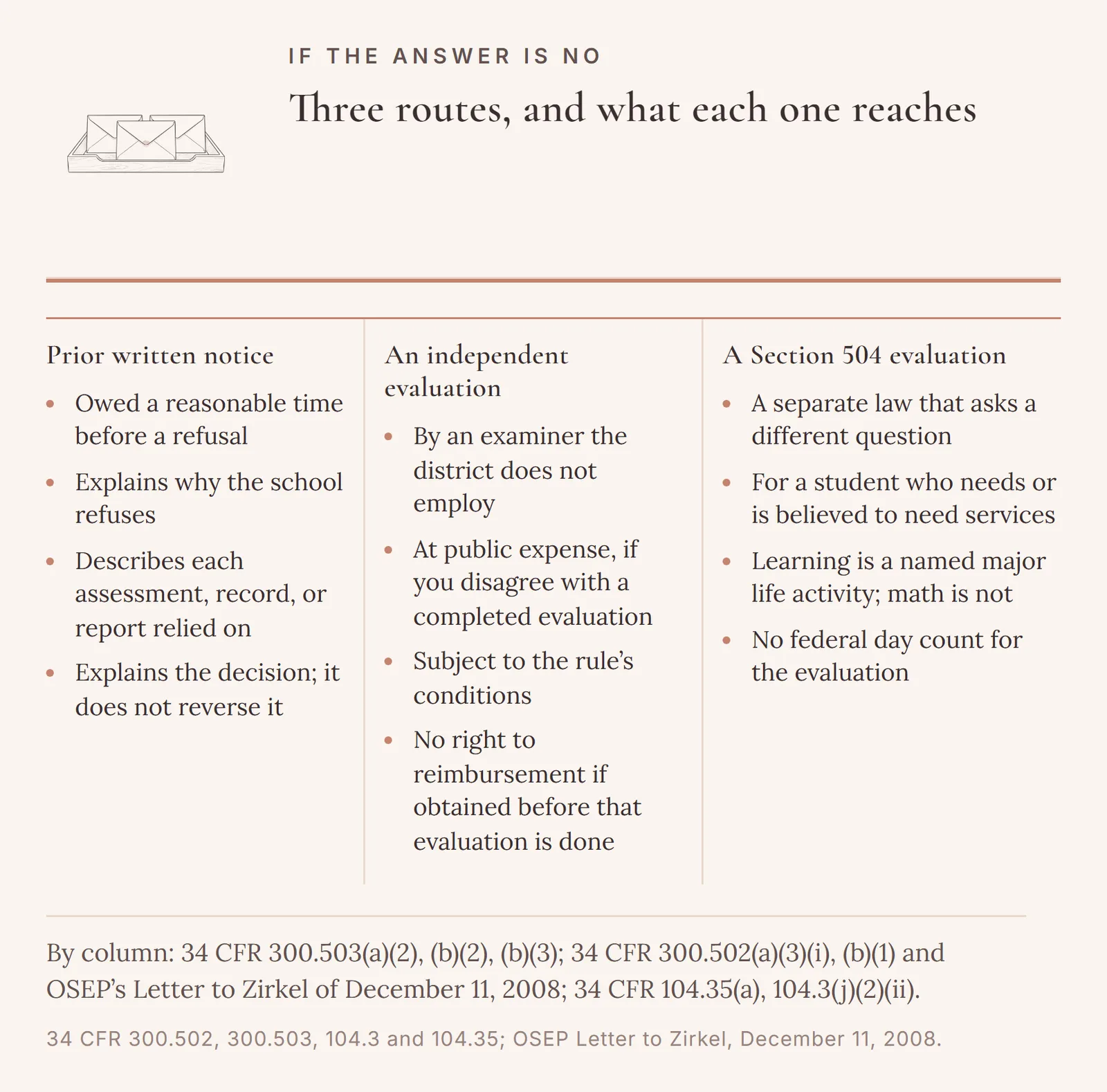
Three routes open first. A refusal to evaluate, to find a child eligible, or to add math instruction is owed in writing, a reasonable time before the school refuses (34 CFR 300.503(a)(2)). That written explanation is prior written notice. It must say why and describe each assessment, record, or report the school relied on (34 CFR 300.503(b)(2), (b)(3)).
If you disagree with an evaluation the school completed, you have the right to an independent educational evaluation, by an examiner the district does not employ, at public expense, subject to the rule's conditions (34 CFR 300.502(a)(3)(i), (b)(1)). The third route is an evaluation under Section 504 of the Rehabilitation Act (34 CFR 104.35(a)), which asks whether an impairment substantially limits a major life activity such as learning (34 CFR 104.3(j)(1)(i)). If the disagreement stays, the formal routes are mediation (34 CFR 300.506(a)), a due process complaint (34 CFR 300.507(a)(1)), and a State complaint (34 CFR 300.153(a)).
Step by step, from a math worry to a decision
- Write down what you see, with dates: homework time, which problems go well, and what the teacher has said.
- Ask in writing for the instruction and progress data in 34 CFR 300.309(b)(1) and (b)(2).
- Request an initial evaluation in writing (34 CFR 300.301(b)), naming a suspected specific learning disability in mathematics calculation and mathematics problem solving. Enclose any private report; keep a dated copy.
- Sign consent and note the date it was received. Consent comes before testing (34 CFR 300.300(a)(1)(i)), and the clock runs from it.
- Ask which assessments will cover each math area (34 CFR 300.304(c)(4)).
- Attend the eligibility meeting as a member. The report and the eligibility documentation are yours at no cost (34 CFR 300.306(a)(2)).
- If the answer is no, ask for it in writing (34 CFR 300.503(a)(2)) and choose a route.
Mistakes and edge cases
Treating more practice as the answer to a written request. For a suspected specific learning disability, the school must "promptly request parental consent to evaluate" whenever a child is referred (34 CFR 300.309(c), (c)(2)). The Office of Special Education Programs (OSEP) says in Memo 11-07 of January 21, 2011 that RTI cannot be used to delay or deny an evaluation. Early intervening services may not be construed to delay one either (34 CFR 300.226(c)). State criteria must permit RTI (34 CFR 300.307(a)(2)); the federal rules do not require it first.
Treating a private diagnosis as the decision. A private evaluation you share must be considered, if it meets agency criteria, in any decision about your child's free appropriate public education (FAPE), the special education and related services owed at public expense (34 CFR 300.502(c)(1); 300.17(a)). Considered is not adopted. OSEP's Letter to Zirkel of December 11, 2008 adds that a district that declined to evaluate the child had no obligation, at that point, to consider one, and a parent who obtains one before the district's evaluation is complete is not entitled to reimbursement.
Every state has a free, federally funded Parent Training and Information Center, and reading an eligibility report with a parent is ordinary work for them. Find yours at parentcenterhub.org.
FAQ
Will the school write dyscalculia in the report?
It may, and it does not have to. OSEP's Letter to Unnerstall of April 25, 2016 says no disability label or "diagnosis" is required, so long as the child is regarded as having a disability and receives needed services.
Does the school have to give a dyscalculia test?
No federal rule names one. The school uses a variety of tools, never a single measure as the sole criterion, and assesses all areas related to the suspected disability (34 CFR 300.304(b)(1), (b)(2), (c)(4)). The same letter, about dyslexia, says a parent cannot dictate the areas assessed, but an assessment the evaluation shows is needed must be done at no cost. I read it the same way for math.
Can a child with dyscalculia have a 504 plan instead?
Possibly. The Section 504 regulation counts specific learning disabilities as impairments and names learning as a major life activity (34 CFR 104.3(j)(2)(i)(B), (j)(2)(ii)); the impairment must substantially limit a major life activity (34 CFR 104.3(j)(1)(i)). Title II of the Americans with Disabilities Act adds reading, concentrating, thinking, and writing (28 CFR 35.108(c)(1)(i)). Math is named in neither list, and no federal day count applies to a 504 evaluation (34 CFR 104.35(a) sets none).
Sources
- eCFR, 34 CFR 300.8, definitions (https://www.ecfr.gov/current/title-34/section-300.8)
- eCFR, 34 CFR 300.17, FAPE (https://www.ecfr.gov/current/title-34/section-300.17)
- eCFR, 34 CFR 300.39, special education (https://www.ecfr.gov/current/title-34/section-300.39)
- eCFR, 34 CFR 300.153, State complaint (https://www.ecfr.gov/current/title-34/section-300.153)
- eCFR, 34 CFR 300.226, early intervening services (https://www.ecfr.gov/current/title-34/section-300.226)
- eCFR, 34 CFR 300.300, consent (https://www.ecfr.gov/current/title-34/section-300.300)
- eCFR, 34 CFR 300.301, initial evaluations (https://www.ecfr.gov/current/title-34/section-300.301)
- eCFR, 34 CFR 300.304, evaluation procedures (https://www.ecfr.gov/current/title-34/section-300.304)
- eCFR, 34 CFR 300.306, eligibility (https://www.ecfr.gov/current/title-34/section-300.306)
- eCFR, 34 CFR 300.307, State criteria (https://www.ecfr.gov/current/title-34/section-300.307)
- eCFR, 34 CFR 300.309, specific learning disability (https://www.ecfr.gov/current/title-34/section-300.309)
- eCFR, 34 CFR 300.502, independent evaluation (https://www.ecfr.gov/current/title-34/section-300.502)
- eCFR, 34 CFR 300.503, prior written notice (https://www.ecfr.gov/current/title-34/section-300.503)
- eCFR, 34 CFR 300.506, mediation (https://www.ecfr.gov/current/title-34/section-300.506)
- eCFR, 34 CFR 300.507, due process complaint (https://www.ecfr.gov/current/title-34/section-300.507)
- eCFR, 34 CFR Part 104, Section 504 (https://www.ecfr.gov/current/title-34/part-104)
- eCFR, 28 CFR 35.108, ADA Title II (https://www.ecfr.gov/current/title-28/section-35.108)
- OSERS, Dear Colleague Letter, October 23, 2015 (https://sites.ed.gov/idea/files/policy_speced_guid_idea_memosdcltrs_guidance-on-dyslexia-10-2015.pdf)
- OSEP, Letter to Unnerstall, April 25, 2016 (https://sites.ed.gov/idea/files/idea/policy/speced/guid/idea/memosdcltrs/oseplettertounnerstall4-25-16dyslexia.pdf)
- OSEP, Memo 11-07, January 21, 2011 (https://sites.ed.gov/idea/files/policy_speced_guid_idea_memosdcltrs_osep11-07rtimemo.pdf)
- OSEP, Letter to Zirkel, December 11, 2008 (https://sites.ed.gov/idea/files/idea/policy/speced/guid/idea/letters/2008-4/zirkel121108iee4q2008.pdf)
- NCES, Digest of Education Statistics 2023, Table 204.30 (https://nces.ed.gov/programs/digest/d23/tables/dt23_204.30.asp)
- NCES, NAEP 2024 Mathematics, summary data tables (https://www.nationsreportcard.gov/reports/mathematics/2024/g4_8/supporting-files/2024_Results_Appendix_Math_National.xlsx)
- Center for Parent Information and Resources, find your Parent Center (https://www.parentcenterhub.org/find-your-center/)