The short answer
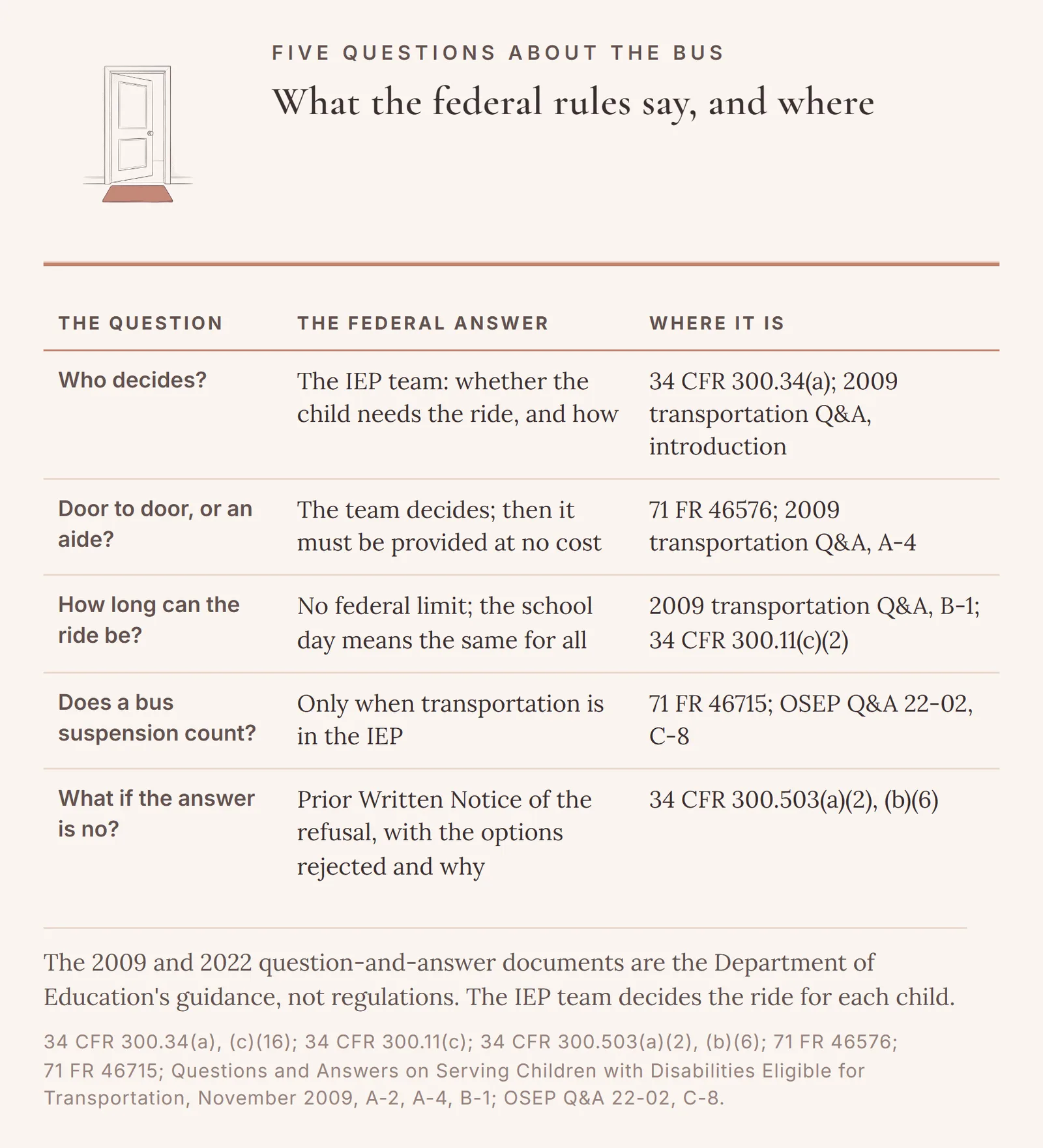
Only when the IEP (Individualized Education Program) team decides your child needs it to benefit from special education (34 CFR 300.34(a)). Then the district must provide the ride, and any support the team decides it takes, at no cost to the parents (71 FR 46576). No federal rule caps how long the ride can be.
What rides on the answer
Whether the ride is in the IEP decides two things. One is cost: a ride in the IEP is part of FAPE, a free appropriate public education, provided "without charge" (34 CFR 300.17(a)). The other is discipline: only then does a bus suspension count under the special education discipline rules and their 10-school-day count (71 FR 46715).
Section 504 of the Rehabilitation Act, the civil-rights law behind the 504 plan, reaches the ride whether or not it is in the IEP (34 CFR 104.37(a)(1), (a)(2)). The Department of Education's Office for Civil Rights (OCR) gives an example in its 2016 guide to Section 504. A bus schedule requiring a "20 minute early departure for administrative convenience" of students who need a wheelchair-accessible bus, and of no other riders, "would result in discrimination in violation of Section 504" (page 30).
How the decision works
Who decides whether a child gets the ride
Under the Individuals with Disabilities Education Act (IDEA), transportation is a related service, a support "required to assist a child with a disability to benefit from special education" (34 CFR 300.34(a)).
The Department's 2009 questions and answers on transportation, informal guidance, give the IEP team both decisions: "if transportation is required" and "how the transportation services should be implemented" (introduction). The default is the regular bus. The Department explained in 2006: "It is assumed that most children with disabilities will receive the same transportation provided to nondisabled children," unless the team decides otherwise (71 FR 46576).
Does the school have to provide door-to-door service or an aide
Not by name. In 2006 the Department declined to define transportation as door-to-door service with an escorting aide, calling the definition "sufficiently broad." If the team "determines that supports or modifications are needed in order for the child to be transported," the child "must receive the necessary transportation and supports at no cost to the parents" (71 FR 46576).
The 2009 questions and answers apply that to the aide. If the team finds a child "requires special transportation arrangements or accommodations, including an aide for safety, the LEA must provide these services" (question A-4). The LEA is the local educational agency, usually the district. A door-to-door pickup, an aide, a harness: the team decides first, and the district provides after.
What should the IEP say about the ride
The 2009 questions and answers say the IEP "should describe the transportation services to be provided" (question A-2). The IEP lists each related service and any "supports for school personnel," where driver or aide training can go (34 CFR 300.320(a)(4)). Each service gets "the projected date for the beginning" and its "anticipated frequency, location, and duration" (34 CFR 300.320(a)(7)). For a ride, that is from where to where, which days and trips, starting when.
How long can the ride be
No federal rule sets a number of minutes. The 2009 questions and answers say "Neither Part B of the IDEA nor the regulations address the issue of the length of a school day," which is left to the state (question B-1). In general, they add, a school day for a child with a disability "should not be longer or shorter" than one for general education students. A shorter day the team writes in must rest on the child's needs, "not solely" on transportation time. The regulation's school day "has the same meaning for all children" (34 CFR 300.11(c)(2)).
Your state may set its own ride-time rule. The School Bus Playbook sets out ten states' rules in their own words.
Does a bus suspension count as a suspension
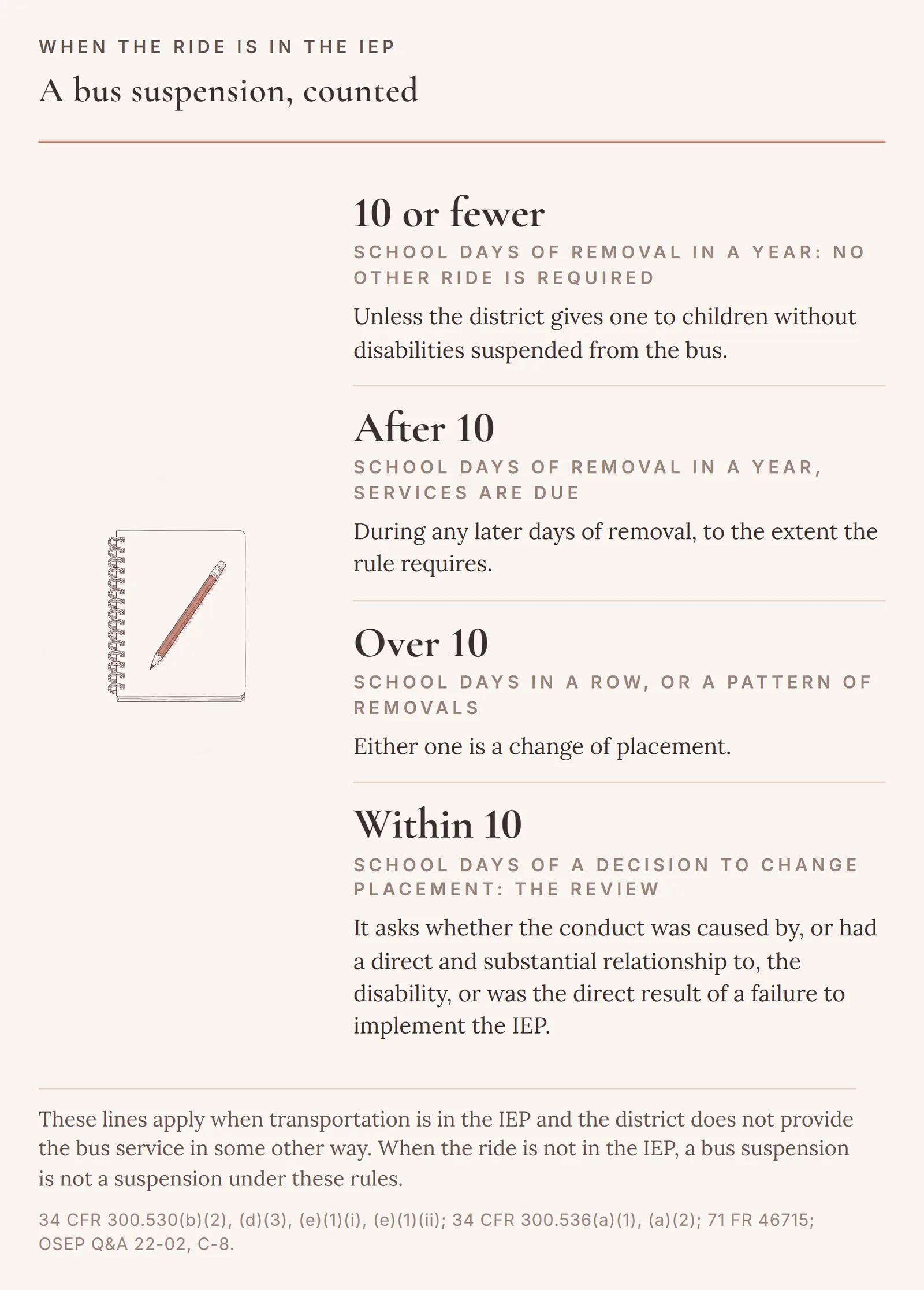
It depends on the IEP. The Department explained in 2006 that it "would depend on whether the bus transportation is a part of the child's IEP." If it is, a bus suspension is treated as a suspension under the discipline rules "unless the public agency provides the bus service in some other way." If it is not, the family has the same obligation to get the child to school as any family whose child is suspended from the bus (71 FR 46715).
When the ride is in the IEP, the count runs like this. For removals of 10 school days or less in a school year, no alternative ride is required unless the district gives one to children without disabilities suspended from the bus. So says the 2022 discipline guidance of the Department's Office of Special Education Programs (OSEP Q&A 22-02, question C-8; 34 CFR 300.530(d)(3)). After 10 school days of removal in a year, services are due during later removals (34 CFR 300.530(b)(2)). More than 10 consecutive school days, or a pattern of removals, is a change of placement (34 CFR 300.536(a)(1), (a)(2)).
Within 10 school days of deciding on that change, the district, the parent, and relevant team members review the file in the manifestation determination (34 CFR 300.530(e)(1)). It asks whether the conduct "was caused by, or had a direct and substantial relationship to, the child's disability," or "was the direct result of the LEA's failure to implement the IEP" (34 CFR 300.530(e)(1)(i), (e)(1)(ii)). The second question fits the bus, as with an aide written in and not on board.
How to get the ride decided, step by step
- Find the ride in the current IEP, with its start date, frequency, location, and duration (34 CFR 300.320(a)(7)).
- Write down the ride as it runs now, with dates, times, and what went wrong.
- Put your concern in writing and ask to meet. The team must consider "the concerns of the parents" (34 CFR 300.324(a)(1)(ii)). Consider is not agree.
- Ask that the ride be written out, with any aide, equipment, or driver training the team decides on (34 CFR 300.320(a)(4)).
- If the answer is no, read the Prior Written Notice, the school's written explanation of a refusal, including the options it rejected and why (34 CFR 300.503(a)(2), (b)(6)).
- If a written-in ride is not happening, write to the school with your dates. If a requirement is not being met, a state complaint to your state education agency is one written route; its procedures carry a 60-day time limit after filing (34 CFR 300.152(a)).
Mistakes and edge cases
Reading "every child with an IEP gets the bus." The test is the child's need (34 CFR 300.34(a)). The reverse is a misreading too. A child who "only needs a related service and not special education" is not a child with a disability under the IDEA rules, unless the state counts that service as special education (34 CFR 300.8(a)(2)(i), (a)(2)(ii)). For that child, Section 504 can still apply (34 CFR 104.33(a)).
Every state has a free, federally funded Parent Training and Information Center. Find yours at parentcenterhub.org.
FAQ
Can the school put my child on a separate small bus?
If the team decides so. The 2009 questions and answers say the IDEA "does not require LEAs to transport children with disabilities in separate vehicles, isolated from their peers," and that districts "should explore options for integrating children with disabilities with nondisabled students" (questions A-2, A-3).
What if my child has a 504 plan and no IEP?
Section 504's regulation lists transportation among the nonacademic services a district must provide in the manner necessary to afford students with disabilities "an equal opportunity for participation" (34 CFR 104.37(a)(1), (a)(2)). OCR's 2016 guide adds that if transportation is a related service for a particular student, the district "cannot charge the student for that transportation" (page 25).
Does IEP transportation cover after-school activities?
When transportation is in the IEP, the 2009 questions and answers say it "should include transportation for required after-school activities" and for activities needed to afford the child "an equal opportunity to participate in extracurricular activities" (question E-1).
Sources
- eCFR, 34 CFR 300.8, child with a disability (https://www.ecfr.gov/current/title-34/section-300.8)
- eCFR, 34 CFR 300.11, school day (https://www.ecfr.gov/current/title-34/section-300.11)
- eCFR, 34 CFR 300.17, FAPE (https://www.ecfr.gov/current/title-34/section-300.17)
- eCFR, 34 CFR 300.34, related services (https://www.ecfr.gov/current/title-34/section-300.34)
- eCFR, 34 CFR 300.152, state complaints (https://www.ecfr.gov/current/title-34/section-300.152)
- eCFR, 34 CFR 300.320, IEP contents (https://www.ecfr.gov/current/title-34/section-300.320)
- eCFR, 34 CFR 300.324, IEP development (https://www.ecfr.gov/current/title-34/section-300.324)
- eCFR, 34 CFR 300.503, prior notice (https://www.ecfr.gov/current/title-34/section-300.503)
- eCFR, 34 CFR 300.530, discipline (https://www.ecfr.gov/current/title-34/section-300.530)
- eCFR, 34 CFR 300.536, change of placement (https://www.ecfr.gov/current/title-34/section-300.536)
- eCFR, 34 CFR 104.33, free appropriate public education (https://www.ecfr.gov/current/title-34/section-104.33)
- eCFR, 34 CFR 104.37, nonacademic services (https://www.ecfr.gov/current/title-34/section-104.37)
- Federal Register, 71 FR 46576 and 46715, August 14, 2006 (https://www.govinfo.gov/content/pkg/FR-2006-08-14/pdf/06-6656.pdf)
- OSERS, Questions and Answers on Serving Children with Disabilities Eligible for Transportation, November 2009 (https://sites.ed.gov/idea/files/OMB_08-0101_Transportation-11-4-09_FINAL-1.pdf)
- OSEP Q&A 22-02, discipline, July 19, 2022 (https://sites.ed.gov/idea/files/qa-addressing-the-needs-of-children-with-disabilities-and-idea-discipline-provisions.pdf)
- Office for Civil Rights, Parent and Educator Resource Guide to Section 504, December 2016 (https://www.ed.gov/sites/ed/files/about/offices/list/ocr/docs/504-resource-guide-201612.pdf)
- Center for Parent Information and Resources, find your Parent Center (https://www.parentcenterhub.org/find-your-center/)