The short answer
School occupational therapy (OT) is a related service. A child gets it when an evaluation finds a listed disability, a need for special education, and a need for OT to benefit from it. The IEP (Individualized Education Program) team writes it in, with frequency, location, and duration. A child who needs only OT is usually a Section 504 question.
How many children this touches
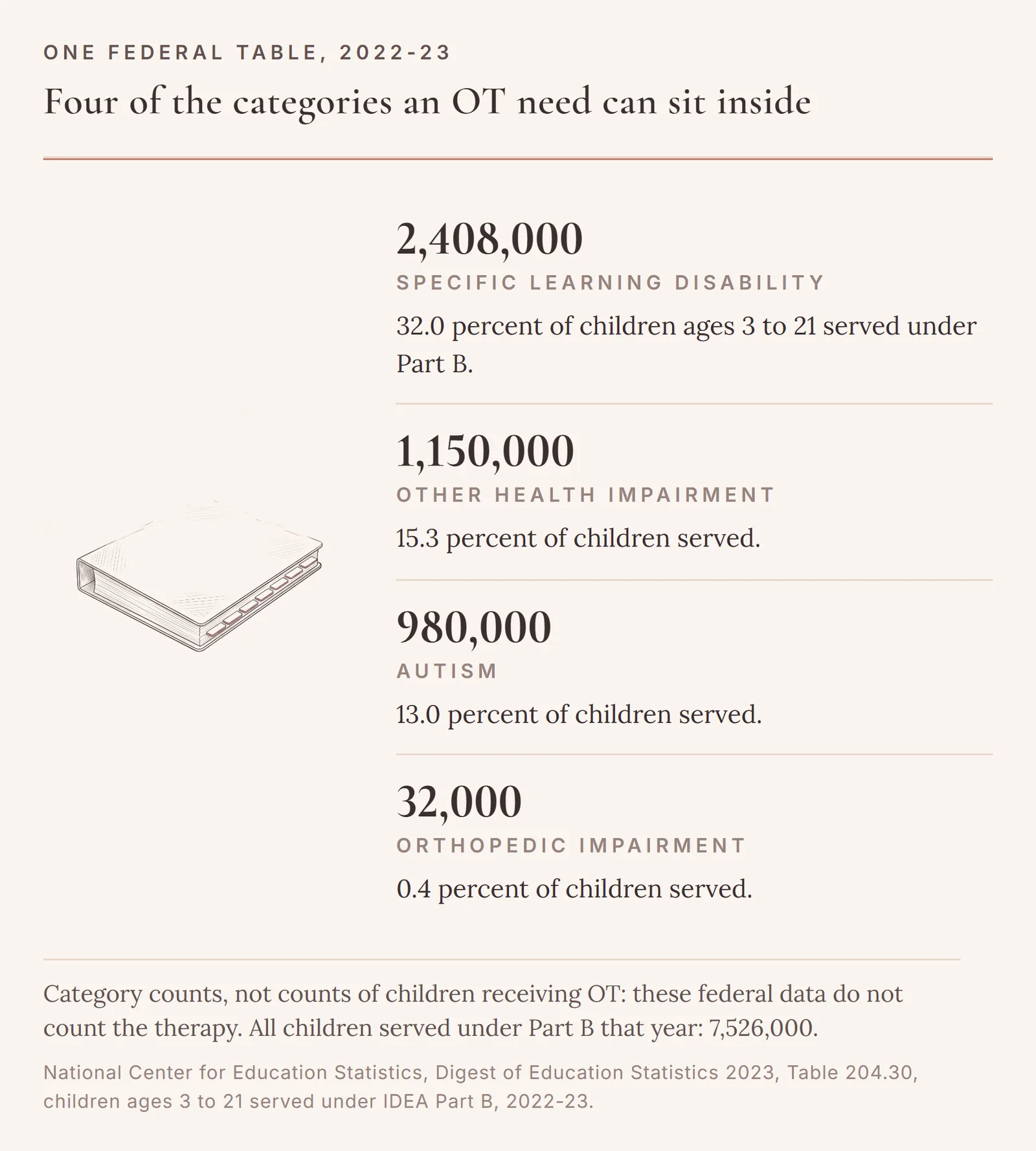
Occupational therapy is on the federal list of related services by name (34 CFR 300.34(a)). The National Center for Education Statistics counts children served under the Individuals with Disabilities Education Act (IDEA), Part B, by disability category, not by related service, so these federal data do not count children receiving OT (Digest of Education Statistics 2023, Table 204.30).
An OT need rides on a category, and any category can carry one: the evaluation has to identify every related service need, whether or not it is commonly linked to the category (34 CFR 300.304(c)(6)). Four categories whose federal definitions touch motor, sensory, or writing needs are where the guide starts (34 CFR 300.8(c)(1)(i), (c)(8), (c)(9), (c)(10)). In 2022-23, 7,526,000 children ages 3 to 21 were served under Part B. Of those, 2,408,000 were in the specific learning disability category (32.0 percent), 1,150,000 in other health impairment (15.3 percent), 980,000 in autism (13.0 percent), and 32,000 in orthopedic impairment (0.4 percent) (Table 204.30).
How the decision works
What is occupational therapy at school
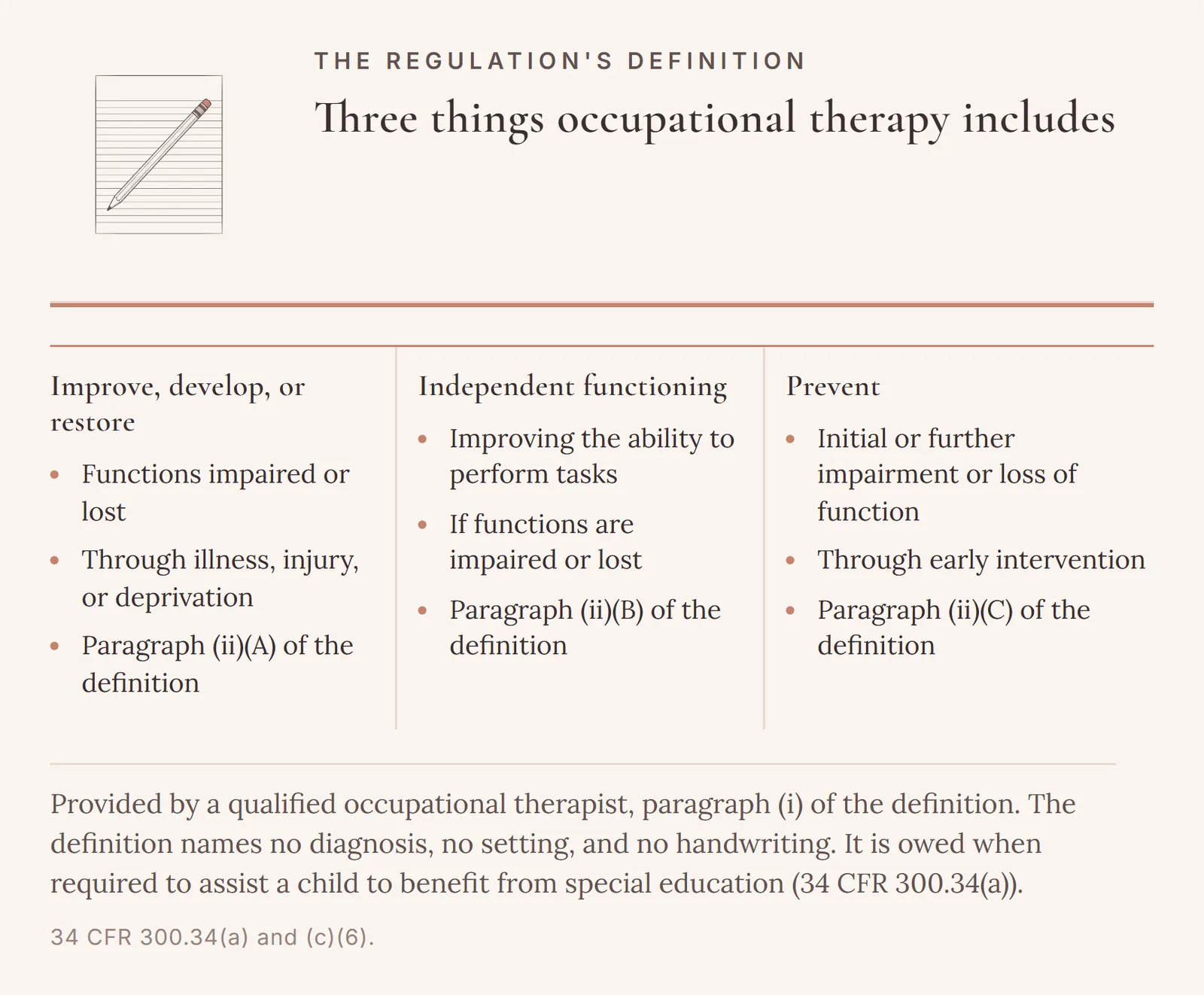
A related service is a supportive service "required to assist a child with a disability to benefit from special education" (34 CFR 300.34(a)). Occupational therapy means services provided by a qualified occupational therapist, and the definition has three parts: improving, developing, or restoring functions impaired or lost; improving the ability to perform tasks for independent functioning; and preventing, through early intervention, initial or further impairment or loss of function (34 CFR 300.34(c)(6)).
The definition never says handwriting, a diagnosis, or a setting. "He holds the pencil like a fist" is a parent's sentence. "Tasks for independent functioning" is the rule's.
What does "medical, not educational" actually mean
It has two answers.
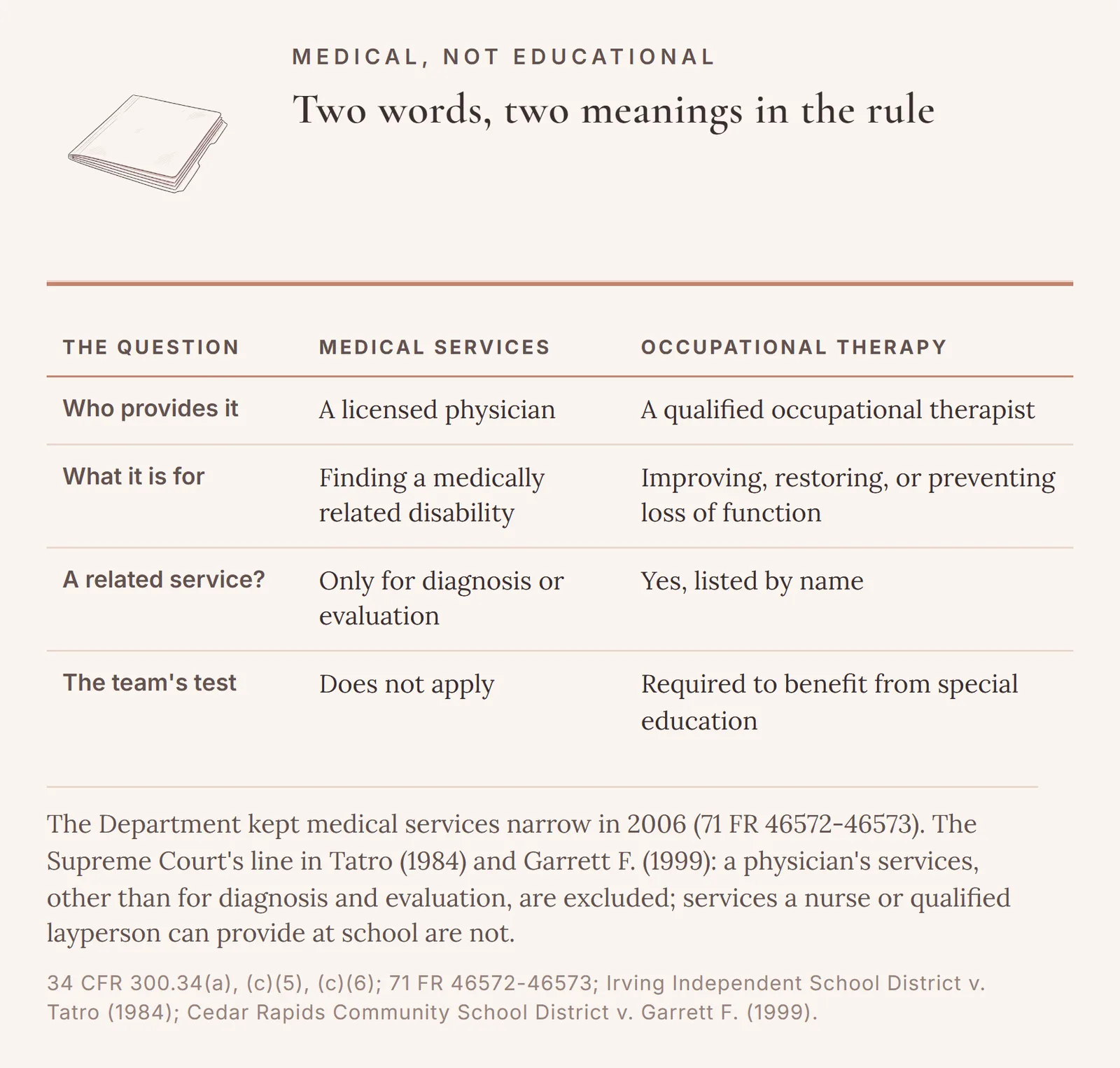
The word. The rule's only medical services are services "provided by a licensed physician to determine a child's medically related disability" (34 CFR 300.34(c)(5)). Occupational therapy is a separate service on the list. In 2006 the U.S. Department of Education declined to define medical services more broadly, saying that would "not be consistent with the Act" (71 FR 46572-46573).
The Supreme Court drew the same line. In Irving Independent School District v. Tatro (1984), it held that the medical services exclusion covers a physician's services. In Cedar Rapids Community School District v. Garrett F. (1999), it applied that bright line: a physician's services, other than for diagnosis and evaluation, are excluded, and services a nurse or qualified layperson can provide at school are not.
The test. Tatro also held that only services necessary to help a child benefit from special education must be provided, which is the regulation's question (34 CFR 300.34(a)). The Department's Office of Special Education Programs (OSEP) wrote in a 2004 letter, guidance rather than law, that this decision "must be made by the child's IEP team on a case-by-case basis in light of the child's unique needs," and that a parent's request alone does not require the team to add OT (OSEP Letter to Geigerman, November 3, 2004).
So "medical, not educational" is a label, not a reason. The reason has to come from the evaluation data.
Who decides, and on what
Eligibility is the decision about whether a child qualifies: a child with a disability is a child evaluated as having one of the listed impairments who, because of it, needs special education and related services (34 CFR 300.8(a)(1)). A group of qualified professionals and the parent decides (34 CFR 300.306(a)(1)).
The evaluation, the school's formal assessment of the child, covers all areas related to the suspected disability, including motor abilities where appropriate (34 CFR 300.304(c)(4)), and it has to identify all of the child's related services needs, whether or not they are commonly linked to the child's category (34 CFR 300.304(c)(6)). The Department wrote in 2006 that if a child's physical status is of concern, evaluations addressing it "must be conducted" (71 FR 46643).
How the request moves, step by step
- Write down what you see and where: the pencil, the scissors, the lunch tray, the coat. The group must draw on parent input (34 CFR 300.306(c)(1)(i)).
- Put the evaluation request in writing and name the motor concerns. A parent may start an initial evaluation (34 CFR 300.301(b)).
- Sign the consent form and keep the date (34 CFR 300.300(a)(1)(i)). The evaluation is due within 60 days of consent, or your State's own timeframe if it has set one (34 CFR 300.301(c)(1)(i), (c)(1)(ii)).
- Ask in writing whether motor abilities are among the areas assessed (34 CFR 300.304(c)(4)).
- The school gives you a copy of the evaluation report at no cost (34 CFR 300.306(a)(2)). Ask for it before the eligibility meeting.
- At the IEP meeting, held within 30 days of the finding that your child needs special education and related services (34 CFR 300.323(c)(1)), read the services line. It states the related services and any supports for school personnel, where consultation with the teacher belongs (34 CFR 300.320(a)(4)), each with its anticipated frequency, location, and duration (34 CFR 300.320(a)(7)).
- If the answer is no, read the Prior Written Notice, the school's written explanation of what it refuses and why, including the options it considered and rejected (34 CFR 300.503(a)(2), (b)(2), (b)(6)).
- If you disagree with the school's evaluation, you may request an independent educational evaluation at public expense (34 CFR 300.502(b)(1)).
Mistakes and edge cases
Hearing "he only needs OT" as the end of it. A child who needs only a related service is not a child with a disability under the federal rule (34 CFR 300.8(a)(2)(i)), unless the State counts that service as special education (34 CFR 300.8(a)(2)(ii), 300.39(a)(2)(i)).
Section 504 of the Rehabilitation Act is the other door. Its regulation names performing manual tasks as a major life activity (34 CFR 104.3(j)(2)(ii)), and its appropriate education includes related aids and services (34 CFR 104.33(b)(1)). The Office for Civil Rights' 2016 Section 504 Resource Guide names occupational therapy among them.
Accepting "we do not have a therapist" as a reason. OSEP wrote in 2021, in guidance about adapted physical education, that basing the team's determination of services on the availability of qualified staff would be inconsistent with the IDEA (OSEP Letter to Tymeson, May 12, 2021).
Looking for a handwriting or sensory category. Neither is one of the categories in 34 CFR 300.8(a)(1). Each need has to sit somewhere, and the guide walks through where.
Every state has a free, federally funded Parent Training and Information Center, and reading an OT evaluation with a parent is ordinary work for them. Find yours at parentcenterhub.org.
FAQ
Does the family pay for school OT?
No. FAPE, a free appropriate public education, is provided at public expense and without charge (34 CFR 300.17(a)), and OSEP's 2004 letter says OT the team finds necessary goes in the IEP at no cost to the parents.
Does a doctor's prescription mean the school has to provide OT?
Not by itself. A prescription is not an evaluation. An outside evaluation you share, including one a doctor performed, must be considered if it meets the school's criteria (34 CFR 300.502(c)(1)). Whether OT is required stays the team's question.
Can the IEP say "consult" instead of direct OT?
Yes, if the team decides the child needs it. Consultation carries the same frequency, location, and duration as any other entry (34 CFR 300.320(a)(7)). "As needed" states none of the three.
Sources
- eCFR, 34 CFR 300.8, child with a disability (https://www.ecfr.gov/current/title-34/section-300.8)
- eCFR, 34 CFR 300.17, FAPE (https://www.ecfr.gov/current/title-34/section-300.17)
- eCFR, 34 CFR 300.34, related services (https://www.ecfr.gov/current/title-34/section-300.34)
- eCFR, 34 CFR 300.39, special education (https://www.ecfr.gov/current/title-34/section-300.39)
- eCFR, 34 CFR 300.300, parental consent (https://www.ecfr.gov/current/title-34/section-300.300)
- eCFR, 34 CFR 300.301, initial evaluations (https://www.ecfr.gov/current/title-34/section-300.301)
- eCFR, 34 CFR 300.304, evaluation procedures (https://www.ecfr.gov/current/title-34/section-300.304)
- eCFR, 34 CFR 300.306, eligibility (https://www.ecfr.gov/current/title-34/section-300.306)
- eCFR, 34 CFR 300.320, IEP contents (https://www.ecfr.gov/current/title-34/section-300.320)
- eCFR, 34 CFR 300.323, IEP timing (https://www.ecfr.gov/current/title-34/section-300.323)
- eCFR, 34 CFR 300.502, independent evaluation (https://www.ecfr.gov/current/title-34/section-300.502)
- eCFR, 34 CFR 300.503, prior notice (https://www.ecfr.gov/current/title-34/section-300.503)
- eCFR, 34 CFR 104.3, Section 504 definitions (https://www.ecfr.gov/current/title-34/section-104.3)
- eCFR, 34 CFR 104.33, Section 504 FAPE (https://www.ecfr.gov/current/title-34/section-104.33)
- Department of Education, Analysis of Comments and Changes, 71 FR 46572-46573 and 46643 (https://www.govinfo.gov/content/pkg/FR-2006-08-14/pdf/06-6656.pdf)
- OSEP Letter to Geigerman, November 3, 2004 (https://sites.ed.gov/idea/files/idea/policy/speced/guid/idea/letters/2004-4/geigerman110304fape4q2004.pdf)
- OSEP Letter to Tymeson, May 12, 2021 (https://sites.ed.gov/idea/files/osep-letter-to-tymeson-05-12-2021.pdf)
- Office for Civil Rights, Section 504 Resource Guide, December 2016 (https://www2.ed.gov/about/offices/list/ocr/docs/504-resource-guide-201612.pdf)
- Irving Independent School District v. Tatro, 468 U.S. 883 (1984) (https://www.law.cornell.edu/supremecourt/text/468/883)
- Cedar Rapids Community School District v. Garrett F., 526 U.S. 66 (1999) (https://www.law.cornell.edu/supremecourt/text/526/66)
- National Center for Education Statistics, Digest of Education Statistics 2023, Table 204.30 (https://nces.ed.gov/programs/digest/d23/tables/dt23_204.30.asp)
- Center for Parent Information and Resources, find your Parent Center (https://www.parentcenterhub.org/find-your-center/)