The short answer
Dyslexia sits inside the federal definition of a specific learning disability (34 CFR 300.8(c)(10)). A child qualifies for an Individualized Education Program (IEP) when the evaluation shows inadequate achievement in one or more of eight named areas, insufficient progress under intervention or a pattern of strengths and weaknesses (300.309(a)(2)), no listed exclusion, and a need for specially designed instruction.
Where this question sits, in numbers
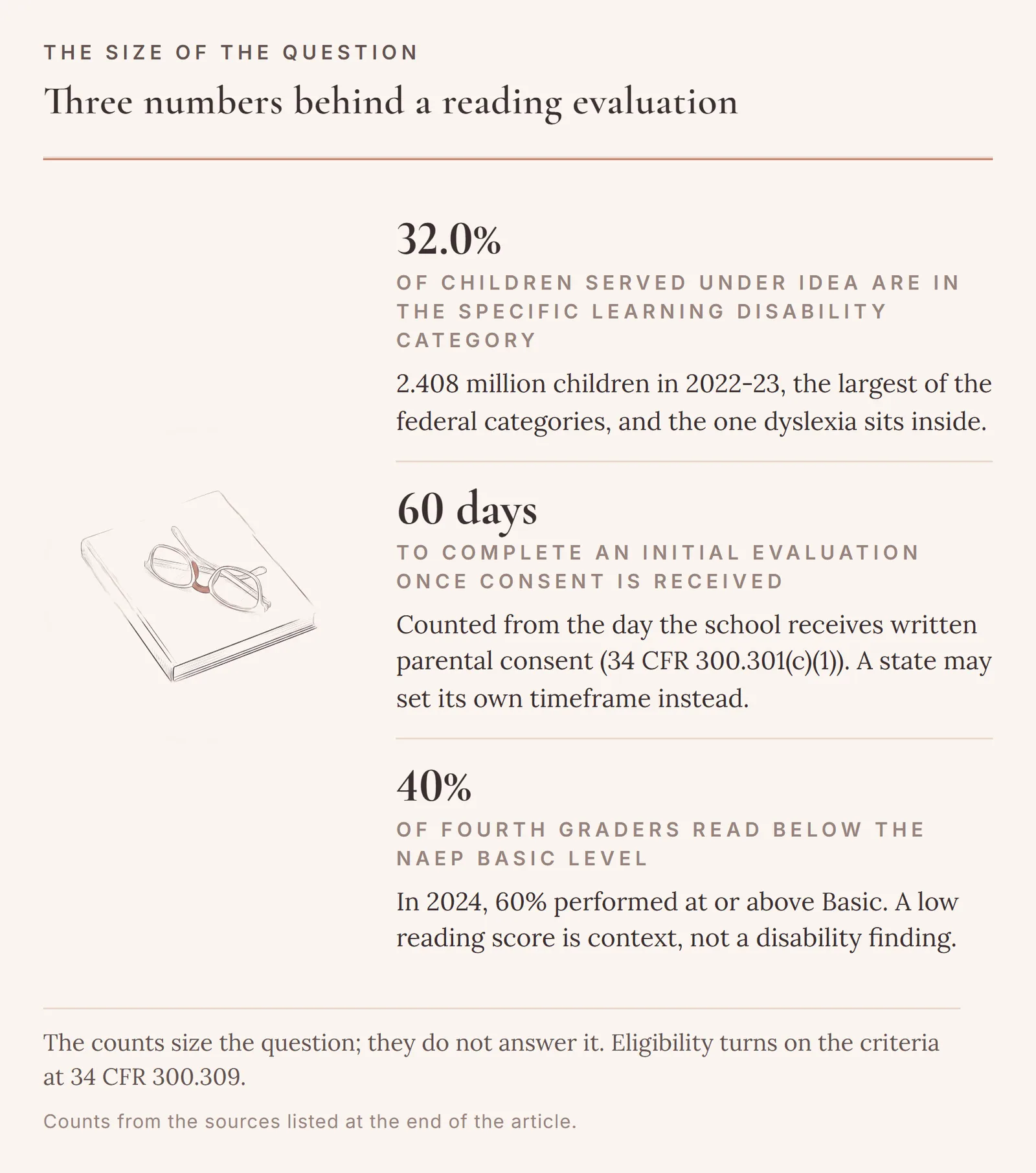
Specific learning disability is the largest disability category served under IDEA (the Individuals with Disabilities Education Act): 2.408 million children in 2022-23, 32.0% of everyone served under the law (Digest of Education Statistics 2023, Table 204.30). Dyslexia belongs to that category.
Reading difficulty by itself is common. In 2024, 60% of fourth graders performed at or above the NAEP Basic level in reading, which leaves 40% below it (NAEP 2024 reading, grade 4). A low reading score is not a disability finding. Eligibility, meaning whether a child meets the criteria for special education under IDEA, is decided at 34 CFR 300.309, not by a percentile.
What a parent can hold onto is the clock. Once the school receives written parental consent, the initial evaluation, meaning the school's own testing, observation, and record review, is completed within 60 days, or within the timeframe the state has set instead (34 CFR 300.301(c)(1)).
How the rules decide it
Where does dyslexia sit in the federal categories
Inside the definition, by name. A specific learning disability (SLD) is a disorder in one or more of the basic psychological processes involved in understanding or using spoken or written language. The regulation lists dyslexia among the conditions the term includes (34 CFR 300.8(c)(10)(i)).
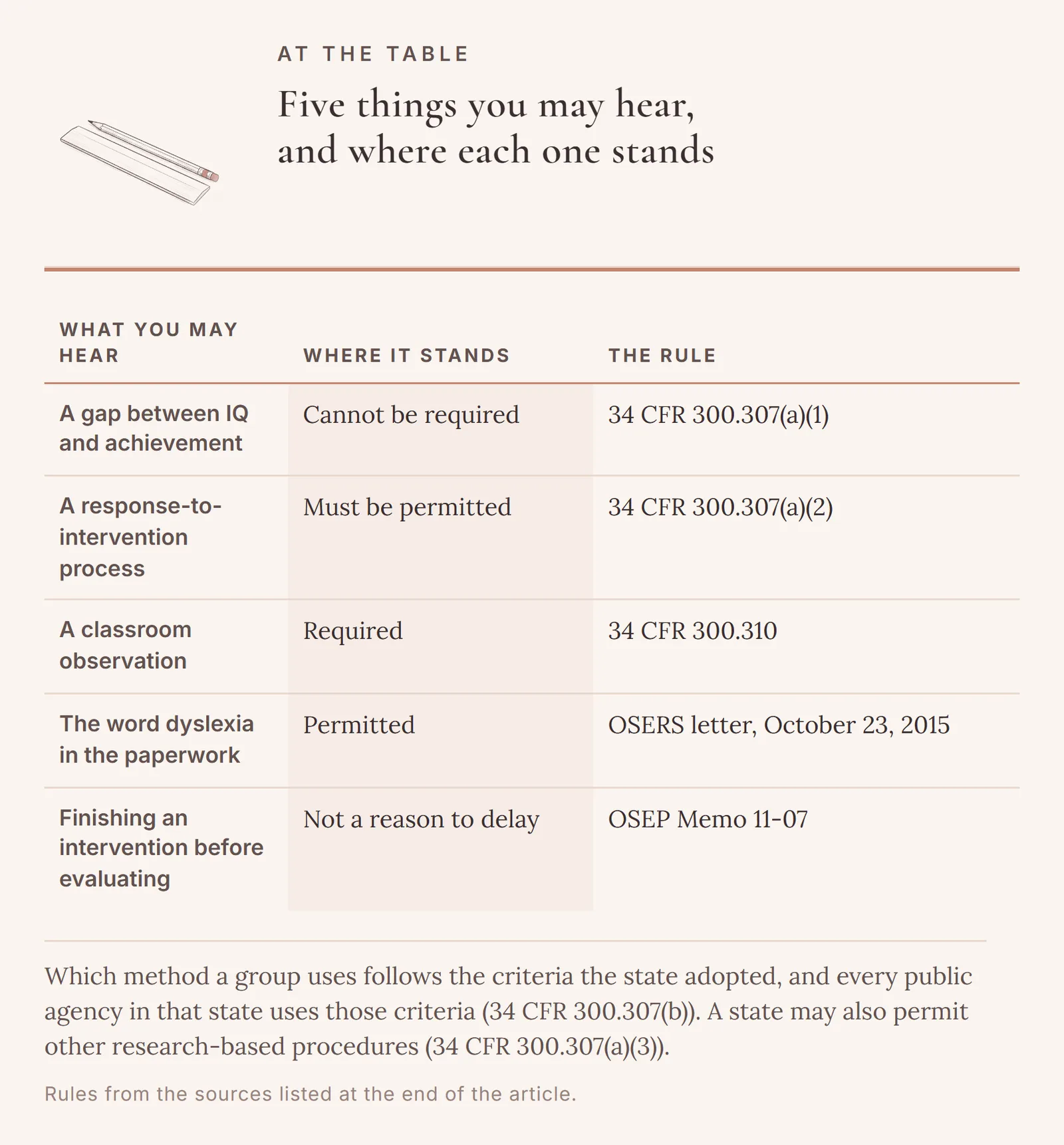
So "we do not say dyslexia here" is a local habit, not a legal limit. The Department of Education's Dear Colleague Letter of October 23, 2015 says nothing in the IDEA prohibits using the terms dyslexia, dyscalculia, and dysgraphia in IDEA evaluation, eligibility determinations, or IEP documents.
A clinical diagnosis is made by a licensed clinician outside the school. A school does something narrower: it decides whether a child meets a federal category and needs specially designed instruction, meaning instruction adapted in content, methodology, or delivery to the child's needs (34 CFR 300.39(b)(3)). The school is not asked to diagnose. It is asked to identify.
What test does the eligibility group apply
Three questions, in order, all of them at 34 CFR 300.309.
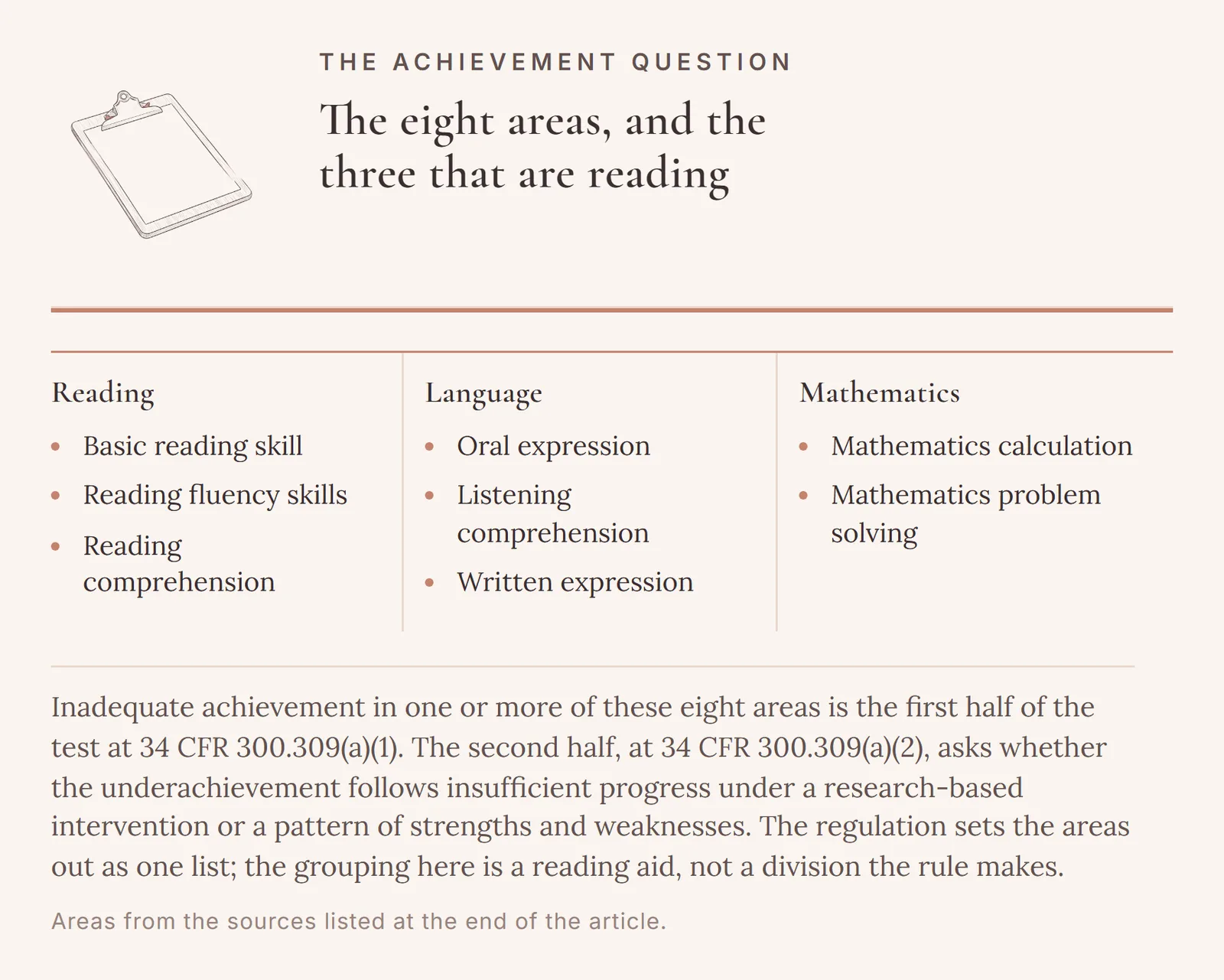
Achievement first. Does the child fail to achieve adequately for age or state-approved grade-level standards in one or more of eight named areas, given instruction appropriate for that age (34 CFR 300.309(a)(1)).
Then the reason. Does the child either fail to make sufficient progress under a scientific, research-based intervention, or show a pattern of strengths and weaknesses the group finds relevant to identifying an SLD (34 CFR 300.309(a)(2)).
Then the rule-outs. A group may not identify an SLD if the findings are primarily the result of a visual, hearing, or motor disability, an intellectual disability, emotional disturbance, cultural factors, environmental or economic disadvantage, or limited English proficiency (34 CFR 300.309(a)(3)). A companion rule adds a condition: a child must not be found eligible if the determinant factor is a lack of appropriate instruction in reading or math, or limited English proficiency, and the child does not otherwise meet the eligibility criteria (34 CFR 300.306(b)(1) and (b)(2)).
Which method do the state's criteria call for
Federal regulation sets the outer edges and the state fills them in. State criteria must not require a severe discrepancy between intellectual ability and achievement (34 CFR 300.307(a)(1)). They must permit a process based on the child's response to scientific, research-based intervention (34 CFR 300.307(a)(2)). They may permit other research-based procedures as well (34 CFR 300.307(a)(3)). Every public agency in a state uses the criteria that state adopted (34 CFR 300.307(b)).
The school must ensure the child is observed in the learning environment, including the regular classroom, and the group either uses observation information gathered before the referral or has at least one member observe after it (34 CFR 300.310(a) and (b)).
The route, step by step
Either a parent or the school district may ask for an initial evaluation (34 CFR 300.301(b)). Put the request in writing and keep the date.
- Write to the special education director and the principal. Describe what you see in reading, name the areas you want assessed, and date the letter.
- Sign consent and note the day it was received. A school obtains informed parental consent before an initial evaluation (34 CFR 300.300(a)), and the 60 days runs from that day (34 CFR 300.301(c)(1)).
- Share any private evaluation you already have. The school must consider it if it meets agency criteria (34 CFR 300.502(c)(1)), and it still runs its own.
- Expect more than one measure, and ask which of the eight areas the data speaks to. A school uses a variety of assessment tools and may not use a single measure as the sole criterion for eligibility (34 CFR 300.304(b)).
- Go to the eligibility meeting as a member of the group, not an audience to it (34 CFR 300.306(a)(1)). The school gives you the evaluation report and the documentation of the determination at no cost (34 CFR 300.306(a)(2)).
- If the answer is no, read the Prior Written Notice, the written explanation a school owes before it proposes or refuses an action. It says what was refused, why, and what the refusal rests on (34 CFR 300.503(a) and (b)).
Mistakes and edge cases
Waiting for the intervention to run its course. A tiered classroom program is not a gate. OSEP Memo 11-07, issued January 21, 2011, says a district may not reject a referral and delay an initial evaluation because a child has not participated in a response-to-intervention framework. The intervention and the evaluation can run at the same time.
Treating "not far enough behind" or "she is too bright" as criteria. Neither is one. The criteria are the three questions above, and 34 CFR 300.309 sets no intelligence threshold. A state may not make a severe discrepancy between ability and achievement the required test (34 CFR 300.307(a)(1)).
Assuming a private report settles it. A private evaluation you share has to be considered if it meets the agency's criteria (34 CFR 300.502(c)(1)), and it does not replace the school's own. If you disagree with the school's evaluation, you may ask for an independent educational evaluation at public expense (34 CFR 300.502(b)(1)), and the district then either provides it or files a due process complaint to defend its evaluation.
Every state has a free, federally funded Parent Training and Information Center, and reading an evaluation report with a parent is ordinary work for them. Find yours at parentcenterhub.org.
FAQ
Does a private dyslexia diagnosis qualify my child for an IEP?
Not on its own. A private evaluation you share must be considered if it meets the agency's criteria (34 CFR 300.502(c)(1)), and the school still conducts its own. The determination is made by a group of qualified professionals and the parent (34 CFR 300.306(a)(1)).
Can a school refuse to use the word dyslexia?
Nothing in the IDEA prohibits the word. The Department of Education's Dear Colleague Letter of October 23, 2015 says the terms dyslexia, dyscalculia, and dysgraphia may be used in IDEA evaluation, eligibility determinations, and IEP documents.
Does my child have to go through response to intervention first?
No. State criteria must permit a process based on a child's response to scientific, research-based intervention (34 CFR 300.307(a)(2)). OSEP Memo 11-07 says a district may not reject a referral and delay an evaluation because a child has not participated in such a framework.
Sources
- eCFR, 34 CFR 300.8, SLD definition (https://www.ecfr.gov/current/title-34/part-300/section-300.8)
- eCFR, 34 CFR 300.39, special education (https://www.ecfr.gov/current/title-34/part-300/section-300.39)
- eCFR, 34 CFR 300.300, parental consent (https://www.ecfr.gov/current/title-34/part-300/section-300.300)
- eCFR, 34 CFR 300.301, initial evaluation (https://www.ecfr.gov/current/title-34/part-300/section-300.301)
- eCFR, 34 CFR 300.304, evaluation procedures (https://www.ecfr.gov/current/title-34/part-300/section-300.304)
- eCFR, 34 CFR 300.306, eligibility determination (https://www.ecfr.gov/current/title-34/part-300/section-300.306)
- eCFR, 34 CFR 300.307, state SLD criteria (https://www.ecfr.gov/current/title-34/part-300/section-300.307)
- eCFR, 34 CFR 300.309, existence of an SLD (https://www.ecfr.gov/current/title-34/part-300/section-300.309)
- eCFR, 34 CFR 300.310, observation (https://www.ecfr.gov/current/title-34/part-300/section-300.310)
- eCFR, 34 CFR 300.502, independent educational evaluation (https://www.ecfr.gov/current/title-34/part-300/section-300.502)
- eCFR, 34 CFR 300.503, prior written notice (https://www.ecfr.gov/current/title-34/part-300/section-300.503)
- U.S. Department of Education, OSEP Dear Colleague Letter on IDEA and IEP terms (https://sites.ed.gov/idea/idea-files/osep-dear-colleague-letter-on-ideaiep-terms/)
- U.S. Department of Education, OSEP Memo 11-07 on response to intervention (https://sites.ed.gov/idea/idea-files/osep-memo-11-07-response-to-intervention-rti-memo/)
- National Center for Education Statistics, Digest of Education Statistics 2023, Table 204.30 (https://nces.ed.gov/programs/digest/d23/tables/dt23_204.30.asp)
- The Nation's Report Card, NAEP reading 2024, grade 4 (https://www.nationsreportcard.gov/reports/reading/2024/g4_8/national-trends/)
- Center for Parent Information and Resources, find your Parent Center (https://www.parentcenterhub.org/find-your-center/)