The short answer
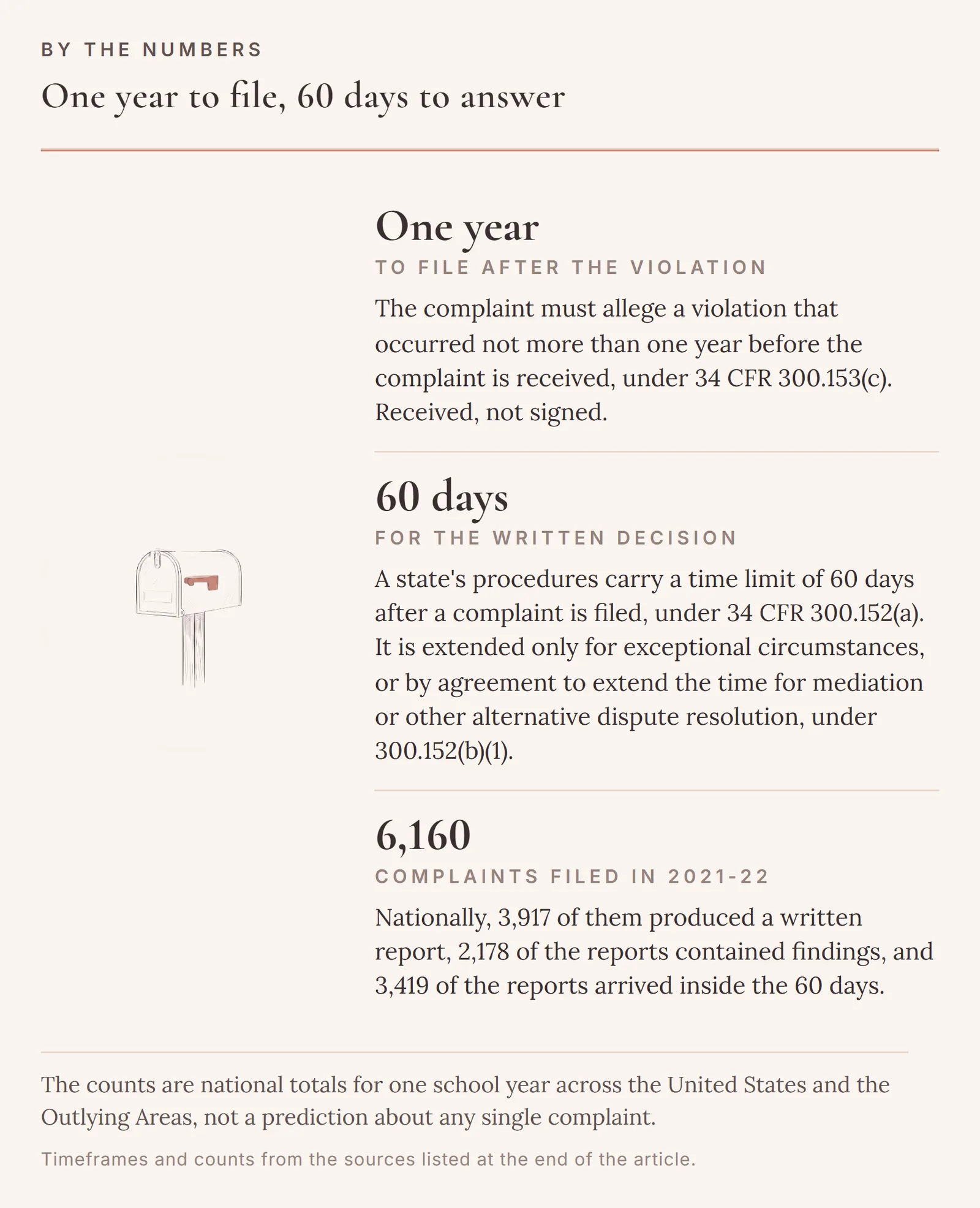
A state complaint is a signed written statement to your state education agency that a public agency, usually the school district, violated a special education requirement, with the facts behind it, filed within one year of the violation (34 CFR 300.153). The state then has 60 days to investigate and issue a written decision addressing each allegation (300.152).
The step between a closed door and a lawyer
When a school closes a subject and the conversation ends there, the only word most parents are offered next is lawyer. There is a step in between.
The regulations under the Individuals with Disabilities Education Act (IDEA), the federal special education law, require every state education agency to adopt written procedures for resolving a complaint that a public agency violated Part B (34 CFR 300.151(a)(1)). Who may use them is the surprise. An organization or individual may file a signed written complaint (34 CFR 300.153(a)). Not an attorney on your behalf. An individual, signing her own name.
Families use this route least of the three. In the 2021-22 school year, across the United States and the Outlying Areas, 6,160 written state complaints were filed against 10,806 mediation requests and 29,490 due process complaints, according to CADRE, the federally funded center for IDEA dispute resolution. Of those complaints, 3,917 produced a written report, 2,178 of the reports contained findings, and 3,419 arrived inside the 60-day timeline.
How the process works
What has to be in the complaint
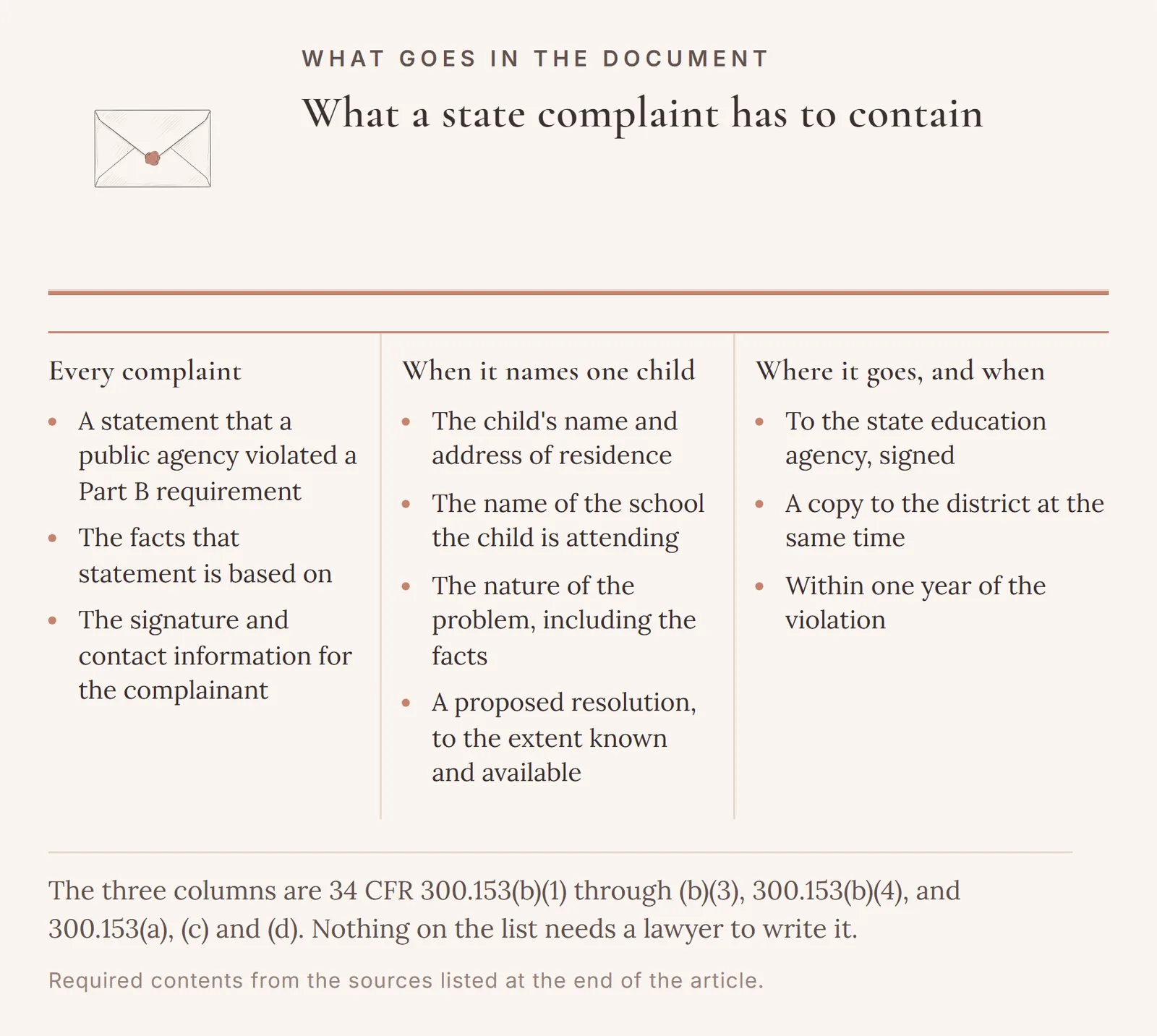
Every complaint carries a statement that a public agency violated a requirement of Part B or of the Part 300 regulations, the facts that statement is based on, and the signature and contact information for the complainant (34 CFR 300.153(b)(1) through (b)(3)).
Facts here means dates, documents, names, and what did or did not happen, off the paperwork rather than out of memory.
A complaint about one specific child adds four elements: the child's name and address of residence, the school the child is attending, a description of the nature of the problem including facts, and a proposed resolution to the extent known and available to you when you file (300.153(b)(4)). Read that last phrase twice. Not knowing what would fix the problem does not disqualify a complaint.
Two requirements sit outside the list. The violation has to have occurred not more than one year before the complaint is received (300.153(c)), so you count backward from the day it lands. And a copy goes to the district serving the child at the same time the complaint is filed with the state (300.153(d)).
What does the state have to do inside the 60 days
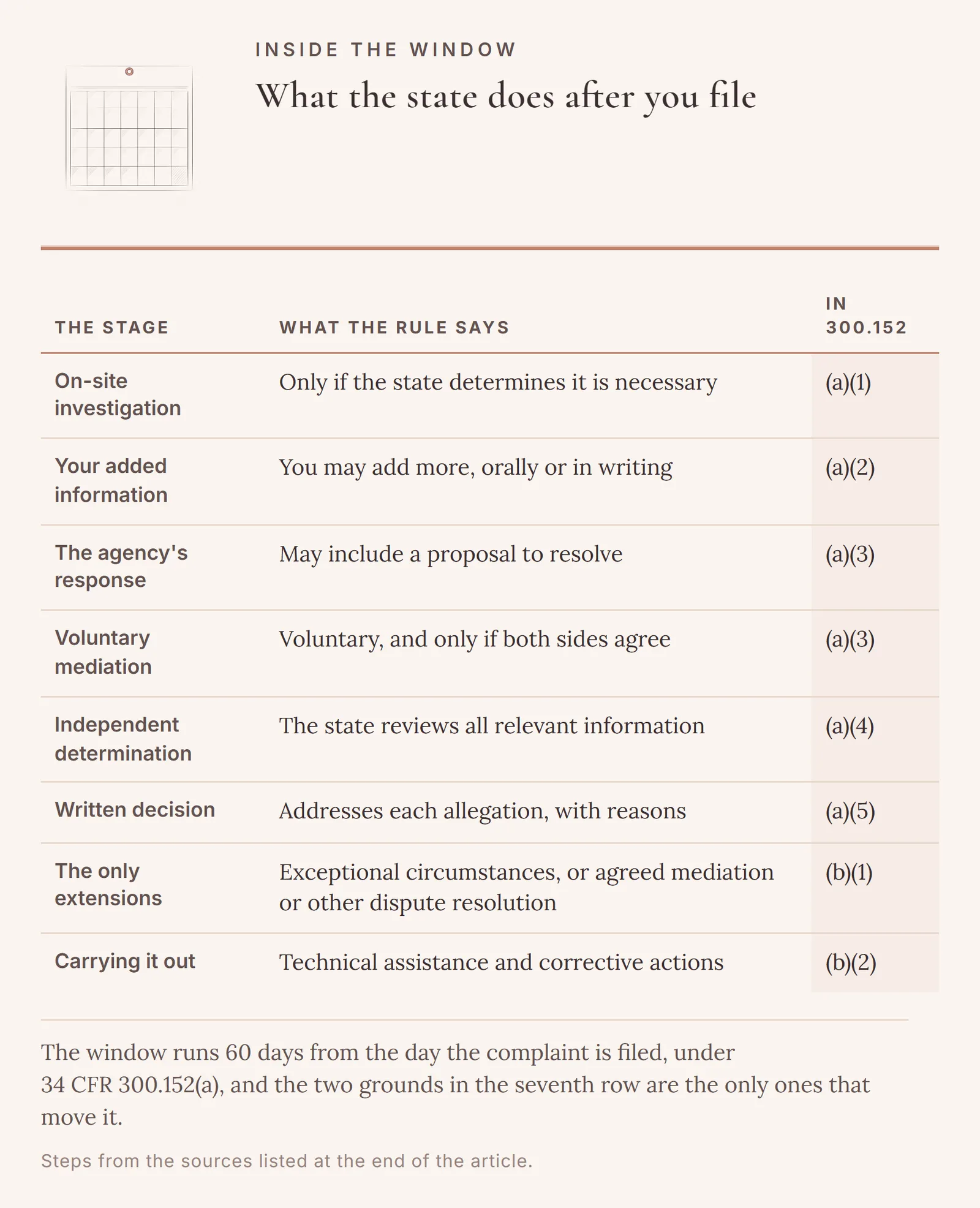
A state's procedures carry a time limit of 60 days after a complaint is filed (34 CFR 300.152(a)). Inside it, the state carries out an independent on-site investigation if it determines one is necessary (300.152(a)(1)), so a visit is the state's call. It gives the complainant an opportunity to submit additional information, orally or in writing (300.152(a)(2)). It must also give the public agency an opportunity to respond (300.152(a)(3)). A proposal to resolve the complaint sits at that agency's discretion. The opportunity for the parent and the agency to voluntarily engage in mediation is required, not discretionary (300.152(a)(3)(i)-(ii)).
Then it reviews all relevant information and makes an independent determination (300.152(a)(4)), and issues a written decision that addresses each allegation, with findings of fact, conclusions, and the reasons behind them (300.152(a)(5)).
The clock moves in two situations only: exceptional circumstances with respect to a particular complaint, or the parent and the agency agreeing to extend the time to engage in mediation or other alternative dispute resolution, where the state offers it (300.152(b)(1)). So if mediation is offered mid-window, it is fair to ask whether saying yes moves the deadline. A state's procedures must also cover implementation of the decision, including technical assistance activities, negotiations, and corrective actions (300.152(b)(2)).
What can a decision reach
Where the state finds a failure to provide appropriate services, it must address that failure, including corrective action appropriate to address the needs of the child, such as compensatory services or monetary reimbursement (34 CFR 300.151(b)(1)). Compensatory services are services that make up for services a child did not receive. The state must also address the appropriate future provision of services for all children with disabilities (300.151(b)(2)).
Two limits belong in the same breath. This route does not carry attorneys' fees, which reach only an action or proceeding brought under section 615 of IDEA (300.517(a)(1)(i)). And it does not hold a placement. Stay-put, the rule that keeps a child where she is while a case is pending, attaches to a due process complaint instead (300.518(a)). That route reaches back two years (300.507(a)(2)). A complaint there opens a 30-day resolution period, the window for settling before a hearing (300.510), and the 45-day clock for the decision starts when it closes (300.515(a)).
How a complaint gets built, step by step
- Check the date. The violation has to fall inside one year of the day the complaint is received (300.153(c)).
- Pull the paperwork: meeting notices, the current Individualized Education Program (IEP), progress reports, evaluation reports, emails.
- Build a dated list from those documents. One entry per event, with the date, what happened, and the document that shows it.
- Separate the grievance into allegations, each naming one requirement that was not met. The decision has to address each allegation (300.152(a)(5)), so three clear ones get answered three times. I think this is the highest-value hour in the process, and it is the one most people skip.
- Decide what you are asking for, to the extent you know it (300.153(b)(4)).
- Write it out with the elements the regulation lists, put each allegation's facts under it, and sign it.
- Take the office name, mailing address, and accepted channel from your own state agency's current dispute resolution page. Channels differ by state.
- Send both copies the same day (300.153(d)) and write down the date. Then the 60 days begin, and you may still add information about your allegations (300.152(a)(2)).
Mistakes and edge cases
Counting from the day you sign. 300.153(c) runs to the date the complaint is received, not the date on the letter. Mail time sits inside the year.
Saying yes to mediation without asking about the clock. Mediation is voluntary and often useful. Agreeing to it, or to other alternative dispute resolution, is one of the two grounds that can extend the 60 days, the other being exceptional circumstances (300.152(b)(1)).
Every state has a free, federally funded Parent Training and Information Center, and telling a parent which form her state uses and where filings go is ordinary work for them. Find yours at parentcenterhub.org.
FAQ
Do I need a lawyer to file a state complaint?
No. An organization or individual may file a signed written complaint (34 CFR 300.153(a)). A state complaint is also not a proceeding that carries attorneys' fees (300.517(a)(1)(i)).
How long does it take?
A state's procedures carry a 60-day limit from the day the complaint is filed (300.152(a)), extended only for exceptional circumstances or by agreement to extend the time for mediation (300.152(b)(1)).
What if the problem started more than a year ago?
The complaint has to allege a violation that occurred not more than one year before it is received (300.153(c)). A due process complaint reaches back two years from when the parent knew or should have known about the action, unless the State has an explicit time limitation of its own (300.507(a)(2)). Your state's own procedures are where to check how the limit applies to your dates.
Sources
- Legal Information Institute, 34 CFR 300.151, State complaint procedures and remedies (https://www.law.cornell.edu/cfr/text/34/300.151)
- Legal Information Institute, 34 CFR 300.152, minimum State complaint procedures and the 60-day limit (https://www.law.cornell.edu/cfr/text/34/300.152)
- Legal Information Institute, 34 CFR 300.153, filing a State complaint (https://www.law.cornell.edu/cfr/text/34/300.153)
- Legal Information Institute, 34 CFR 300.507, filing a due process complaint (https://www.law.cornell.edu/cfr/text/34/300.507)
- Legal Information Institute, 34 CFR 300.510, the resolution process (https://www.law.cornell.edu/cfr/text/34/300.510)
- Legal Information Institute, 34 CFR 300.515, timelines for a due process hearing decision (https://www.law.cornell.edu/cfr/text/34/300.515)
- Legal Information Institute, 34 CFR 300.517, attorneys' fees (https://www.law.cornell.edu/cfr/text/34/300.517)
- Legal Information Institute, 34 CFR 300.518, the child's status during proceedings (https://www.law.cornell.edu/cfr/text/34/300.518)
- CADRE, IDEA Dispute Resolution Data Summary for U.S. and Outlying Areas, 2011-12 to 2021-2022, counts for state complaints, mediation, and due process (https://www.cadreworks.org/sites/default/files/resources/2023%20National%20Data%20Summary%20FINAL%20-%20Accessible.pdf)
- Center for Parent Information and Resources, find your state's Parent Training and Information Center (https://www.parentcenterhub.org/find-your-center/)