The short answer
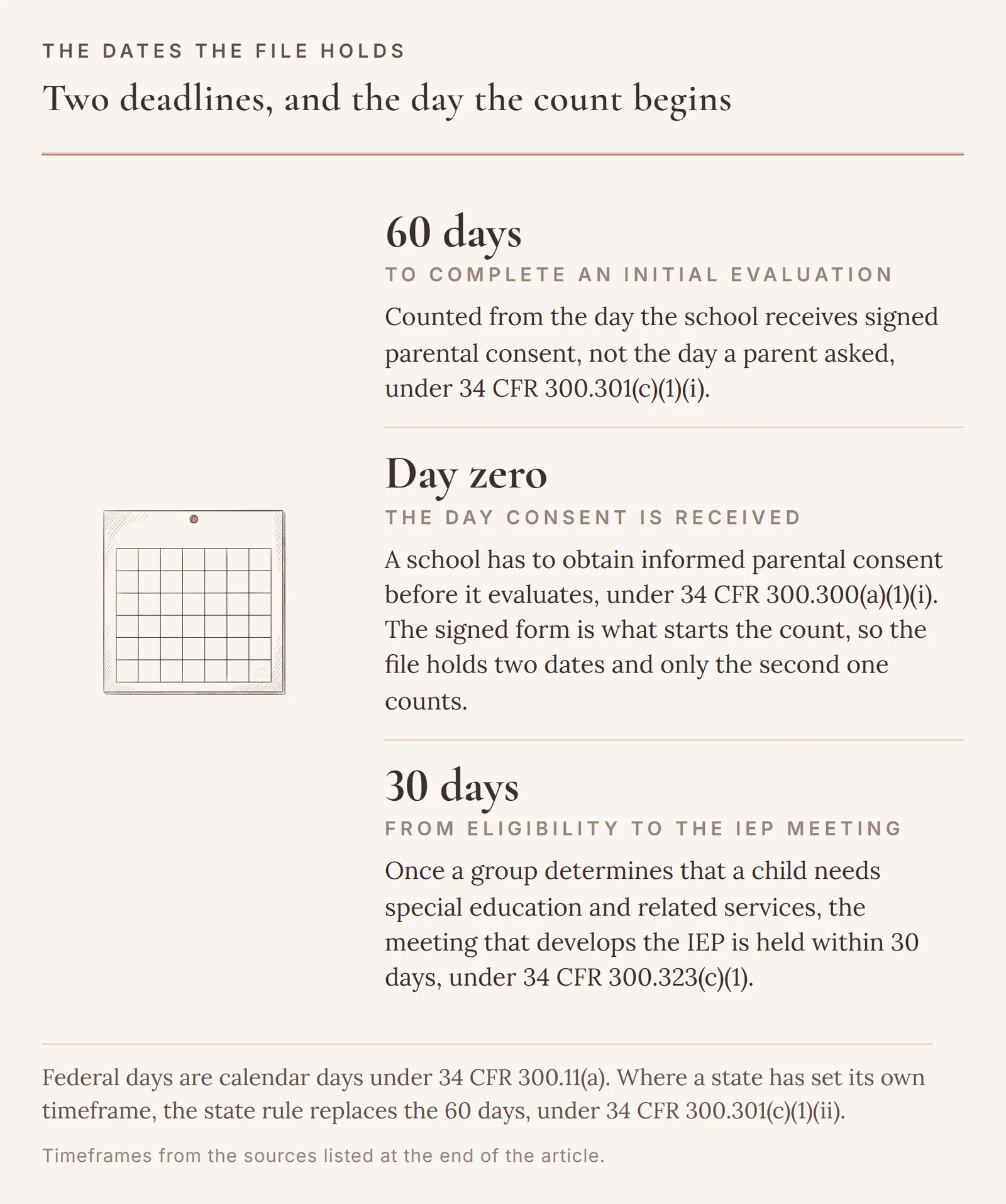
Under the federal rules the school has 60 calendar days to complete an initial evaluation, counted from the day it receives your signed parental consent, not from the day you asked (34 CFR 300.301(c)(1)(i)). If your state has set its own timeframe, that state rule replaces the 60 days. Two narrow exceptions apply (34 CFR 300.301(d)).
Why the date matters
An evaluation is the door to everything else: no eligibility decision, no Individualized Education Program (IEP), and no services until it is finished. In school year 2022-23, 7.5 million students ages 3 through 21, about 15 percent of all public school students, received special education or related services under the Individuals with Disabilities Education Act (IDEA), according to the National Center for Education Statistics.
Once a group determines that a child needs special education and related services, the school has 30 days to hold the meeting that develops the IEP (34 CFR 300.323(c)(1)). The evaluation window is the longer stretch, and the one parents most often miscount, because the date they remember is the date they asked. That is not the date the law counts.
How the deadline actually works
When does the clock start
It starts when the school receives parental consent, not when the request goes in. The federal rule says the initial evaluation must be conducted "within 60 days of receiving parental consent for the evaluation" (34 CFR 300.301(c)(1)(i)), and the statute reads the same way (20 U.S.C. 1414(a)(1)(C)(i)(I)). A school proposing an initial evaluation has to obtain informed parental consent before it evaluates (34 CFR 300.300(a)(1)(i)). So every file holds two dates: the day the request went in writing, and the day the signed consent form came back. Only the second starts the count.
Consent to evaluate is only consent to evaluate. The regulation says so plainly: parental consent for an initial evaluation "must not be construed as consent for initial provision of special education and related services" (34 CFR 300.300(a)(1)(ii)). Services take their own separate consent later (34 CFR 300.300(b)).
Is it calendar days or school days
Federally, calendar days. Weekends count, holidays count, spring break counts. When Part 300 says "day" without qualifying it, it means calendar day (34 CFR 300.11(a)). That baseline is exactly what a state rule may change.
Does my state's own timeframe replace the 60 days
Yes, and this is the part to settle before counting anything. The regulation is explicit: if the State establishes a timeframe within which the evaluation must be conducted, the evaluation happens within that timeframe instead (34 CFR 300.301(c)(1)(ii)). Many states have set one. Some are shorter. Some are written in school days rather than calendar days, which stretches the real deadline across every break on the calendar. Several start counting at the written request or at referral rather than at consent. Wherever a state has set a timeframe, the state rule controls.
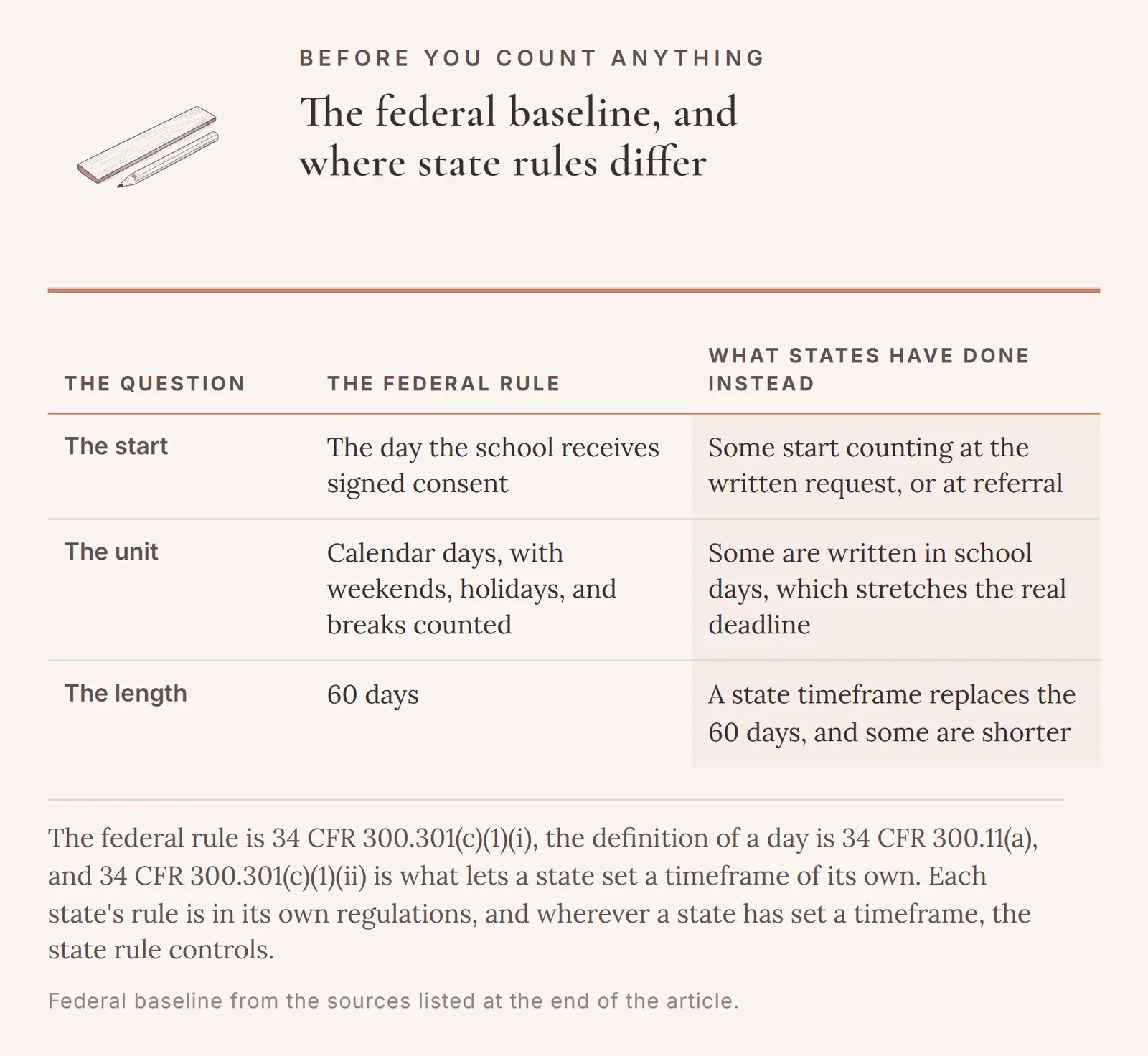
I am not printing state numbers in an article, because a number that is right in one state is wrong one border over. Three places give you yours: your state education agency's special education regulations, which are the source; the procedural safeguards notice your district must hand you (34 CFR 300.504(a)), which usually states the timeline in plain language; and your state's Parent Training and Information Center, which will look it up with you for free.
What stops the clock
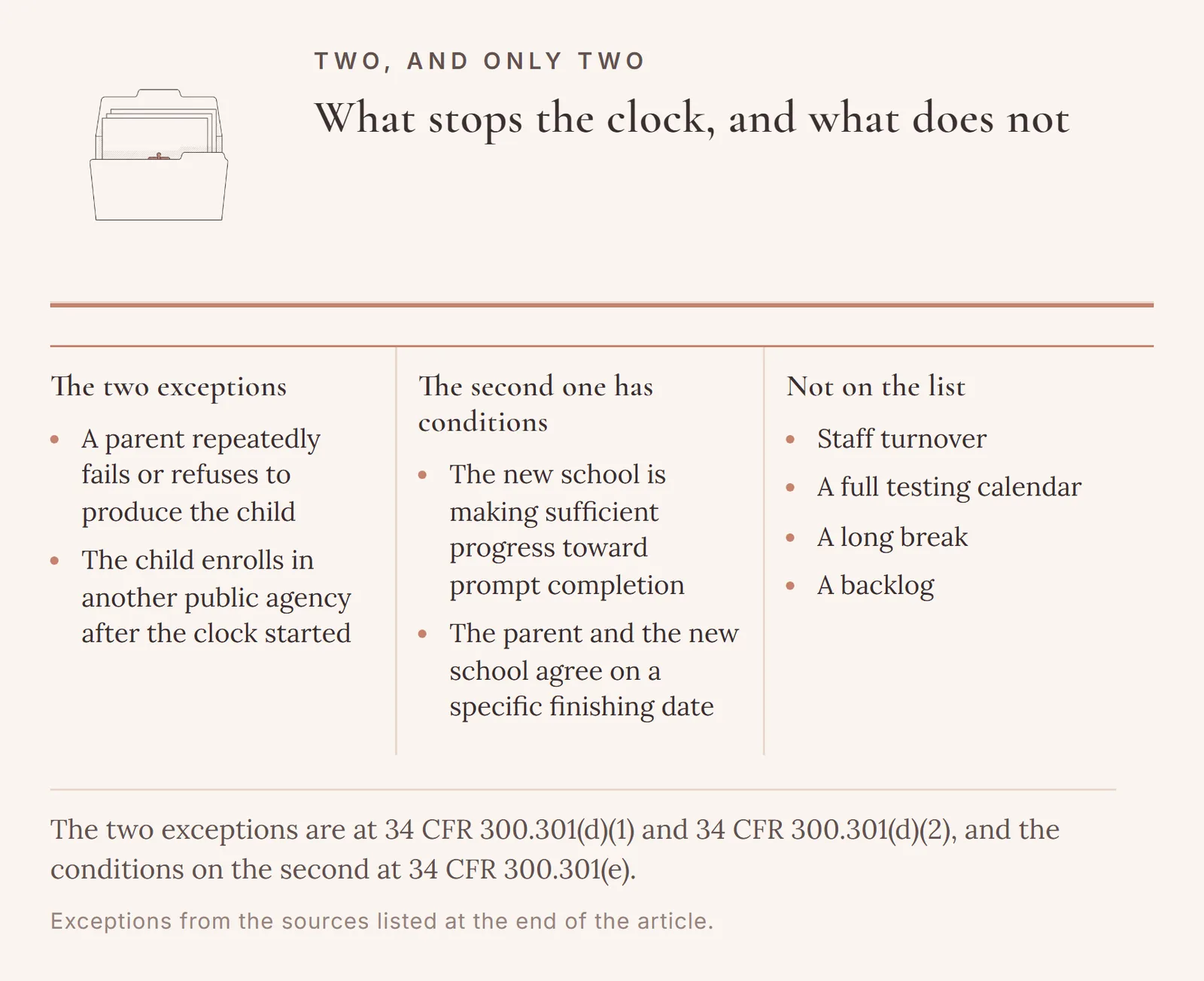
Two things, and only two. The timeframe does not apply if the parent repeatedly fails or refuses to produce the child for the evaluation (34 CFR 300.301(d)(1)), or if the child enrolls in a school of another public agency after the clock has started and before the previous agency decided eligibility (34 CFR 300.301(d)(2)). The second is conditional: it holds only if the new school is making sufficient progress toward prompt completion and the parent and the new school agree on a specific finishing date (34 CFR 300.301(e)).
Staff turnover, a full testing calendar, a long break, and a backlog are not on that list.
Step by step
- Put the request in writing and date it. Either a parent or the school may start an initial evaluation (34 CFR 300.301(b)). Email is fine and timestamps itself. Describe what has been observed, request a full initial evaluation, and ask for a written response.
- Keep the proof. Save the sent message, or mail it certified with return receipt. Record the date the school received it, even though that is not day zero.
- Watch for the answer. A school that proposes or refuses to evaluate must give prior written notice, and the rule spells out what it has to contain (34 CFR 300.503). If the answer is yes, a consent form usually comes with it.
- Sign, date, and log the day the school receives it. That day is day zero (34 CFR 300.301(c)(1)(i)). Hand it in and ask for a date stamp, or return it by email so the timestamp is yours too.
- Look up the state timeframe before counting. Write down the rule and where you found it.
- Put the deadline on the calendar. Calendar days from consent, unless the state rule says otherwise.
- Check in at the halfway mark. A short, friendly email asking whether testing is scheduled and whether the eligibility meeting is on the calendar surfaces problems early.
- If the date passes, ask in writing. Ask for the completion date and the meeting date. A refusal to evaluate triggers prior written notice (34 CFR 300.503). If it stays unresolved, the procedural safeguards notice lists the formal options: a state complaint, mediation, and a due process hearing.
Mistakes and edge cases
Counting from the request. The most common error by a distance, and it makes the deadline look earlier than it is.
Assuming school days. The federal count is calendar days, and it keeps running through July (34 CFR 300.11(a)). A state timeframe written in school days often does not. Same request, two different answers, depending on where the family lives.
Waiting out another intervention cycle. A district may want to run more classroom support first, often called response to intervention (RTI). The Department of Education's Office of Special Education Programs addressed that directly: an RTI process cannot be used to delay or deny an evaluation for a child suspected of having a disability (OSEP Memorandum 11-07, January 21, 2011).
FAQ
The school never sent a consent form. Is the clock running?
No. The federal timeframe runs from receipt of consent (34 CFR 300.301(c)(1)(i)), so no consent means no federal clock. What the school does owe is an answer: prior written notice when it proposes or refuses to evaluate (34 CFR 300.503). A written follow-up asking for the consent form or the written refusal is the ordinary next step.
Does signing the consent mean agreeing to special education?
No. Consent for an initial evaluation "must not be construed as consent for initial provision of special education and related services" (34 CFR 300.300(a)(1)(ii)). Services require separate consent after eligibility is decided (34 CFR 300.300(b)).
Does meeting the deadline mean the child qualifies?
No. The timeframe governs when the evaluation is completed, not what it finds. The evaluation determines whether the child is a child with a disability under IDEA and what the educational needs are (34 CFR 300.301(c)(2)). Eligibility is decided separately, afterward.
Where can a parent find the state timeframe without paying anyone?
Every state and territory has a free, federally funded Parent Training and Information Center, listed at parentcenterhub.org. Naming the state's evaluation timeline and where it is written is squarely the kind of question they exist for. The district's procedural safeguards notice and the state education agency's regulations are the other two places to look.
Sources
- Electronic Code of Federal Regulations, 34 CFR 300.301, initial evaluations and the 60-day timeframe (https://www.ecfr.gov/current/title-34/section-300.301)
- Electronic Code of Federal Regulations, 34 CFR 300.300, parental consent (https://www.ecfr.gov/current/title-34/section-300.300)
- Electronic Code of Federal Regulations, 34 CFR 300.11, definitions of day and school day (https://www.ecfr.gov/current/title-34/section-300.11)
- Electronic Code of Federal Regulations, 34 CFR 300.503, prior written notice (https://www.ecfr.gov/current/title-34/section-300.503)
- Electronic Code of Federal Regulations, 34 CFR 300.504, procedural safeguards notice and when the district must provide it (https://www.ecfr.gov/current/title-34/section-300.504)
- Electronic Code of Federal Regulations, 34 CFR 300.323, the 30-day IEP meeting deadline (https://www.ecfr.gov/current/title-34/section-300.323)
- Legal Information Institute, 20 U.S.C. 1414(a)(1)(C), the statutory evaluation timeframe (https://www.law.cornell.edu/uscode/text/20/1414)
- National Center for Education Statistics, Students With Disabilities, 2022-23 figures (https://nces.ed.gov/programs/coe/indicator/cgg/students-with-disabilities)
- U.S. Department of Education, OSEP Memorandum 11-07, response to intervention and evaluation timelines (https://sites.ed.gov/idea/files/osep11-07rtimemo.pdf)
- Center for Parent Information and Resources, directory of state Parent Training and Information Centers (https://www.parentcenterhub.org/find-your-center/)