The short answer
School personnel may remove a child with an IEP (Individualized Education Program) for up to 10 consecutive school days for a conduct violation, the same as any other student (34 CFR 300.530(b)(1)). Past 10 cumulative school days in a year, services must continue, and a longer or patterned removal is a change of placement.
What the count decides
A suspension notice tells you about one incident. The running count tells you where your child stands. Nearly every protection in the discipline rules attaches to a number of school days.
The scale is not small. In the 2013-14 federal civil rights data, students with disabilities were approximately 12 percent of public school students and approximately 25 percent of those who received an out-of-school suspension (GAO-18-258, March 2018).
The count runs higher than parents expect, because a school day is any day, including a partial day, that children are in attendance for instructional purposes (34 CFR 300.11(c)). The morning that ended with a phone call at 10:40 was a removal on a school day.
How the ten-day rules work
What changes at ten days
Two ten-day counts sit inside the rules, and they do different jobs.
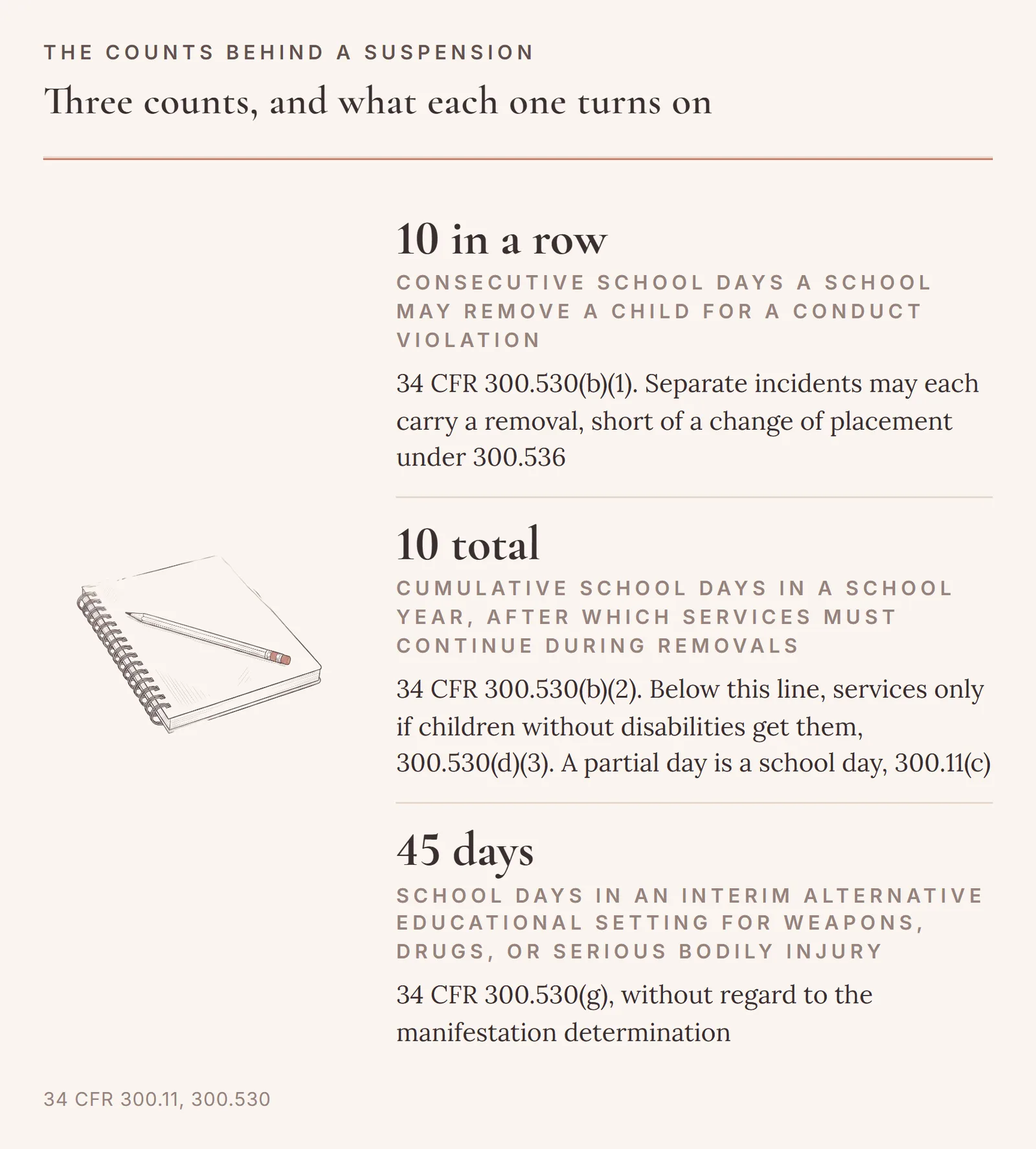
The first is consecutive. School personnel may remove a child with a disability for not more than 10 consecutive school days for a code-of-conduct violation, to the extent the same is done with children without disabilities (34 CFR 300.530(b)(1)). Separate incidents can each carry their own removal, short of a change of placement. An IEP is not a shield against suspension.
The second is cumulative. After a child has been removed for 10 school days in the same school year, the school must provide services during any later day of removal (34 CFR 300.530(b)(2)). Below that line, services are required only if children without disabilities who are similarly removed get them (34 CFR 300.530(d)(3)).
One rule sits outside both counts. For a weapon, illegal drugs, the sale of a controlled substance, or serious bodily injury inflicted on another person at school, on school premises, or at a school function, school personnel may remove a child for not more than 45 school days (34 CFR 300.530(g)). The child goes to an interim alternative educational setting, a temporary placement where services continue, whatever the manifestation question decides. Each of those terms carries a narrow federal definition.
What makes a removal a change of placement
A disciplinary change of placement is the door everything else comes through, and 34 CFR 300.536(a) describes two ways to reach it.
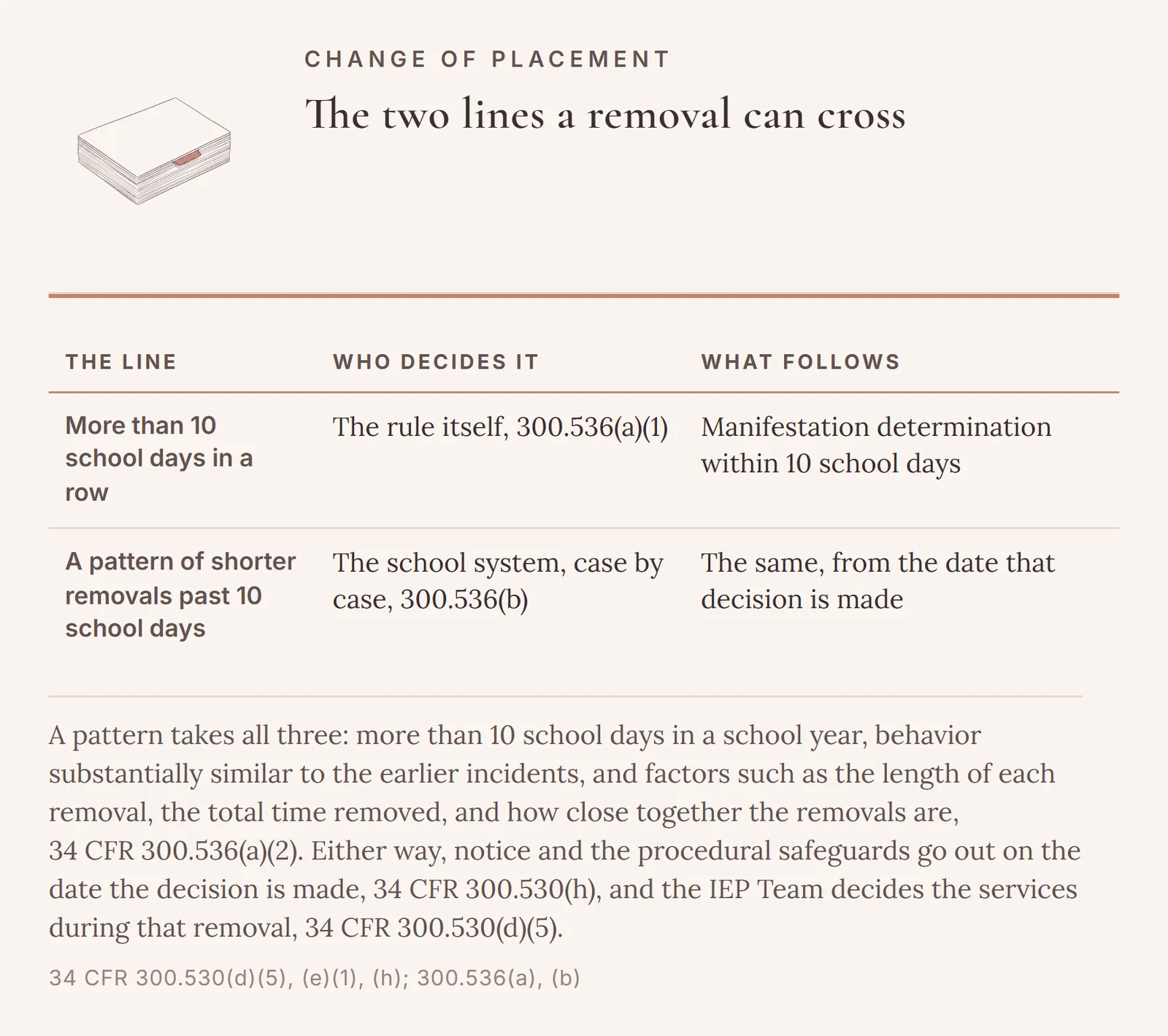
One is length. A removal for more than 10 consecutive school days is a change of placement (34 CFR 300.536(a)(1)).
The other is pattern. A series of shorter removals counts when three things are true: the series totals more than 10 school days in a school year, the behavior is substantially similar to the earlier incidents, and factors such as the length of each removal, the total time removed, and how close together they are support it (34 CFR 300.536(a)(2)).
Two duties attach once a removal is a change of placement. On the date the decision is made, the school must notify the parents and give them the procedural safeguards notice, the written summary of parent rights, 34 CFR 300.530(h). And the child's IEP Team, not school personnel alone, decides the services during it, 34 CFR 300.530(d)(5).
Popular coverage compresses this into one sentence: reach day 10 and the school must hold the manifestation meeting. The rule is narrower. The school system decides, case by case, whether a pattern of removals is a change of placement, and that decision is open to review through due process and the courts (34 CFR 300.536(b)). What day 10 turns on by itself is the services obligation.
What follows the manifestation determination
Within 10 school days of a decision to change placement, the school, the parent, and relevant members of the IEP Team review the file: the IEP, teacher observations, and information the parents provide (34 CFR 300.530(e)(1)). That review is the manifestation determination, and it asks two questions.
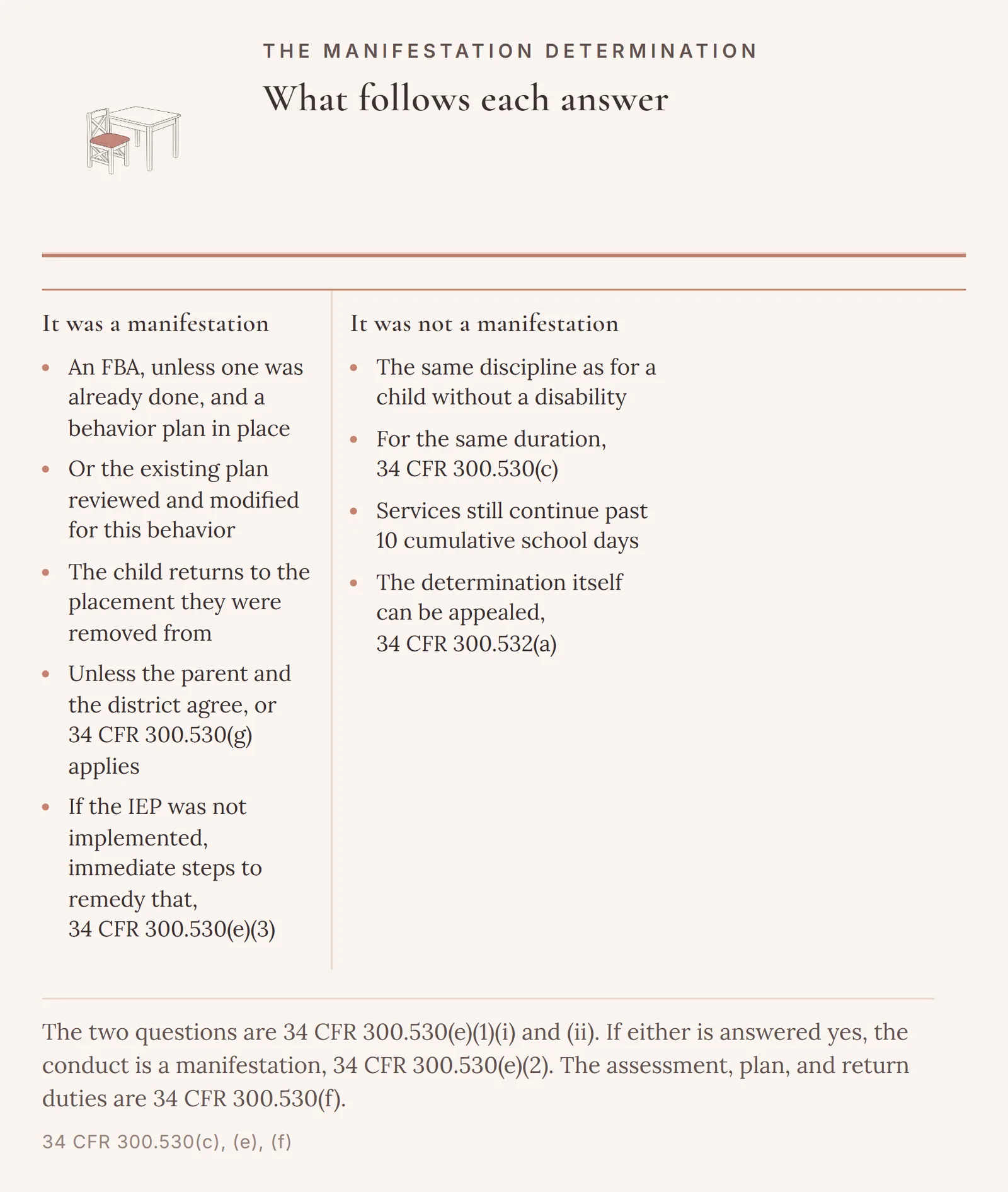
Was the conduct caused by, or did it have a direct and substantial relationship to, the child's disability. Was it the direct result of the school's failure to implement the IEP. Both come from 34 CFR 300.530(e)(1)(i)-(ii), and if either answer is yes, the conduct is a manifestation (34 CFR 300.530(e)(2)).
A yes on the second question carries its own duty: the school must take immediate steps to remedy the deficiencies (34 CFR 300.530(e)(3)). A manifestation finding also reopens the behavior plan. The team conducts a functional behavioral assessment (an FBA, the study of what a behavior is doing for a child) unless one was already done, and puts a behavior intervention plan in place, or reviews and modifies the one that exists (34 CFR 300.530(f)).
If the conduct was not a manifestation, school personnel may apply the same disciplinary procedures, for the same duration, as they would for a child without a disability (34 CFR 300.530(c)).
How to keep the count yourself
I think the running total is the most useful thing a parent keeps in a behavior year, because every later conversation runs on it.
- Write down every removal the day it happens, while you still remember how the call went.
- Keep your own running total, since a removal nobody wrote up will not be in the school's count.
- Ask in writing how a partial day counts toward the ten (34 CFR 300.11(c)).
- Compare your total against the school's discipline record.
- Past 10, ask in writing what services are provided during removals, and who decided them (34 CFR 300.530(d)(4)-(d)(5)).
- If the removals start to look alike, ask what the district concluded on the pattern question at 34 CFR 300.536(a)(2).
Mistakes and edge cases
Counting only what the school coded as a suspension. Federal guidance calls an exclusion for part or all of a day, imposed for behavior without the disciplinary procedures, an informal removal, and says it carries the same requirements as a formal one (OSEP discipline guidance, July 2022). An administratively shortened school day is the named example.
Assuming a shortened day or a morning in the office never counts. The same guidance asks three things about repeated informal removals: whether the child can still participate appropriately in the general curriculum, still receives the services on the IEP, and still participates with nondisabled children as the placement calls for. Unless all three are true, those removals generally count as disciplinary removals from the current placement (OSEP discipline guidance, question C-6). All three, not two.
Reading the federal rule as the whole rule. States add a layer, and some of it is more protective. Minnesota bars disciplinary dismissals in preschool through grade 3, with narrow exceptions (Minn. Stat. 121A.425). Section 504 has its own rule: a child with a 504 plan and no IEP is owed an evaluation before a long exclusion, which the Office for Civil Rights reads as a significant change in placement (34 CFR 104.35(a), OCR discipline guidance, July 2022).
Every state has a free, federally funded Parent Training and Information Center, and sitting with a parent over a removal count is ordinary work for them. Find yours at parentcenterhub.org.
FAQ
Does the ten-day count start over each school year?
It runs by school year. Services attach after 10 school days of removal in the same school year (34 CFR 300.530(b)(2)), and the pattern question at 34 CFR 300.536(a)(2) looks at one year too.
What if we disagree with the manifestation determination?
A parent may request a due process hearing, and it is expedited: the hearing must occur within 20 school days of the date the complaint is filed, and the hearing officer must decide within 10 school days after it (34 CFR 300.532(a), (c)(2)).
What happens if the behavior was not a manifestation?
School personnel may apply the same procedures, for the same duration, as for a child without a disability (34 CFR 300.530(c)). What does not stop is instruction: past 10 cumulative school days, services continue (34 CFR 300.530(b)(2)).
Sources
- eCFR, 34 CFR 300.530, school discipline (https://www.ecfr.gov/current/title-34/subtitle-B/chapter-III/part-300/subpart-E/section-300.530)
- eCFR, 34 CFR 300.536, change of placement (https://www.ecfr.gov/current/title-34/subtitle-B/chapter-III/part-300/subpart-E/section-300.536)
- eCFR, 34 CFR 300.11, school day (https://www.ecfr.gov/current/title-34/subtitle-B/chapter-III/part-300/subpart-A/section-300.11)
- eCFR, 34 CFR 300.532, expedited appeal (https://www.ecfr.gov/current/title-34/subtitle-B/chapter-III/part-300/subpart-E/section-300.532)
- eCFR, 34 CFR 104.35, Section 504 evaluation (https://www.ecfr.gov/current/title-34/subtitle-B/chapter-I/part-104/subpart-D/section-104.35)
- U.S. Department of Education, OSEP discipline Q and A (2022) (https://sites.ed.gov/idea/files/qa-addressing-the-needs-of-children-with-disabilities-and-idea-discipline-provisions.pdf)
- Office for Civil Rights, Section 504 discipline guidance (2022) (https://www.ed.gov/media/document/504-discipline-guidance-2022-21258.pdf)
- U.S. Government Accountability Office, GAO-18-258 (https://www.gao.gov/products/gao-18-258)
- Minnesota Revisor of Statutes, Minn. Stat. 121A.425 (https://www.revisor.mn.gov/statutes/cite/121A.425)
- Center for Parent Information and Resources, Parent Training and Information Centers (https://www.parentcenterhub.org/find-your-center/)