The short answer
No federal rule names a one-on-one aide. It is one form of supplementary aids and services. Ask in writing. When the team decides a child needs it, the Individualized Education Program (IEP) must state the support with its start date, frequency, location, and duration (34 CFR 300.42, 300.320(a)(4), (a)(7)). A refusal comes in writing with its reasons (300.503(a)(2), (b)(2)).
What you are actually asking for
Someone said it to you first: ask for a one-on-one. Then you look for the rule that says your child can have one, and there is none: no paragraph of the federal special education regulations names a one-on-one aide.
What the regulations name is the category. Supplementary aids and services are aids, services, and other supports provided in regular classes and other school settings, so a child can be educated with nondisabled children to the maximum extent appropriate (34 CFR 300.42). An adult assigned to one child is one of those other supports. State rules allow paraprofessionals who are appropriately trained and supervised to assist in providing special education and related services (34 CFR 300.156(b)(2)(iii)).
So you are asking about a support, not a job title. Whether a district must provide and pay for a paraprofessional is decided case by case by the student's IEP Team, the Office of Special Education Programs wrote in a 2013 letter about a transition-age student. Guidance, not a regulation.
The staffing picture is real, and it is not the decision. The Bureau of Labor Statistics counted 1,463,000 teacher assistant jobs in 2025 and projects a 0 percent change through 2035. That is every teacher assistant in every setting, not a count of special education aides.
How the team decides
What does the team weigh before it decides
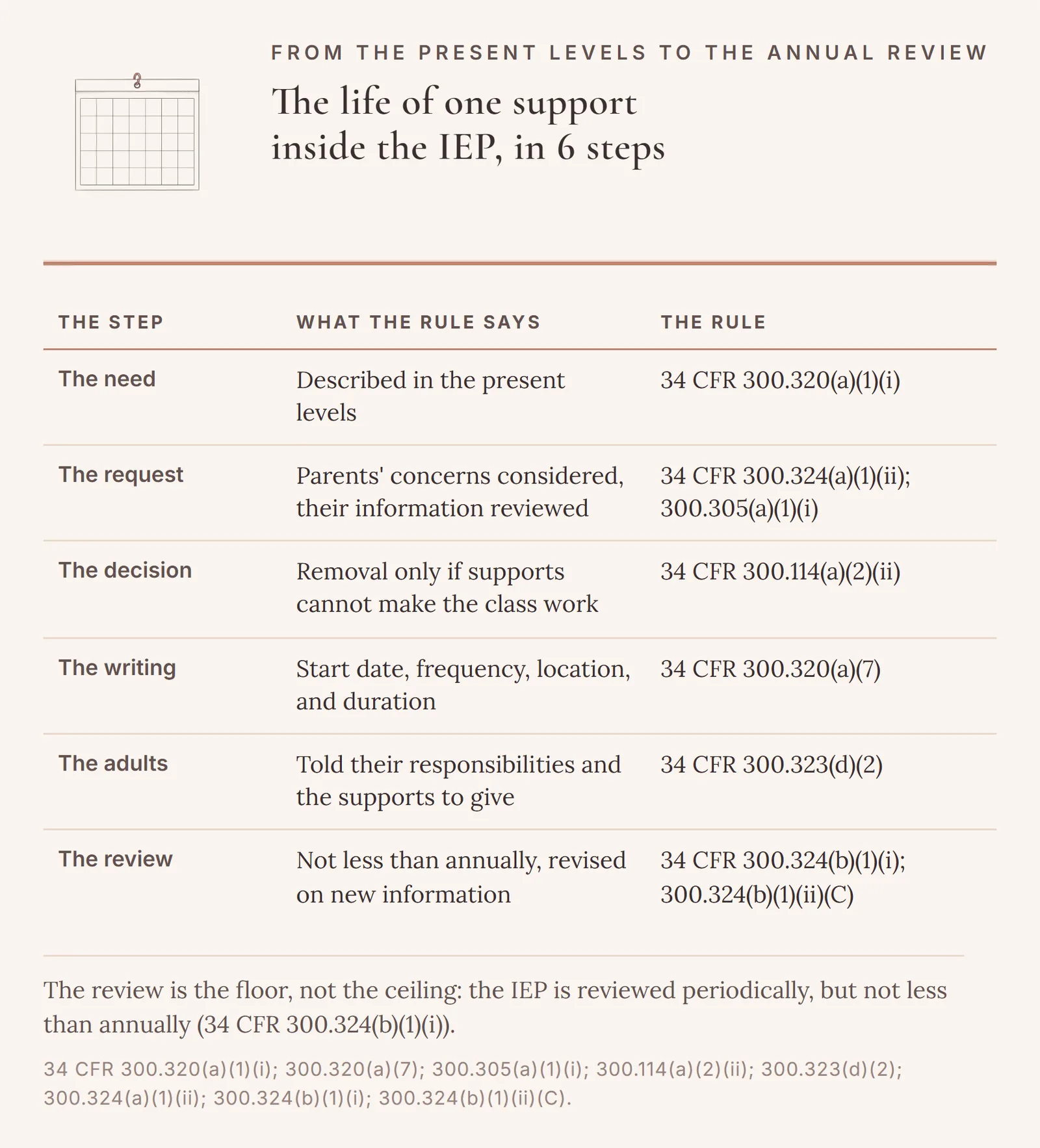
The need is written in the present levels, the part of the IEP that says where your child is now in academic achievement and functional performance, including how the disability affects progress in the general education curriculum (34 CFR 300.320(a)(1), 300.320(a)(1)(i)).
The team must consider the parents' concerns for enhancing their child's education (34 CFR 300.324(a)(1)(ii)), and a review of existing evaluation data includes information provided by the parents (34 CFR 300.305(a)(1)(i)). Your dated notes are that information.
Where behavior impedes learning, the team also considers positive behavioral interventions and supports (34 CFR 300.324(a)(2)(i)).
Underneath sits the regular class question. Removal from the regular educational environment occurs only if the nature or severity of the disability is such that education in regular classes with the use of supplementary aids and services cannot be achieved satisfactorily (34 CFR 300.114(a)(2)(ii)). That is the least restrictive environment rule, or LRE. An aide is not a room: placement is based on the child's IEP (34 CFR 300.116(b)(2)), and parents are part of any group that decides it (34 CFR 300.327).
One state has written the questions down. Before recommending a one-to-one aide, New York's committees must consider nine factors, among them the skills that would reduce the need, other supports, staff ratios, and any potential harmful effect (8 NYCRR 200.4(d)(3)(vii)). That is one state's rule, not a federal list.
What does the IEP have to say for the support to be real
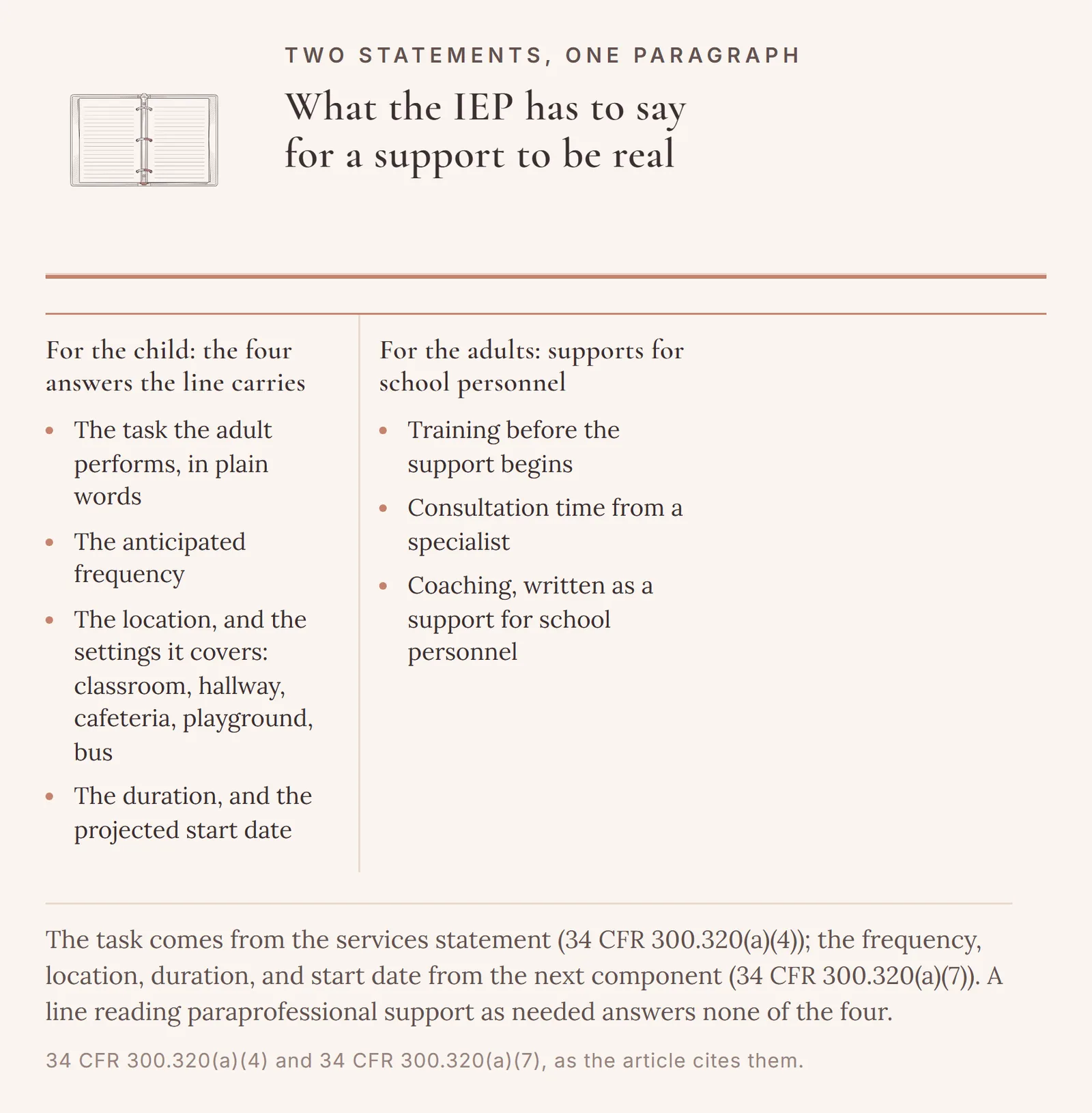
One paragraph carries two statements: the services, aids, and supports provided to the child or on behalf of the child, and the program modifications or supports for school personnel (34 CFR 300.320(a)(4)). Training and a specialist's consultation time belong in the second.
The IEP must also give the projected date for the beginning of those services and modifications, and their anticipated frequency, location, and duration (34 CFR 300.320(a)(7)). A line reading "paraprofessional support as needed" answers none of them. The adults have a rule of their own: each provider responsible for implementing the IEP (34 CFR 300.323(d)(1)) is informed of specific responsibilities and of the specific supports that must be provided (34 CFR 300.323(d)(2)(i), (d)(2)(ii)).
How to ask, step by step
- Write down what happens without an adult nearby: the setting, what happened, the date. A review of existing evaluation data includes information the parents provide (34 CFR 300.305(a)(1)(i)).
- Send the request in writing to the case manager and the special education director, and keep a dated copy.
- Ask for a decision, not a person: whether your child needs adult support, what it would do, and in which settings, including arrival, lunch, and recess.
- Ask that the meeting include the district representative who is knowledgeable about the availability of resources of the public agency (34 CFR 300.321(a)(4)(iii)).
- Expect one of two routes: the team meets, or, after the annual meeting for that school year, you and the district may agree to amend the IEP in writing instead (34 CFR 300.324(a)(4)(i)).
- At the table, ask the four things the line has to answer: the task, how often, where and in which settings, and for how long, plus the projected start date (34 CFR 300.320(a)(4), (a)(7)). Ask how and when the assigned adult will be told the responsibilities and supports (34 CFR 300.323(d)(2)(i), (d)(2)(ii)).
What happens if the school says no
If the district will not add the support, that answer belongs on paper. Written notice must be given a reasonable time before a public agency refuses to change the provision of FAPE, a free appropriate public education (34 CFR 300.503(a)(2)). That is prior written notice, the district's written explanation of what it refuses and why. Seven things have to be in it (34 CFR 300.503(b)).
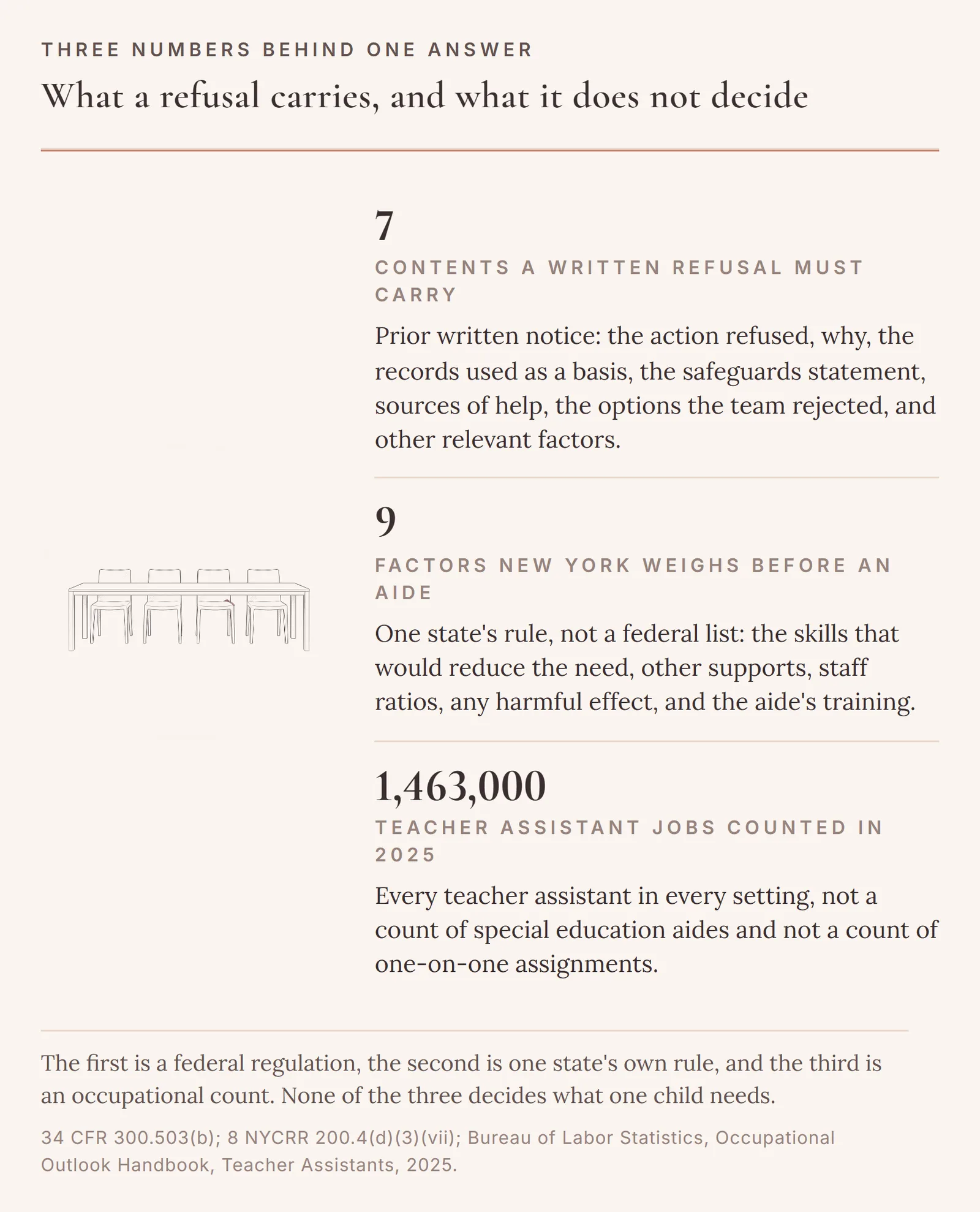
Three of the seven do the work: why the district refuses (34 CFR 300.503(b)(2)), the records used as a basis (300.503(b)(3)), and the other options the team considered and why they were rejected (300.503(b)(6)).
A district with no one to hire is naming a factor, and the notice has a place for other relevant factors (300.503(b)(7)). The Department's explanation of the 2006 regulations says placement decisions must be individually determined on each child's abilities and needs and each child's IEP, not solely on factors such as the availability of services or of space, or administrative convenience (71 FR 46588). That is the Department's explanation, not a regulation, and the word doing the work is solely.
Mistakes and edge cases
Asking for a person instead of a support. The team decides what a child needs; the district decides whom it employs. A request that describes what happens at arrival, at lunch, and on the playground gives the team something to answer.
Waiting for the annual meeting. The team reviews the IEP not less than annually (34 CFR 300.324(b)(1)(i)) and revises it to address information the parents provide and the child's anticipated needs (34 CFR 300.324(b)(1)(ii)(C), (b)(1)(ii)(D)). Not less than annually is a floor.
Every state has a federally funded Parent Training and Information Center, whose staff help parents put a request like this together at no cost, at parentcenterhub.org.
FAQ
Can an aide be added without another IEP meeting
May agree is the operative language in 34 CFR 300.324(a)(4)(i): after the annual IEP Team meeting for that school year, a written amendment replaces a meeting only when both you and the district want it, and either side can ask for the meeting instead.
Does the IEP have to say who the aide will be
No. Nothing in the IEP section requires information beyond what the statute explicitly requires (34 CFR 300.320(d)(1)), so the document describes the support rather than naming an employee.
What if the support is in the IEP and no one has been hired
The regulation's only timing rule is written for a new IEP: special education and related services are made available as soon as possible following development of the IEP (34 CFR 300.323(c)(2)). It sets no separate clock for a support added later, so as soon as possible is the standard to hold the district to, not a date. Put the question in writing, and The One-on-One Aide, Decoded sets out the routes open to a parent.
Sources
- eCFR, 34 CFR 300.42, supplementary aids (https://www.ecfr.gov/current/title-34/section-300.42)
- eCFR, 34 CFR 300.114, the regular class rule (https://www.ecfr.gov/current/title-34/section-300.114)
- eCFR, 34 CFR 300.116, placement (https://www.ecfr.gov/current/title-34/section-300.116)
- eCFR, 34 CFR 300.156, personnel (https://www.ecfr.gov/current/title-34/section-300.156)
- eCFR, 34 CFR 300.305, existing data (https://www.ecfr.gov/current/title-34/section-300.305)
- eCFR, 34 CFR 300.320, IEP contents (https://www.ecfr.gov/current/title-34/section-300.320)
- eCFR, 34 CFR 300.321, IEP Team (https://www.ecfr.gov/current/title-34/section-300.321)
- eCFR, 34 CFR 300.323, IEPs in effect (https://www.ecfr.gov/current/title-34/section-300.323)
- eCFR, 34 CFR 300.324, revising the IEP (https://www.ecfr.gov/current/title-34/section-300.324)
- eCFR, 34 CFR 300.327, placement group (https://www.ecfr.gov/current/title-34/section-300.327)
- eCFR, 34 CFR 300.503, prior written notice (https://www.ecfr.gov/current/title-34/section-300.503)
- Federal Register, 71 FR 46588, the 2006 IDEA regulations (https://www.govinfo.gov/content/pkg/FR-2006-08-14/pdf/06-6656.pdf)
- Department of Education, OSEP Letter to Dude, 2013 (https://sites.ed.gov/idea/files/policy_speced_guid_idea_memosdcltrs_11-007493r-co-dude-transition9-3-13.pdf)
- Legal Information Institute, 8 NYCRR 200.4, New York's rule (https://www.law.cornell.edu/regulations/new-york/8-NYCRR-200.4)
- Bureau of Labor Statistics, Teacher Assistants (https://www.bls.gov/ooh/education-training-and-library/teacher-assistants.htm)
- Center for Parent Information and Resources, parent centers (https://www.parentcenterhub.org/find-your-center/)