The short answer
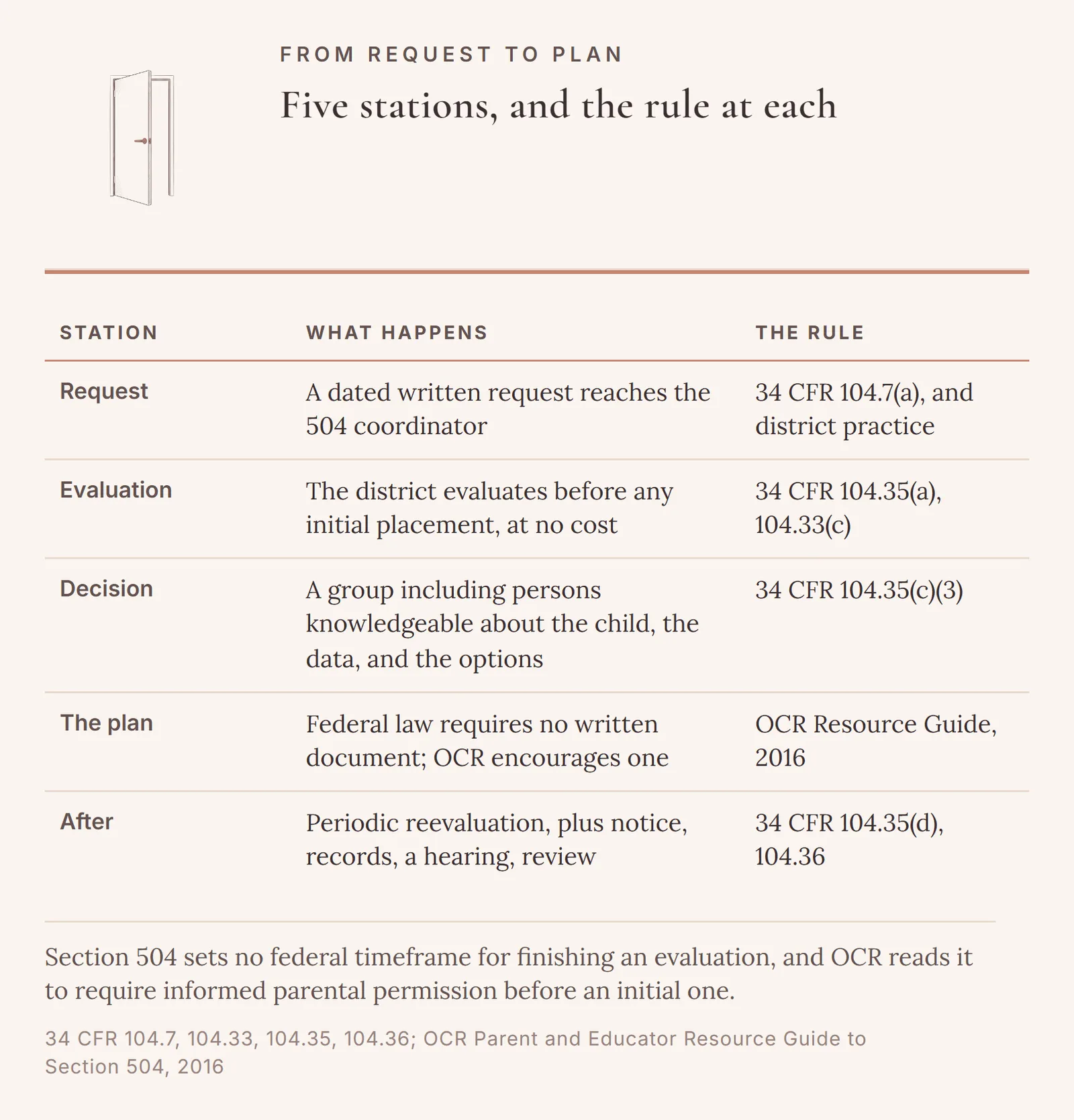
A 504 plan starts with a written request to the school's Section 504 coordinator. The district must evaluate before initial placement (34 CFR 104.35(a)). The evaluation costs you nothing. A group of people, including people who know your child, the evaluation data, and the placement options, decides eligibility (104.35(c)(3)). Federal law sets the steps, not a day count.
What Section 504 promises, and what it costs
Section 504 of the Rehabilitation Act of 1973 bars disability discrimination by any program or activity receiving federal financial assistance (29 U.S.C. 794). That reaches every public school district.
What it promises is FAPE, a free appropriate public education. Under Section 504 that means regular or special education plus related aids and services, designed to meet your child's needs as adequately as the school meets other students' needs (34 CFR 104.33(b)(1)). Equal access, not a different curriculum.
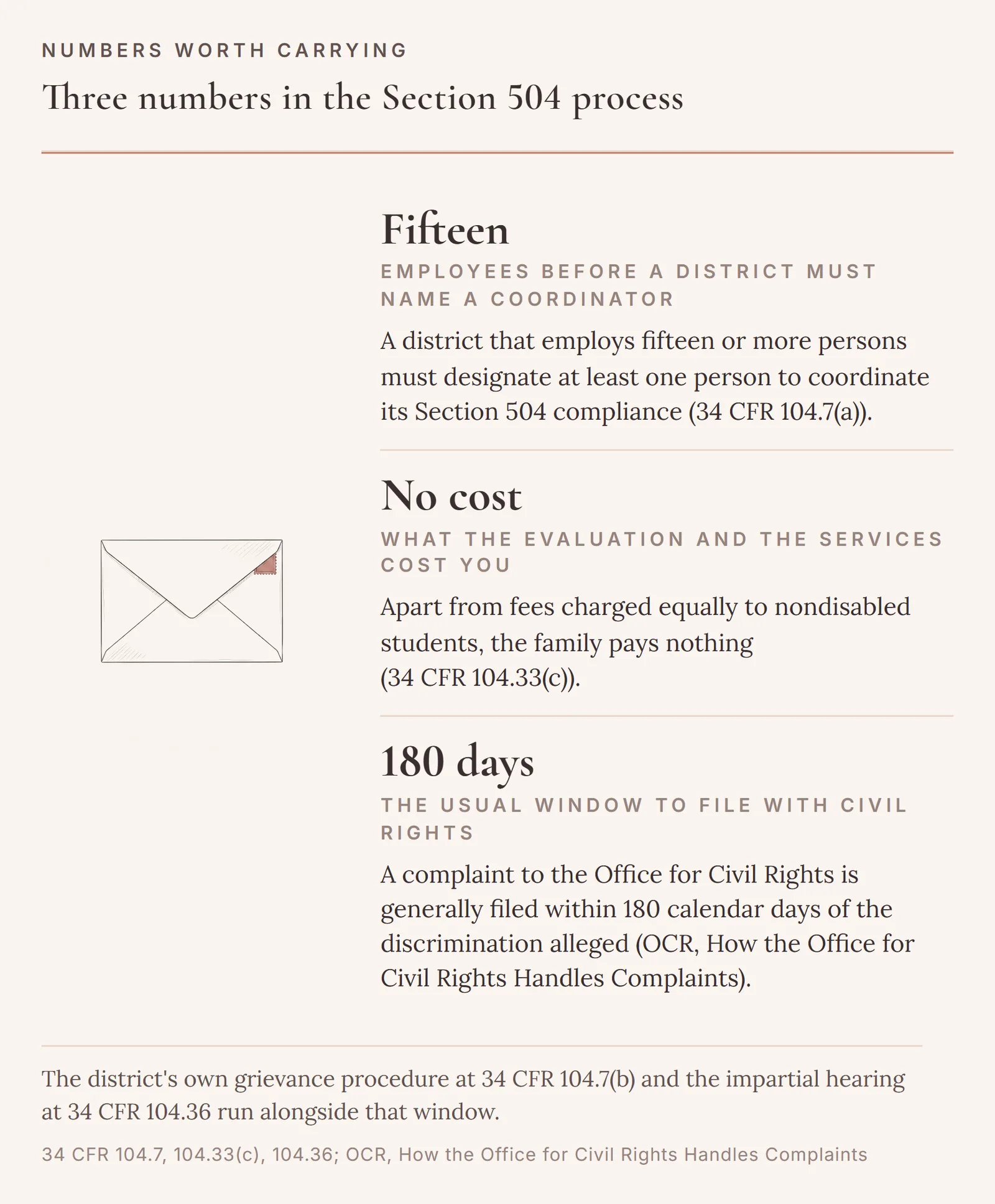
The evaluation must be conducted at no cost to the parents or student (OCR Parent and Educator Resource Guide to Section 504, 2016), and so are the services, apart from fees charged equally to nondisabled students (34 CFR 104.33(c)).
There is a person whose job this is. A district that employs fifteen or more persons must designate at least one person to coordinate its Section 504 compliance (34 CFR 104.7(a)).
How the process works
Who qualifies for a 504 plan
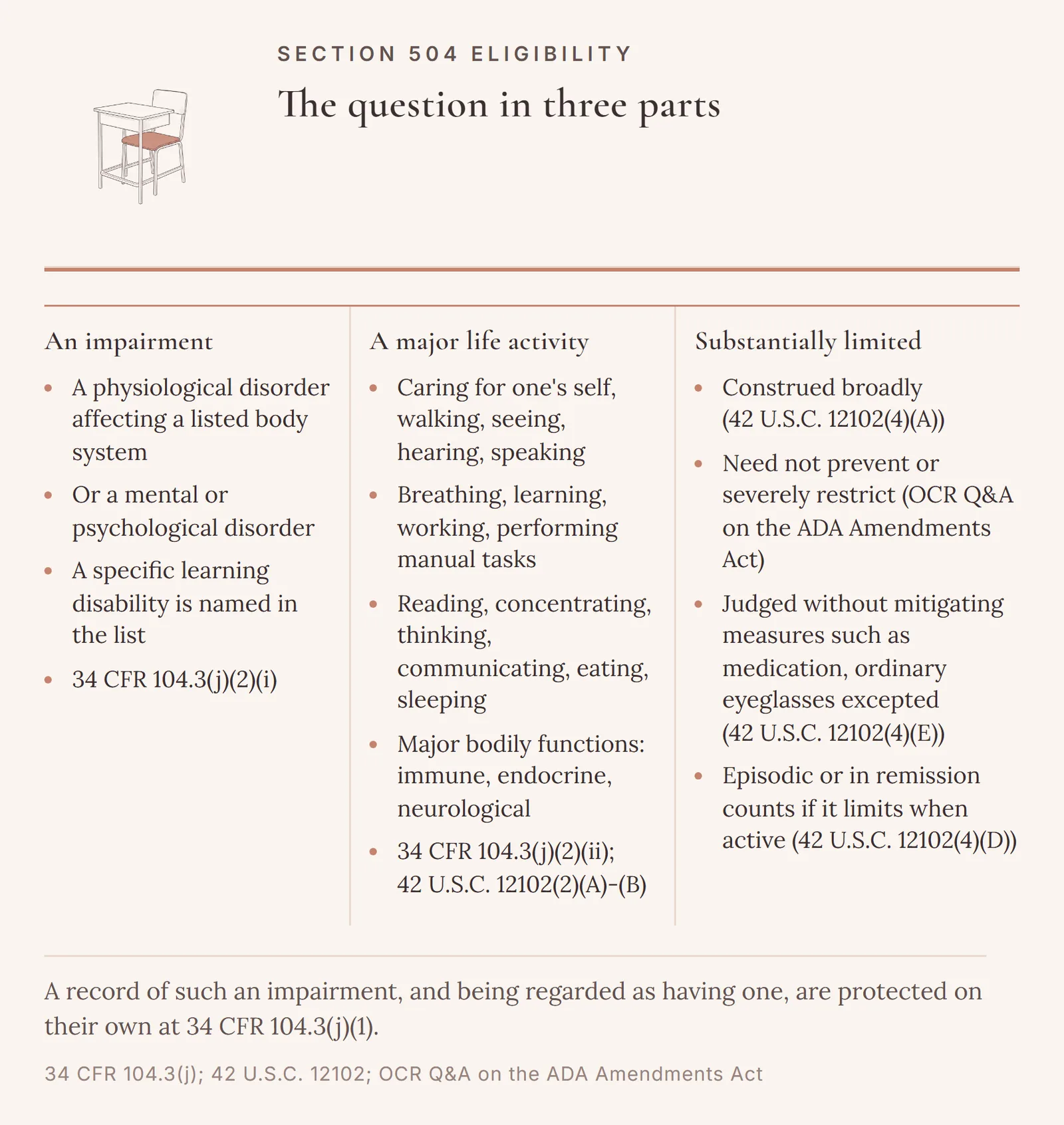
Section 504 protection has three doors (34 CFR 104.3(j)(1)). An impairment that substantially limits a major life activity. A record of such an impairment. Being regarded as having one.
An impairment means a physiological disorder affecting a listed body system, or a mental or psychological disorder such as a specific learning disability (34 CFR 104.3(j)(2)(i)). The regulation's list of major life activities runs from caring for one's self through learning and working, and it is illustrative rather than closed (34 CFR 104.3(j)(2)(ii)).
The ADA Amendments Act of 2008 widened that list, and it governs Section 504 decisions. It adds reading, concentrating, thinking, communicating, eating, and sleeping, and the operation of major bodily functions (42 U.S.C. 12102(2)(A)-(B)). Endocrine function is how diabetes qualifies, immune function how a severe food allergy does.
Two rules in that Act do quiet work. Substantially limits is construed broadly (42 U.S.C. 12102(4)(A)), and an impairment need not prevent or severely restrict an activity to be substantially limiting (OCR Q&A on the ADA Amendments Act). The decision also ignores mitigating measures such as medication, with ordinary eyeglasses and contact lenses the one exception (42 U.S.C. 12102(4)(E)(i)-(ii)). A child is judged as she is without the medication.
An impairment that is episodic or in remission still counts if it would substantially limit an activity when active (42 U.S.C. 12102(4)(D)).
What the school has to do once you ask
A district must evaluate any child who, because of disability, needs or is believed to need special education or related services (34 CFR 104.35(a)). That comes before any action on an initial placement. An evaluation here is a structured look at what the school already knows, not automatically a testing room.
Before the first one, the school needs your permission. OCR reads Section 504 to require informed parental permission before an initial evaluation, and written consent satisfies it (OCR Parent and Educator Resource Guide to Section 504, 2016).
In interpreting evaluation data the district must draw on information from a variety of sources (34 CFR 104.35(c)(1)-(2)). A doctor's diagnosis is one of those sources, not a decision on its own (OCR FAQ on Section 504 and FAPE), and nothing in Section 504 makes a medical assessment a precondition to eligibility (OCR Resource Guide on Students with ADHD, 2016).
Classroom strategies are not a substitute. Interventions inside a school's response to intervention (RTI) or multi-tiered system of supports (MTSS) program must not be used to delay or deny an evaluation (OCR Resource Guide on Students with ADHD, 2016).
Who decides, and what gets written down
The eligibility and placement decision is made by a group of persons, including persons knowledgeable about the child, the meaning of the evaluation data, and the placement options (34 CFR 104.35(c)(3)). Districts call that group the 504 team.
Here is the part that surprises people. Federal law does not require the plan to be a written document. OCR encourages schools to document a student's Section 504 services in a written plan to avoid misunderstandings (OCR Parent and Educator Resource Guide to Section 504, 2016). Nearly every district writes one, and with no federal form, plans differ district to district.
The district must also reevaluate periodically, with no interval set in federal law (34 CFR 104.35(d)). And it must run procedural safeguards: notice, a chance to examine relevant records, an impartial hearing with participation by parents and counsel, and a review procedure (34 CFR 104.36).
How the process runs, step by step
- Ask the front office or the district's nondiscrimination page for the coordinator's name.
- Put the request in writing and date it. That is district practice rather than law, and it fixes the day the school was on notice.
- Use the phrase "evaluation under Section 504," and describe what you see as situations, not labels.
- Ask for the district's timeline in the same message, and ask what it plans to look at before you sign consent. Section 504 sets no federal timeframe (OCR Parent and Educator Resource Guide to Section 504, 2016).
- Send the records you have, and do not buy testing first. If the district decides a medical assessment is necessary, it must arrange it at no cost (OCR Resource Guide to Section 504, 2016).
- Go to the eligibility meeting knowing the two questions: is a major life activity substantially limited, and what does your child need for equal access.
- If the answer is yes, read the plan for who does each thing and when it is reviewed.
Mistakes and edge cases
Offering to pay for private testing. If a parent volunteers to pay, the district must make clear the parent has a choice and can accept a school-furnished assessment at no cost (OCR Resource Guide to Section 504, 2016).
Teachers who never see the plan. OCR has found that failing to give staff access to a 504 plan, or to inform them of their responsibilities, often results in a failure to provide FAPE (OCR Resource Guide on Students with ADHD, 2016).
The routes for a disagreement are built already. The same districts must adopt grievance procedures (34 CFR 104.7(b)), and the 34 CFR 104.36 safeguards include an impartial hearing. A complaint to the Office for Civil Rights is generally filed within 180 calendar days of the discrimination alleged (OCR, How the Office for Civil Rights Handles Complaints). Every state also has a free, federally funded Parent Training and Information Center, and this is ordinary work for them. Find yours at parentcenterhub.org.
FAQ
How long does a Section 504 evaluation take?
Section 504 sets no federal timeframe once a child is referred, and OCR assesses whether a delay was reasonable (OCR Parent and Educator Resource Guide to Section 504, 2016). Some states set their own, so ask what timeline this district follows.
Does my child need a medical diagnosis first?
No. Nothing in Section 504 makes a medical assessment a precondition to eligibility (OCR Resource Guide on Students with ADHD, 2016). A diagnosis is one of the sources the group weighs at 34 CFR 104.35(c)(1)-(2), alongside teacher recommendations and adaptive behavior.
Can a plan include services if my child does not need special education?
Yes. A 504 plan can include related services such as medication administration, counseling, or health services even where no special education instruction is needed (OCR Q&A on the ADA Amendments Act).
Sources
- eCFR, 34 CFR 104.3, definitions (https://www.ecfr.gov/current/title-34/subtitle-B/chapter-I/part-104/subpart-A/section-104.3)
- eCFR, 34 CFR 104.7, coordinator and grievances (https://www.ecfr.gov/current/title-34/subtitle-B/chapter-I/part-104/subpart-A/section-104.7)
- eCFR, 34 CFR 104.35, evaluation and placement (https://www.ecfr.gov/current/title-34/subtitle-B/chapter-I/part-104/subpart-D/section-104.35)
- eCFR, 34 CFR 104.36, procedural safeguards (https://www.ecfr.gov/current/title-34/subtitle-B/chapter-I/part-104/subpart-D/section-104.36)
- Cornell LII, 34 CFR 104.33, free appropriate public education (https://www.law.cornell.edu/cfr/text/34/104.33)
- Cornell LII, 29 U.S.C. 794 (https://www.law.cornell.edu/uscode/text/29/794)
- Cornell LII, 42 U.S.C. 12102 (https://www.law.cornell.edu/uscode/text/42/12102)
- Office for Civil Rights, Parent and Educator Resource Guide to Section 504, 2016 (https://www.ed.gov/sites/ed/files/about/offices/list/ocr/docs/504-resource-guide-201612.pdf)
- Office for Civil Rights, Resource Guide on Students with ADHD, 2016 (https://www.ed.gov/sites/ed/files/about/offices/list/ocr/letters/colleague-201607-504-adhd.pdf)
- Office for Civil Rights, FAQ on Section 504 and FAPE (https://www.ed.gov/laws-and-policy/civil-rights-laws/disability-discrimination/frequently-asked-questions-section-504-free-appropriate-public-education-fape)
- Office for Civil Rights, Q&A on the ADA Amendments Act (https://www.ed.gov/laws-and-policy/individuals-disabilities/section-504/questions-and-answers-ada-amendments-act-of-2008-students-disabilities-attending-public-elementary-and-secondary-schools)
- Office for Civil Rights, how OCR handles complaints (https://www.ed.gov/laws-and-policy/civil-rights-laws/file-complaint/how-the-office-for-civil-rights-handles-complaints)
- Center for Parent Information and Resources, find your parent center (https://www.parentcenterhub.org/find-your-center/)