The short answer
Counseling reaches the Individualized Education Program (IEP) as a related service when the IEP team decides your child needs it to benefit from special education (34 CFR 300.34(a)). The IEP states its start date, frequency, location, and duration (34 CFR 300.320(a)(7)), at no cost (34 CFR 300.17(a)). A child who needs only counseling is usually a Section 504 question.
What the federal numbers count, and what they do not
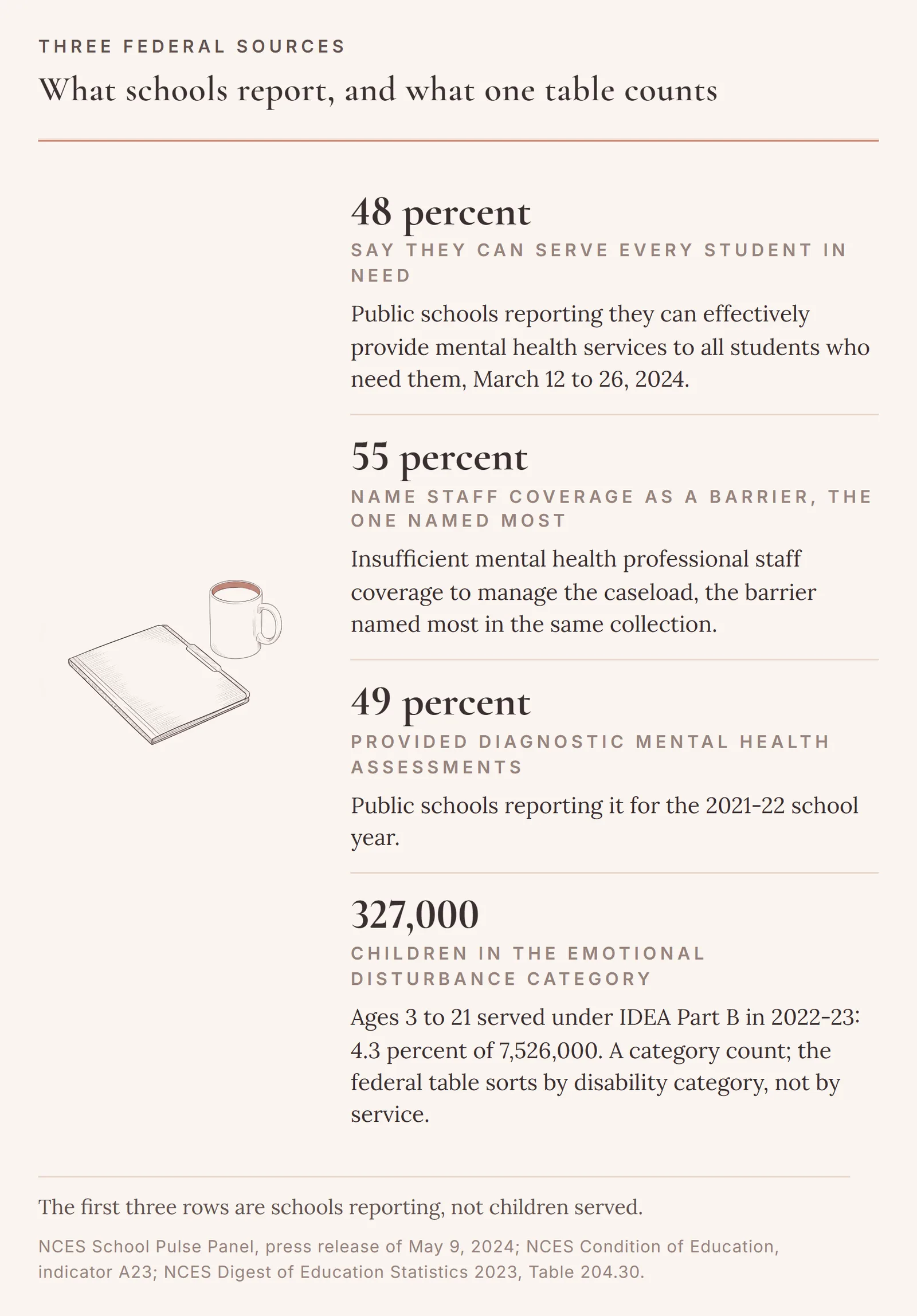
The federal count of children served under the Individuals with Disabilities Education Act (IDEA) sorts them by disability category, not by the services on their IEPs. In 2022-23, the National Center for Education Statistics (NCES) put 327,000 children ages 3 to 21 in the emotional disturbance category, 4.3 percent of the 7,526,000 served under Part B (Digest of Education Statistics 2023, Table 204.30).
The other numbers describe schools. In the NCES School Pulse Panel collected March 12 to 26, 2024, 48 percent of public schools said they can effectively provide mental health services to all students who need them; the barrier named most was insufficient mental health professional staff coverage to manage the caseload (55 percent). In 2021-22, 49 percent of public schools reported providing diagnostic mental health assessments (Condition of Education, indicator A23).
Those numbers describe the system a request enters. Counseling offered to every student carries no amount for any one child; the amount written on the IEP page is the rest of this article.
How counseling gets onto the IEP
What makes counseling a related service
Eligibility, the decision that a child qualifies, takes two findings from an evaluation (the school's formal assessment): one of the listed disabilities, and a need, because of it, for special education and related services (34 CFR 300.8(a)(1)). Special education is specially designed instruction (34 CFR 300.39(a)(1)). Counseling services are on the list of related services, the supportive services "required to assist a child with a disability to benefit from special education" (34 CFR 300.34(a)).
The question is not whether therapy would help in general, but whether this child needs the service. The IEP team decides, with you on it (34 CFR 300.321(a)(1)).
Which services can carry counseling
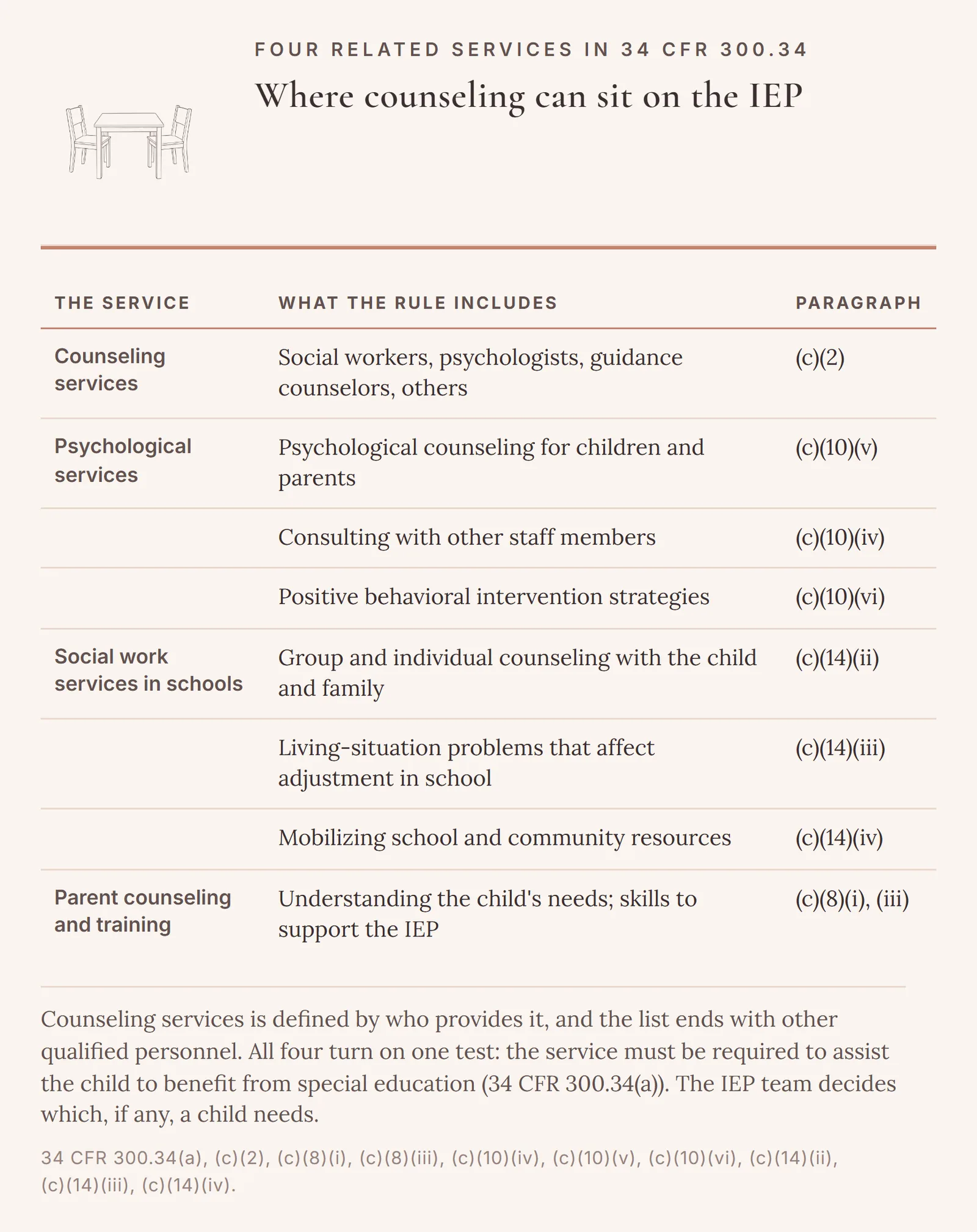
Four related services can carry it: counseling services, defined by who provides them (34 CFR 300.34(c)(2)); psychological services, which include "psychological counseling for children and parents" and positive behavioral intervention strategies (34 CFR 300.34(c)(10)(v), (c)(10)(vi)); social work services in schools, which include group and individual counseling with the child and family (34 CFR 300.34(c)(14)(ii)); and parent counseling and training, written on the IEP for you (34 CFR 300.34(c)(8)(i)). The table below lists the activities each one names, with the paragraph for each.
Medical services on the list are diagnostic only: a licensed physician's services "to determine a child's medically related disability" (34 CFR 300.34(c)(5)). A psychiatrist's treatment, including prescribing medication, is a physician's service outside that definition; counseling by a psychologist, social worker, or counselor falls under counseling services (34 CFR 300.34(c)(2)).
Is a weekly check-in with the counselor the same thing
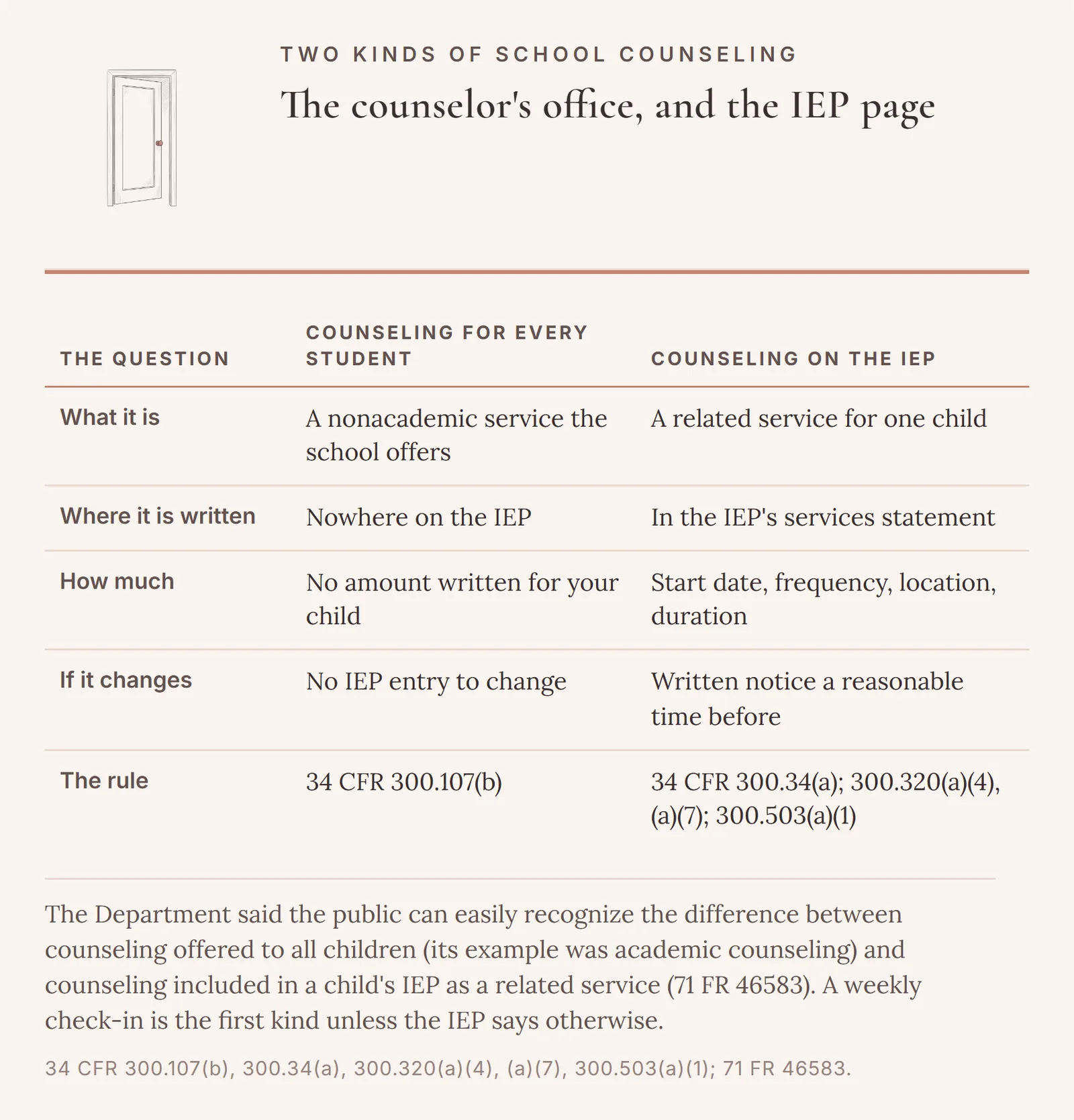
"He is in the counselor's office every week, and nothing is on paper" describes a different kind of counseling. Counseling services also appear among the nonacademic services a school may offer (34 CFR 300.107(b)), and the U.S. Department of Education said the public "can easily recognize the difference" between counseling offered to all children (its example was academic counseling) and counseling "included in a child's IEP as a related service" (71 FR 46583). A check-in is the first kind unless the IEP says otherwise.
What if my child needs counseling but not special education
A child who needs only a related service, and not special education, is not a child with a disability under the IDEA regulations (34 CFR 300.8(a)(2)(i)), unless your state counts that service as special education (34 CFR 300.8(a)(2)(ii), 300.39(a)(2)(i)).
Section 504 of the Rehabilitation Act, the law behind the 504 plan, is the other door. Its regulation names "emotional or mental illness" among mental impairments (34 CFR 104.3(j)(2)(i)(B)), and the impairment must substantially limit a major life activity, such as learning (34 CFR 104.3(j)(1), (j)(2)(ii)). The education it requires includes "related aids and services" (34 CFR 104.33(b)(1)), and the Department's 2021 mental health resource says those services "may include mental health services" (Challenge 5, page 16). A group of people who know the child decides, after an evaluation (34 CFR 104.35(a), (c)(3)).
How to get counseling written in, step by step
- Write down what you see at school, with dates. The eligibility group must draw on parent input (34 CFR 300.306(c)(1)(i)).
- Ask in writing for an evaluation (34 CFR 300.301(b)). If your child already has an IEP, ask for a reevaluation (34 CFR 300.303(a)(2)) or ask the IEP team to revise the IEP on the information you provide (34 CFR 300.324(b)(1)(ii)(C)). Name social and emotional status as an area to assess (34 CFR 300.304(c)(4)). The evaluation must find every related services need, "whether or not commonly linked to the disability category" (34 CFR 300.304(c)(6)).
- Read the notice of proposed evaluation procedures before you sign consent (34 CFR 300.304(a)). The initial evaluation is due within 60 days of the school receiving your consent, or within your state's timeframe if it has set one (34 CFR 300.301(c)(1)(i), (c)(1)(ii)).
- Take your seat at the eligibility meeting; the group includes you (34 CFR 300.306(a)(1)). The IEP meeting follows within 30 days of a finding that your child needs special education and related services (34 CFR 300.323(c)(1)).
- If the team says no, read the prior written notice, the school's written explanation of a decision. It is owed a reasonable time before the school refuses to add a service or proposes to change one, such as a move to consult only (34 CFR 300.503(a)(1), (a)(2)). It must give the reasons and the other options the team considered and rejected (34 CFR 300.503(b)(2), (b)(6)).
- If the team says yes, read what the IEP says. Counseling belongs in the statement of related services (34 CFR 300.320(a)(4)), with a start date and its frequency, location, and duration (34 CFR 300.320(a)(7)), so that "the level of the agency's commitment of resources" is clear, the Department said (71 FR 46667). "Counseling as needed" states no frequency, location, or duration.
Mistakes and edge cases
Taking "find a therapist outside" as the end of it. It can be lawful advice when the service is not required for your child to benefit from special education (34 CFR 300.34(a)). Mobilizing community resources can be part of a social work service (34 CFR 300.34(c)(14)(iv)), not a replacement for one. But if you asked the team to consider counseling and it declined, that refusal is owed in writing (34 CFR 300.503(a)(2)).
Accepting "that is a home problem." Social work services in schools reach problems in a child's living situation, "home, school, and community," that affect adjustment in school (34 CFR 300.34(c)(14)(iii)). The test stays the same (34 CFR 300.34(a)).
Hearing "he seems better" as the end of the service. Ending counseling inside a continuing IEP comes with prior written notice (34 CFR 300.503(a)(1)). Lack of progress counts too: the team revises the IEP, as appropriate, to address any lack of expected progress and information you provide (34 CFR 300.324(b)(1)(ii)(A), (b)(1)(ii)(C)).
A worry about safety. If you are worried about your child's safety right now, turn to the 988 Suicide and Crisis Lifeline and your school's crisis procedures; this article covers the school process.
Every state has a free, federally funded Parent Training and Information Center, and reading a services line or a refusal notice with a parent is ordinary work for them. Find yours at parentcenterhub.org.
FAQ
Does the family pay for counseling on the IEP?
No. A service the IEP requires is provided "at public expense, under public supervision and direction, and without charge" (34 CFR 300.17(a)).
Does an outside therapist's report mean the school has to add counseling?
Not by itself. An outside evaluation you share must be considered, if it meets the school's criteria (34 CFR 300.502(c)(1)). Considered is not adopted: the IEP team still decides whether your child needs the service.
Can the IEP say "consult" instead of direct counseling?
Yes, when the team decides consultation is what your child needs. Consulting with other staff members is a psychological-services activity (34 CFR 300.34(c)(10)(iv)), and the entry still needs its own frequency, location, and duration (34 CFR 300.320(a)(7)).
Sources
- eCFR, 34 CFR 300.8 (https://www.ecfr.gov/current/title-34/section-300.8)
- eCFR, 34 CFR 300.17 (https://www.ecfr.gov/current/title-34/section-300.17)
- eCFR, 34 CFR 300.34 (https://www.ecfr.gov/current/title-34/section-300.34)
- eCFR, 34 CFR 300.39 (https://www.ecfr.gov/current/title-34/section-300.39)
- eCFR, 34 CFR 300.107 (https://www.ecfr.gov/current/title-34/section-300.107)
- eCFR, 34 CFR 300.301 (https://www.ecfr.gov/current/title-34/section-300.301)
- eCFR, 34 CFR 300.303 (https://www.ecfr.gov/current/title-34/section-300.303)
- eCFR, 34 CFR 300.304 (https://www.ecfr.gov/current/title-34/section-300.304)
- eCFR, 34 CFR 300.306 (https://www.ecfr.gov/current/title-34/section-300.306)
- eCFR, 34 CFR 300.320 (https://www.ecfr.gov/current/title-34/section-300.320)
- eCFR, 34 CFR 300.321 (https://www.ecfr.gov/current/title-34/section-300.321)
- eCFR, 34 CFR 300.323 (https://www.ecfr.gov/current/title-34/section-300.323)
- eCFR, 34 CFR 300.324 (https://www.ecfr.gov/current/title-34/section-300.324)
- eCFR, 34 CFR 300.502 (https://www.ecfr.gov/current/title-34/section-300.502)
- eCFR, 34 CFR 300.503 (https://www.ecfr.gov/current/title-34/section-300.503)
- eCFR, 34 CFR 104.3 (https://www.ecfr.gov/current/title-34/section-104.3)
- eCFR, 34 CFR 104.33 (https://www.ecfr.gov/current/title-34/section-104.33)
- eCFR, 34 CFR 104.35 (https://www.ecfr.gov/current/title-34/section-104.35)
- U.S. Department of Education, 71 FR 46583 and 46667 (https://www.govinfo.gov/content/pkg/FR-2006-08-14/pdf/06-6656.pdf)
- U.S. Department of Education, Supporting Child and Student Social, Emotional, Behavioral, and Mental Health Needs, October 2021 (https://www.govinfo.gov/content/pkg/GOVPUB-ED1_200-PURL-gpo171894/pdf/GOVPUB-ED1_200-PURL-gpo171894.pdf)
- NCES, Digest of Education Statistics 2023, Table 204.30 (https://nces.ed.gov/programs/digest/d23/tables/dt23_204.30.asp)
- NCES, Condition of Education, indicator A23 (https://nces.ed.gov/programs/coe/indicator/a23)
- NCES, School Pulse Panel press release, May 9, 2024 (https://nces.ed.gov/learn/press-release/over-half-public-schools-report-staffing-and-funding-limit-their-efforts-effectively-provide-mental)
- Center for Parent Information and Resources, find your Parent Center (https://www.parentcenterhub.org/find-your-center/)
- Substance Abuse and Mental Health Services Administration, 988 Suicide and Crisis Lifeline (https://www.samhsa.gov/mental-health/988)