The short answer
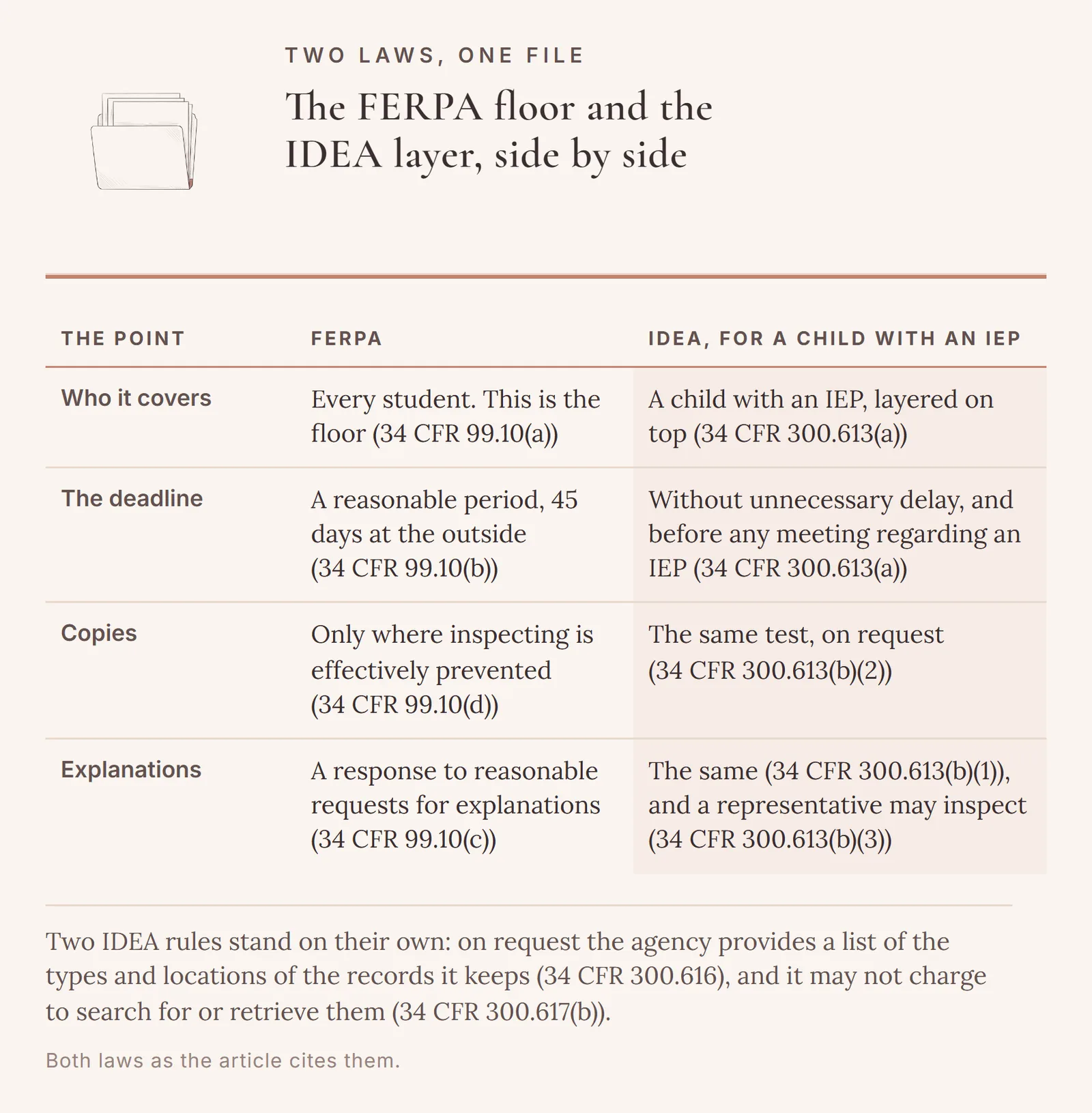
Two federal laws open a child's school file to a parent. FERPA gives every parent the right to inspect and review education records (34 CFR 99.10(a)), within 45 days at the outside (99.10(b)). For a child with an IEP, IDEA is stricter: access comes before any meeting about that IEP (34 CFR 300.613(a)). Neither law promises copies.
Why the file is worth reading before the meeting
At an IEP meeting, everyone at the table is reading the same pages: evaluation reports, progress data, service logs, discipline entries, prior IEPs, prior written notices. A parent who has not seen the file is following a conversation about documents she has never read.
Federal law treats reading it as ordinary. Under FERPA (20 U.S.C. 1232g), an educational agency must give a parent the opportunity to inspect and review the student's education records (34 CFR 99.10(a)), within a reasonable period and in no case more than 45 days (34 CFR 99.10(b)). Under IDEA, a participating agency must permit inspection without unnecessary delay and before any meeting regarding an IEP (34 CFR 300.613(a)).
Two smaller rules carry weight: on request, the agency must provide a list of the types and locations of the records it keeps (34 CFR 300.616), and it may not charge to search for or retrieve them (34 CFR 300.617(b)).
What the two laws actually cover
What counts as an education record
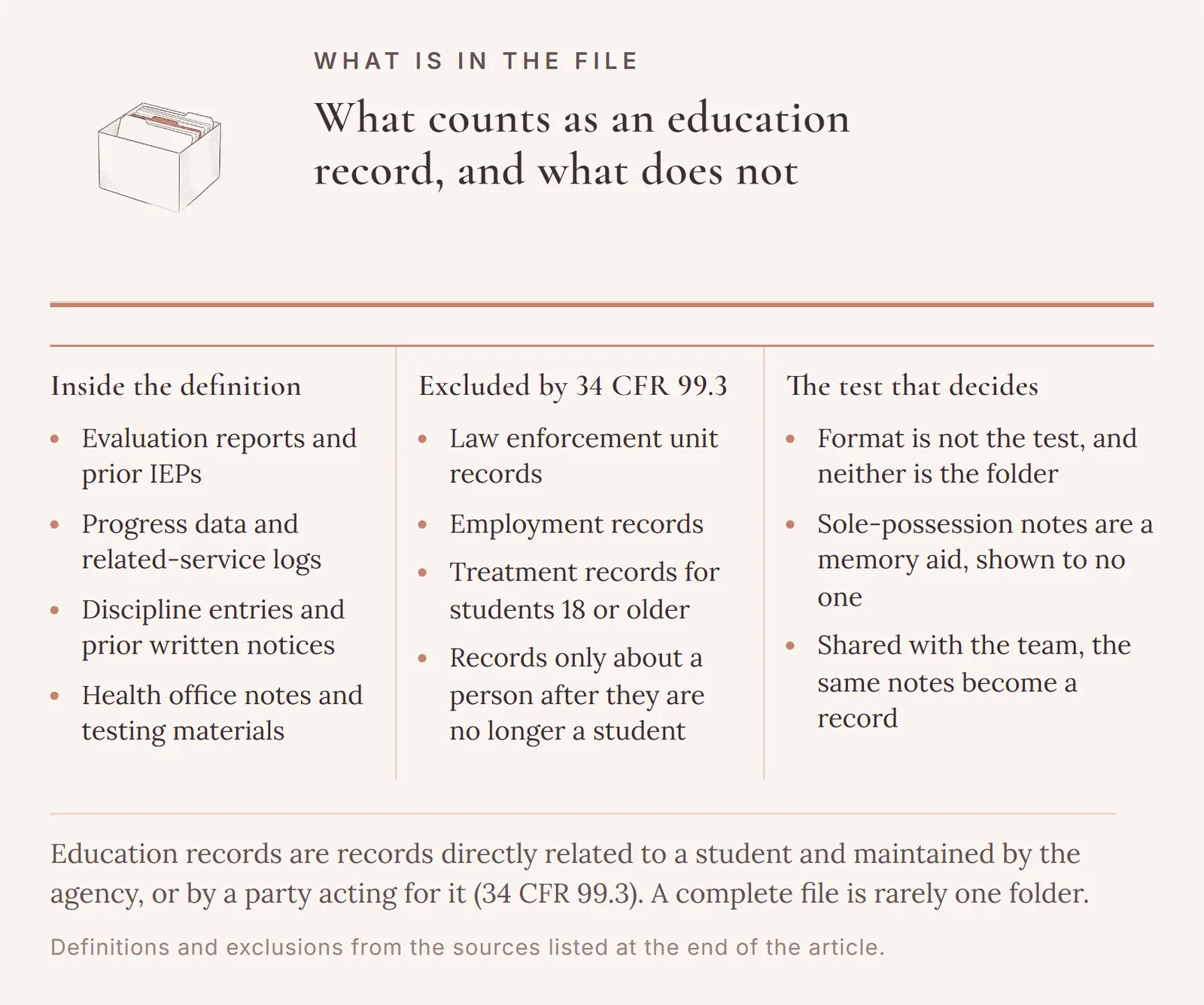
Education records are records directly related to a student and maintained by the agency, or by a party acting for it (34 CFR 99.3). Format is not the test and neither is the folder: paper files, database entries, scanned forms, and district-maintained email can all qualify.
A complete file is rarely one folder. Expect a cumulative record in the front office, a separate special education file, health office notes, discipline records, related-service logs, and the psychologist's testing materials.
What does not count
FERPA excludes a short list (34 CFR 99.3): law enforcement unit records, employment records, treatment records for students who are 18 or older, or who are attending a postsecondary institution, and records made after a person is no longer a student. The one parents meet most often is records kept in the sole possession of the maker, used only as a personal memory aid, and not revealed to anyone except a temporary substitute.
That is narrower than it sounds. A teacher's private notebook can qualify; the same notes, once shared with the team or attached to a report, stop meeting the test.
Which clock applies to a request
Both, and they are not the same clock. FERPA sets the floor for every student: a reasonable period, 45 days at the outside (34 CFR 99.10(b)). IDEA is stricter for a child with an IEP, because it ties the file to the next event rather than to a fixed number of days: without unnecessary delay and before any meeting regarding an IEP, any hearing, or any resolution session, and in no case more than 45 days (34 CFR 300.613(a)).
So 45 days is a ceiling, not a schedule. If the annual review is fourteen days out, the file is due before it. I think this is the most misreported pair of rules in writing for parents, usually by quoting 45 days as the whole answer.
Is inspecting the same as getting copies
No, and that is the second thing widely misstated. The baseline right under both laws is to inspect and review, not to be handed copies.
FERPA requires copies only where circumstances effectively prevent a parent from inspecting, distance being the standard example, and even then the agency may instead arrange another way to inspect (34 CFR 99.10(d)). IDEA reads the same way: the right includes requesting copies where failure to provide them would effectively prevent the parent from inspecting and reviewing (34 CFR 300.613(b)(2)). Fees may be charged for copies, but not for search or retrieval (34 CFR 300.617).
Most districts copy on request anyway; the distinction matters on the day one says no.
How to open the file, step by step
- Ask for the list first. Request the list of types and locations of education records the agency collects, maintains, or uses (34 CFR 300.616). It turns a vague ask into a checkable one.
- Put the request in writing and name both laws. Date it, send it to the school registrar and the special education director, and cite FERPA (34 CFR 99.10(a)) and IDEA (34 CFR 300.613(a)). The dated request is what starts the clock.
- Name the meeting. If an IEP meeting, hearing, or resolution session is on the calendar, say so and ask to inspect before that date (34 CFR 300.613(a)). Without it in writing, the 45-day ceiling is the only deadline anyone tracks.
- Ask for explanations, and bring someone if that helps. Both laws require a response to reasonable requests for explanations and interpretations (34 CFR 99.10(c); 34 CFR 300.613(b)(1)), and IDEA lets a parent's representative inspect the records (34 CFR 300.613(b)(3)).
- Decide what to copy after reading, not before. Copies can carry a fee, though not one that effectively prevents access (34 CFR 300.617).
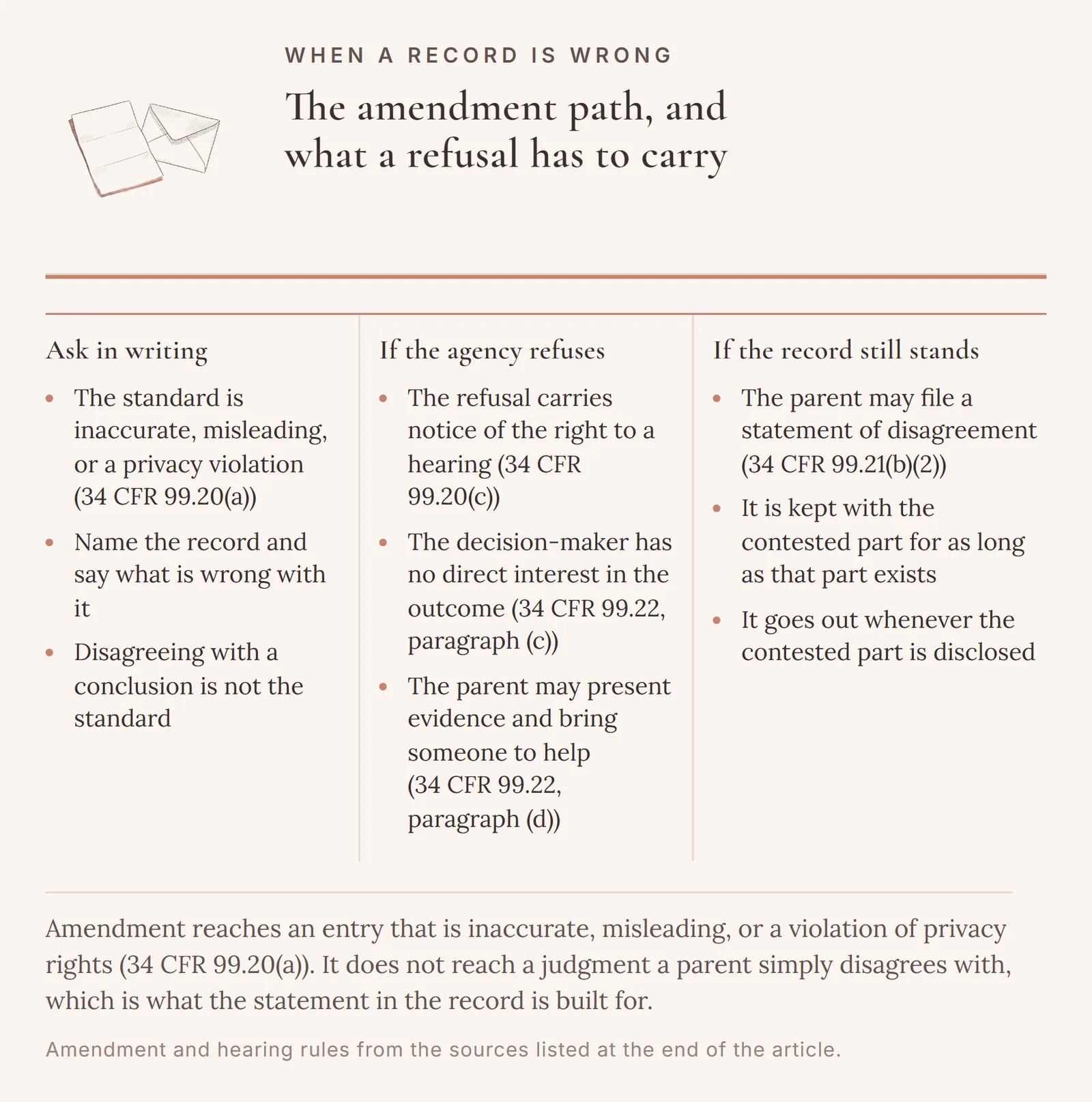
- Request an amendment in writing if something is wrong. A parent who believes a record is inaccurate, misleading, or in violation of privacy rights may ask the agency to amend it (34 CFR 99.20(a)). A refusal must carry notice of the right to a hearing (34 CFR 99.20(c)), held before a decision-maker with no direct interest in the outcome, with the parent free to present evidence and be assisted by a person of her choice (34 CFR 99.21(a), 34 CFR 99.22). If the record still stands, she may file a statement of disagreement, kept and disclosed with the contested part for as long as it exists (34 CFR 99.21(b)(2) and (c)).
Mistakes and edge cases
Treating 45 days as the norm. For a child with an IEP it is the outer limit, and the meeting usually arrives first (34 CFR 300.613(a)).
Asking for "my child's file." One request, one folder, and the special education file and service logs stay where they are. The list under 34 CFR 300.616 exists to prevent that.
Records that mention more than one child. The right is to inspect only the information relating to one's own child, or to be informed of it (34 CFR 300.615). Redactions there are routine, not evasive.
Using amendment to contest a judgment. The standard is inaccurate, misleading, or a privacy violation (34 CFR 99.20(a)), narrower than disagreeing with a conclusion. The statement in the record is built for the rest (34 CFR 99.21(b)(2)).
Every state has a free, federally funded Parent Training and Information Center staffed by people who read these files for a living. Find yours at parentcenterhub.org.
FAQ
Can a school charge a parent to see the file?
No fee applies to the inspection itself, and none may be charged to search for or retrieve information (34 CFR 300.617(b)). A district may charge for copies, but only if the fee does not effectively prevent access (34 CFR 300.617(a)).
The meeting is in ten days and the district says it has 45. Who is right?
For a child with an IEP, the 45 days in 34 CFR 300.613(a) sits in the same sentence requiring access without unnecessary delay and before any meeting regarding an IEP. Both parts bind. FERPA's 45-day rule (34 CFR 99.10(b)) is the floor and does not displace the earlier IDEA deadline.
Is there a right to a copy of the whole file?
Not as a baseline. Both laws grant inspection and review, with copies required only where the alternative would effectively prevent a parent from exercising that right (34 CFR 99.10(d); 34 CFR 300.613(b)(2)).
Sources
- Cornell LII, 20 U.S.C. 1232g, FERPA (https://www.law.cornell.edu/uscode/text/20/1232g)
- Cornell LII, 34 CFR 99.3, education records and the sole-possession exclusion (https://www.law.cornell.edu/cfr/text/34/99.3)
- Cornell LII, 34 CFR 99.10, inspection, 45 days, explanations, copies (https://www.law.cornell.edu/cfr/text/34/99.10)
- Cornell LII, 34 CFR 99.20, requesting amendment (https://www.law.cornell.edu/cfr/text/34/99.20)
- Cornell LII, 34 CFR 99.21, hearing and statement in the record (https://www.law.cornell.edu/cfr/text/34/99.21)
- Cornell LII, 34 CFR 99.22, hearing requirements (https://www.law.cornell.edu/cfr/text/34/99.22)
- U.S. Department of Education, 34 CFR 300.613, IDEA access rights (https://sites.ed.gov/idea/regs/b/f/300.613)
- U.S. Department of Education, 34 CFR 300.615, records on more than one child (https://sites.ed.gov/idea/regs/b/f/300.615)
- U.S. Department of Education, 34 CFR 300.616, types and locations list (https://sites.ed.gov/idea/regs/b/f/300.616)
- U.S. Department of Education, 34 CFR 300.617, fees (https://sites.ed.gov/idea/regs/b/f/300.617)
- U.S. Department of Education, Protecting Student Privacy, Parents and Students (https://studentprivacy.ed.gov/audience/parents-and-students)
- Center for Parent Information and Resources, find your state's parent center (https://www.parentcenterhub.org/find-your-center/)