The short answer
An IEP (Individualized Education Program) progress report says how your child is doing on each annual goal, on the measure the IEP itself names (34 CFR 300.320(a)(3)(i)). Read every entry against that goal's baseline and target. If it gives a word instead of a number, you may ask to inspect the records behind it (34 CFR 300.613(a)).
What the second sheet is for
In 2022-23, 7.5 million students ages 3 to 21 received special education or related services under IDEA, 15 percent of all public school students (National Center for Education Statistics). A few times a year their families get a report card and, behind it, a sheet with a word in a box beside each goal.
That second sheet is the one that speaks to whether the program is working. An IEP must describe how your child's progress toward the annual goals will be measured (34 CFR 300.320(a)(3)(i)), and state when periodic reports on that progress will be provided (34 CFR 300.320(a)(3)(ii)). The report is the second half answering the first: not a grade, not an opinion about your child.
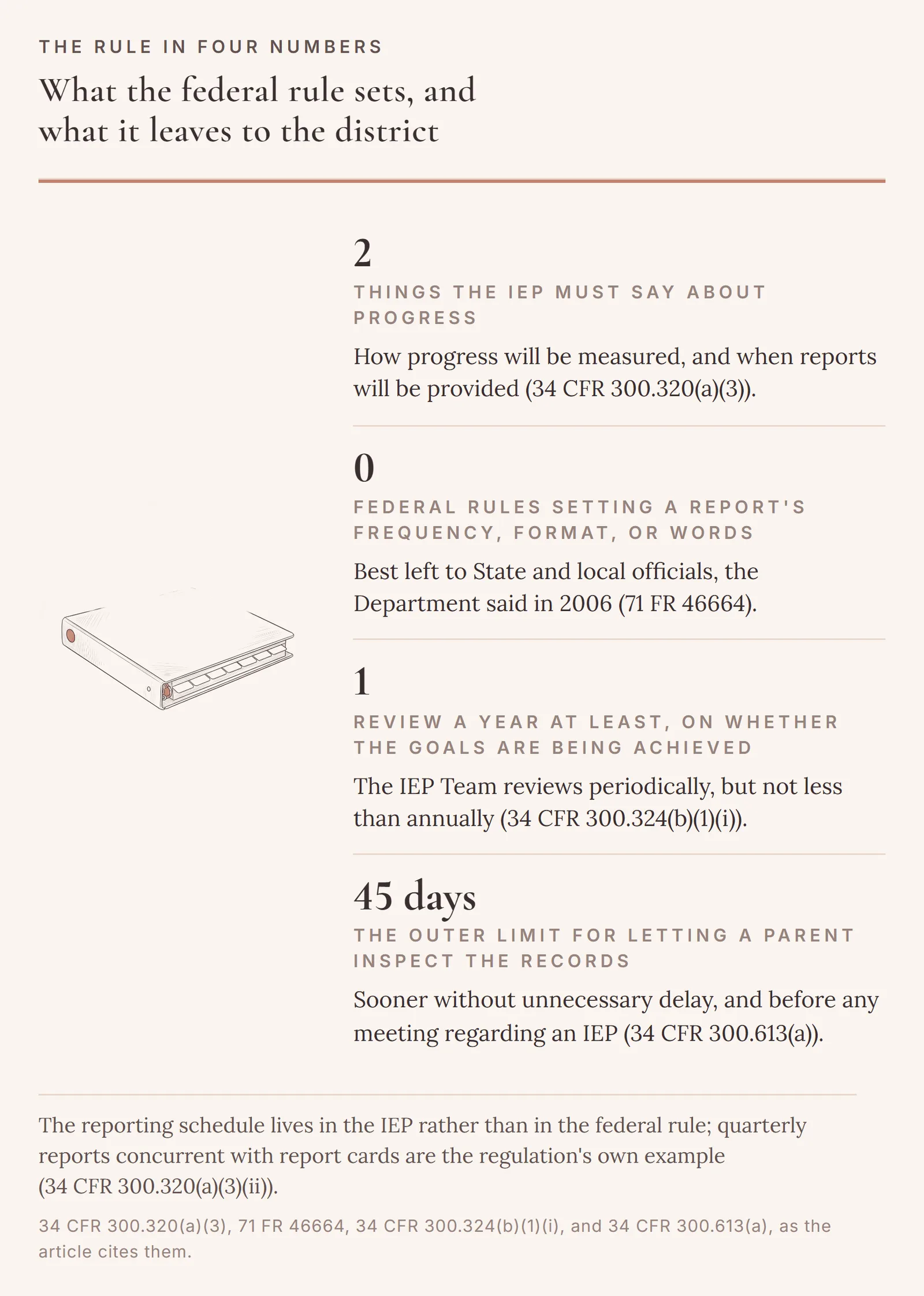
The form is wide open. Quarterly or other periodic reports, concurrent with the issuance of report cards, is the regulation's own example (34 CFR 300.320(a)(3)(ii)); the schedule that binds your school is the one in the IEP. The Department's explanation of the 2006 regulations says the times, manner, and format are best left to State and local officials (71 FR 46664).
How the rule works
What makes one entry readable
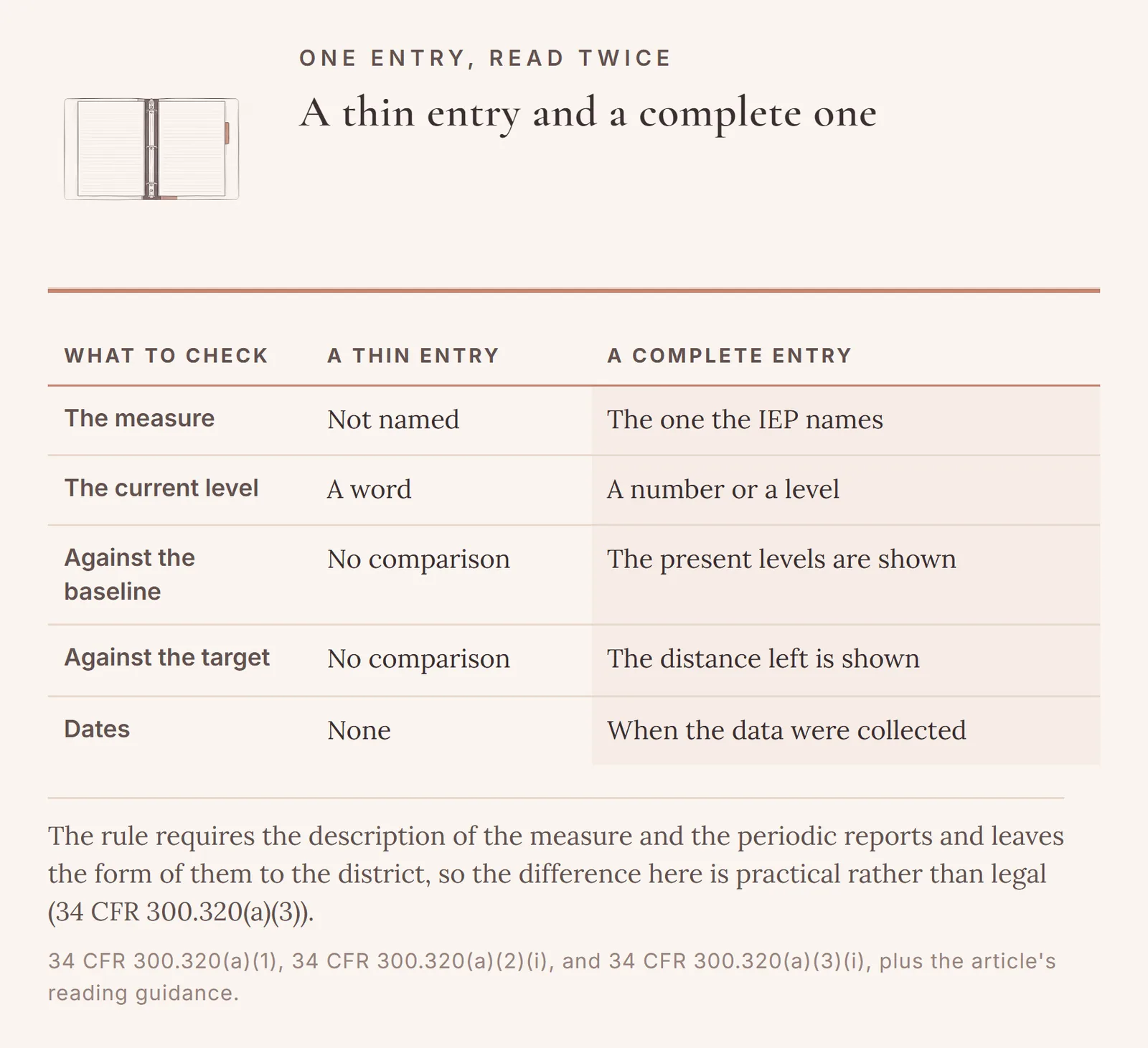
Three pieces of the IEP. The baseline is the statement of present levels of academic achievement and functional performance (34 CFR 300.320(a)(1)). The target is the statement of measurable annual goals (34 CFR 300.320(a)(2)(i)), and measurable is the regulation's own word. The measure is the description of how progress toward those goals will be measured (34 CFR 300.320(a)(3)(i)).
A complete entry names that measure, gives the current level on it, and lets you set the level against the baseline and the target. A thin entry gives you a word. The difference is practical: one entry can be read, the other can only be asked about.
What if the entry is only a word
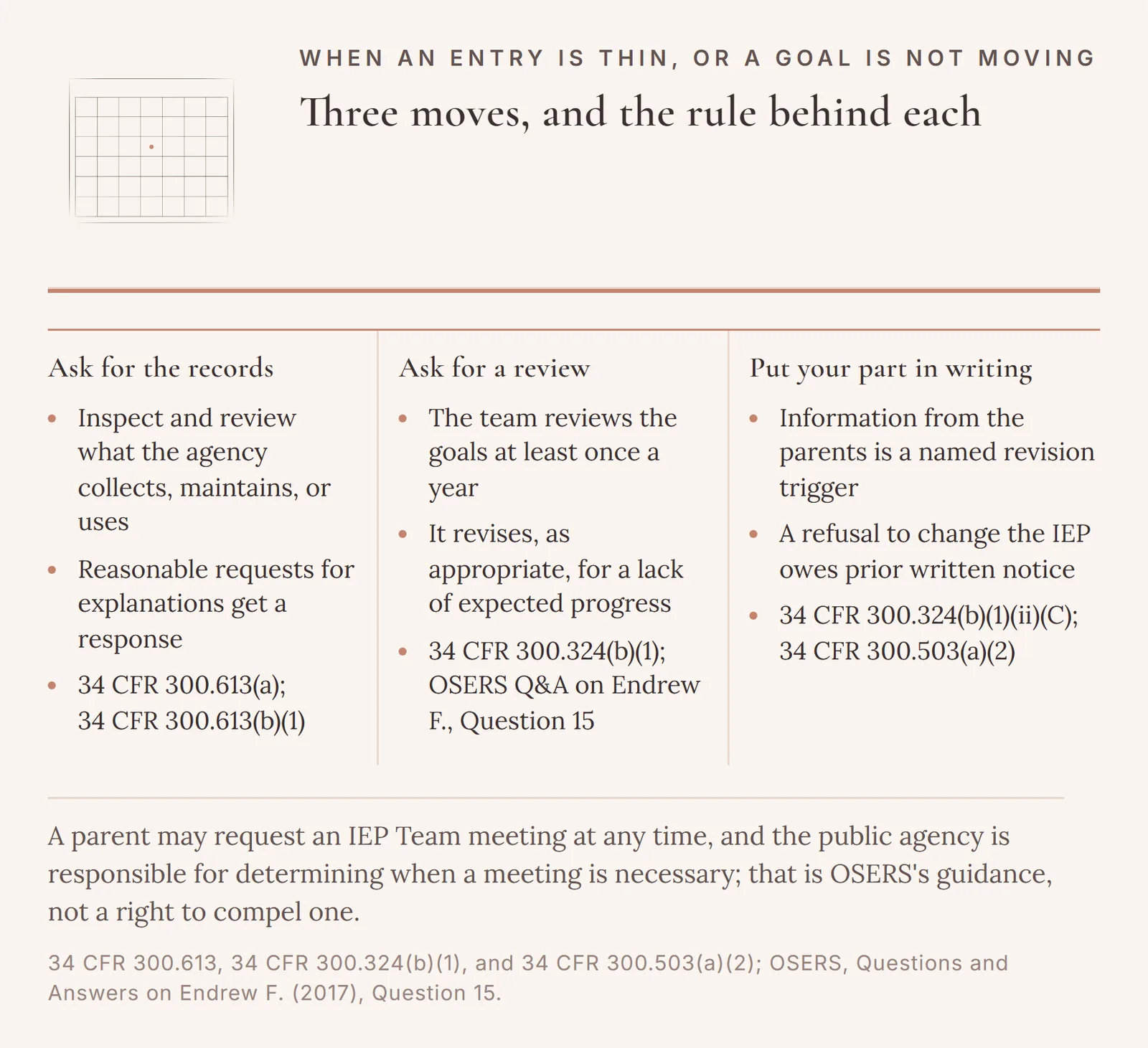
A word is a summary of measurements someone took on particular days, and those live in the records it was written from. Each participating agency must permit parents to inspect and review any education record it collects, maintains, or uses, without unnecessary delay and before any meeting regarding an IEP, and in no case more than 45 days after the request (34 CFR 300.613(a)). Forty-five days is the outer wall, not the ordinary wait. Reasonable requests for explanations get a response (34 CFR 300.613(b)(1)).
Two limits keep this honest. Education records are those directly related to a student and maintained by the agency, and the definition leaves out records kept in the sole possession of the maker, used only as a memory aid, and shown to no one else (34 CFR 99.3, borrowed into the special education rules by 34 CFR 300.611(b)). And nothing in the records rules makes a school produce data it never collected: the Department's FERPA guidance says FERPA does not require schools to create education records.
What has to happen when a goal is not moving
The IEP Team must review the IEP periodically, but not less than annually, to determine whether the annual goals are being achieved (34 CFR 300.324(b)(1)(i)), and revise it, as appropriate, to address any lack of expected progress toward them (34 CFR 300.324(b)(1)(ii)(A)). The judgment stays with the team; no rule says a stalled goal must be rewritten, and none lets a lack of expected progress go unaddressed. Your own reading belongs there: information about the child provided to, or by, the parents is one of the things a revision addresses (34 CFR 300.324(b)(1)(ii)(C)).
Expected progress is not defined in the regulation, though the Supreme Court held in Endrew F. v. Douglas County School District RE-1 (2017) that a school must offer an IEP reasonably calculated to enable a child to make progress appropriate in light of the child's circumstances. It set no number. Practitioners use a drawn line instead: the IRIS Center, a technical assistance resource funded by the Department's Office of Special Education Programs, describes a goal line from the baseline to the end-of-year goal, and the four most recent data points below it as a sign the instruction should change. Practice, never a legal test.
How to read the report you were handed
- Open the IEP beside the report, at the goal this entry belongs to.
- Write the baseline beside the entry, from the present levels (34 CFR 300.320(a)(1)), and the target, from the goal (34 CFR 300.320(a)(2)(i)).
- Name the measure the IEP says this goal will be measured by (34 CFR 300.320(a)(3)(i)), then check that the entry reports on that same measure.
- Read the entry against both numbers, and against how much of the IEP year is gone.
- Check the housekeeping: dates on the data, an entry for every goal, wording not copied from the last report, and a report on schedule.
- Ask in writing for what is missing, naming the goal, the report date, and the measure, and asking to inspect the records this entry was written from (34 CFR 300.613(a)).
- If a goal is not moving, ask the team to look at it. OSERS's guidance on Endrew F. says parents may request an IEP Team meeting at any time, while the agency decides when one is necessary.
Work one goal at a time, not one page. A page averages, and a goal does not.
Mistakes and edge cases
Expecting every sheet of paper. The right reaches what the agency collects, maintains, or uses; the sole-possession exception at 34 CFR 99.3 sits outside it.
Treating an undelivered service as a stalled goal. A goal that has not moved because the service in the IEP was not delivered is a different problem with a different answer.
Assuming a no ends the conversation. A refusal to change your child's program, placement, or services carries prior written notice, the school's written record of what it refused and why (34 CFR 300.503(a)(2)).
Assuming the federal floor is the whole rule. Massachusetts requires written progress reports at least as often as report cards or progress reports go to students without disabilities (603 CMR 28.07(3)). Minnesota requires the IEP to say how parents will be regularly informed of progress and of the extent to which that progress is sufficient to reach the goals by year end (Minn. R. 3525.2810, subp. 1, item A, subitem (9)). Your state may set its own rule.
Every state has a free, federally funded Parent Training and Information Center, and reading a progress report with a parent is ordinary work for them. Find yours at parentcenterhub.org.
FAQ
Can I see the data behind an entry?
Ask to inspect and review the education records the agency collects, maintains, or uses (34 CFR 300.613(a)). The Department's FERPA guidance says the rules do not require a school to create records it never made.
Should short-term objectives be on the report?
Only for some children. Benchmarks or short-term objectives are required for children who take alternate assessments aligned to alternate academic achievement standards (34 CFR 300.320(a)(2)(ii)). A team may add them by choice.
The entry says progressing on a goal that looks stuck. What now?
Ask what measure produced the entry and for the data points behind it, then ask the team to review it. The team must review the IEP at least annually to determine whether the annual goals are being achieved, and revise it, as appropriate, for a lack of expected progress (34 CFR 300.324(b)(1)).
Sources
- eCFR, 34 CFR 300.320, the contents of an IEP (https://www.ecfr.gov/current/title-34/section-300.320)
- eCFR, 34 CFR 300.324, review and revision (https://www.ecfr.gov/current/title-34/section-300.324)
- eCFR, 34 CFR 300.613, access rights (https://www.ecfr.gov/current/title-34/section-300.613)
- eCFR, 34 CFR 300.611, records definitions (https://www.ecfr.gov/current/title-34/section-300.611)
- eCFR, 34 CFR 99.3, education records defined (https://www.ecfr.gov/current/title-34/section-99.3)
- eCFR, 34 CFR 300.503, prior written notice (https://www.ecfr.gov/current/title-34/section-300.503)
- Federal Register, 71 FR 46540 at 46664 (https://www.govinfo.gov/content/pkg/FR-2006-08-14/pdf/06-6656.pdf)
- Supreme Court, Endrew F., No. 15-827 (https://www.supremecourt.gov/opinions/16pdf/15-827_0pm1.pdf)
- Department of Education, OSERS, Endrew F. questions and answers (https://sites.ed.gov/idea/files/qa-endrewcase-12-07-2017.pdf)
- Department of Education, FERPA FAQ on creating records (https://studentprivacy.ed.gov/faq/does-educational-agency-or-institution-have-discretion-over-what-education-records-it-decides)
- IRIS Center, create a goal line (https://iris.peabody.vanderbilt.edu/module/pmr/cresource/q2/p05/)
- IRIS Center, progress monitoring decisions (https://iris.peabody.vanderbilt.edu/module/pmr/cresource/q2/p07/)
- National Center for Education Statistics, students with disabilities (https://nces.ed.gov/programs/coe/indicator/cgg/students-with-disabilities)
- Massachusetts Department of Elementary and Secondary Education, 603 CMR 28.07 (https://www.doe.mass.edu/lawsregs/603cmr28.html?section=07)
- Minnesota Revisor of Statutes, Minn. R. 3525.2810 (https://www.revisor.mn.gov/rules/3525.2810/)
- Center for Parent Information and Resources, find your parent center (https://www.parentcenterhub.org/find-your-center/)