The short answer
If a school district evaluated your child and you disagree with the results, federal law gives you the right to ask for a second evaluation by an outside examiner, paid for by the district (34 CFR 300.502(b)(1)). Once you ask, the district must either pay for that evaluation or file for a hearing to defend its own.
What a second opinion costs, and who can end up paying
Private testing is expensive. Families who pay out of pocket for psychological, neuropsychological, or speech and language evaluations commonly spend in the low thousands of dollars, with the total moving by region, discipline, and number of areas tested. Any figure you find online is a starting point, not a quote.
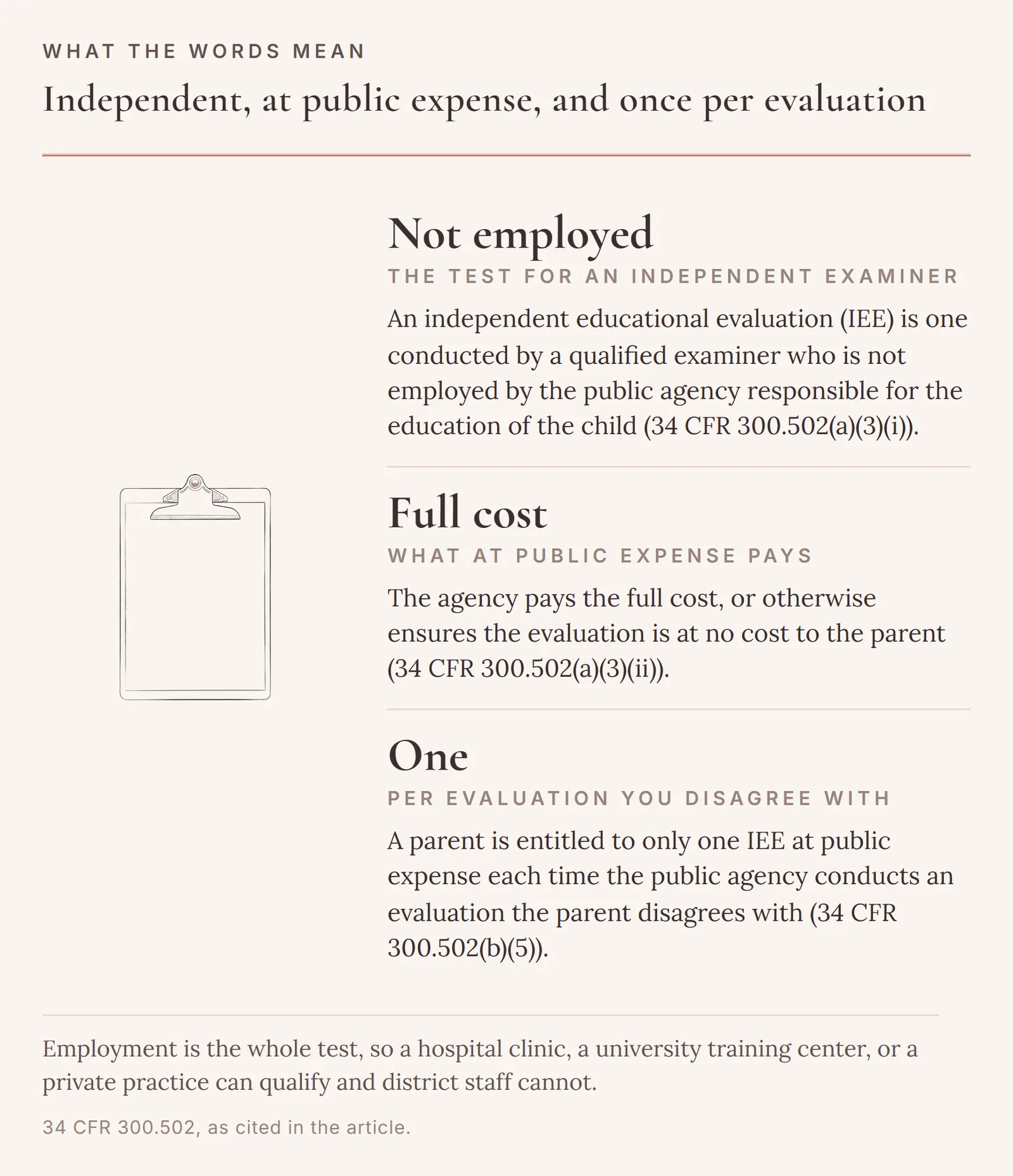
The federal regulations call outside testing an independent educational evaluation (IEE), defined as "an evaluation conducted by a qualified examiner who is not employed by the public agency responsible for the education of the child in question" (34 CFR 300.502(a)(3)(i)). Employment is the whole test, so a hospital clinic, a university training center, or a private practice can qualify and district staff cannot. Parents have the right to obtain one (34 CFR 300.502(a)(1)). The part most parents are never told concerns the money: a parent has the right to an IEE at public expense if the parent disagrees with an evaluation obtained by the public agency (34 CFR 300.502(b)(1)).
That right carries weight because of what follows. When a parent asks for an IEE at public expense, the district must, without unnecessary delay, either file a due process complaint to show that its own evaluation is appropriate, or ensure that the independent evaluation is provided at public expense (34 CFR 300.502(b)(2)(i)-(ii)). A flat refusal is not on that list. Neither is silence.
How the public expense rule works
When does the right to public payment attach
This is where the rule is misread most often. Public expense is tied to disagreement with an evaluation the district conducted or obtained (34 CFR 300.502(b)(1)). If a district has never evaluated a child, there is nothing yet to disagree with, and the public expense right has not attached. In that situation the first written request is a request for an initial evaluation, not a request for an IEE. A family can still obtain private testing, at its own cost.
What are the district's two lawful answers
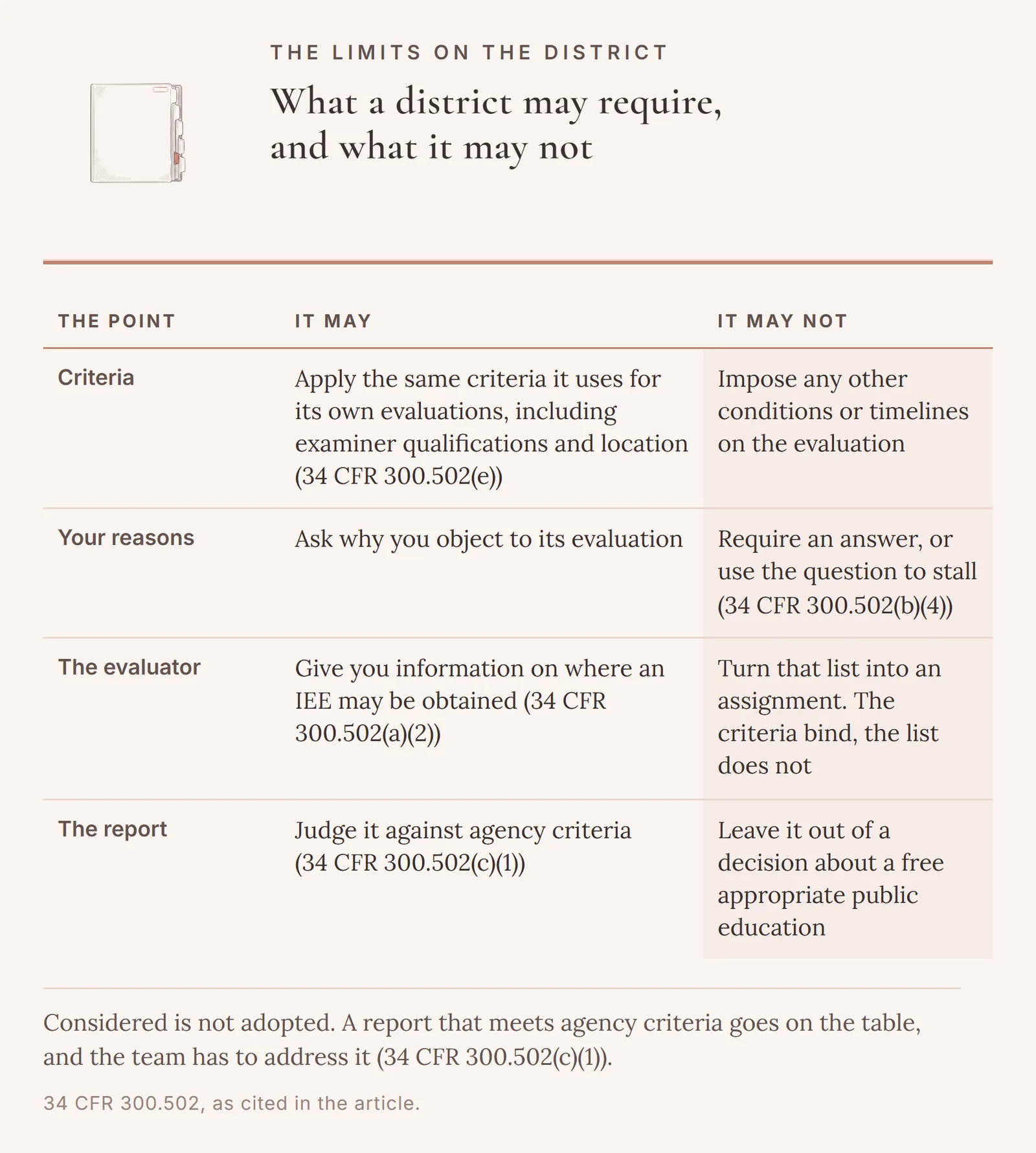
Fund it, or file. Those are the options in 34 CFR 300.502(b)(2)(i)-(ii), and filing means a due process complaint, the step that opens a hearing (34 CFR 300.507). The district may ask why a parent objects to its evaluation, but it may not require an explanation, and it may not use the question to unreasonably delay either providing the IEE at public expense or filing (34 CFR 300.502(b)(4)).
What can the district require of the evaluator
Its own criteria, and nothing past them. If an IEE is at public expense, the criteria under which it is obtained, including the location of the evaluation and the qualifications of the examiner, must be the same as the criteria the agency uses when it initiates an evaluation, and no other conditions or timelines may be imposed (34 CFR 300.502(e)). A cost ceiling or credential standard the district applies to its own evaluators can apply here too; a rule written only for parents cannot.
Does the district have to use the report
It has to consider it. An evaluation the parent obtains, at public expense or at private expense and shared with the district, must be considered by the agency, if it meets agency criteria, in any decision made about the provision of a free appropriate public education, or FAPE (34 CFR 300.502(c)(1)). Considered is not adopted. It means the report goes on the table and the team has to address it.
How to ask, step by step
- Confirm the district evaluated. Find the evaluation report and the date the team completed it. Public expense attaches to an evaluation the district conducted or obtained (34 CFR 300.502(b)(1)). No district evaluation, no IEE at public expense yet.
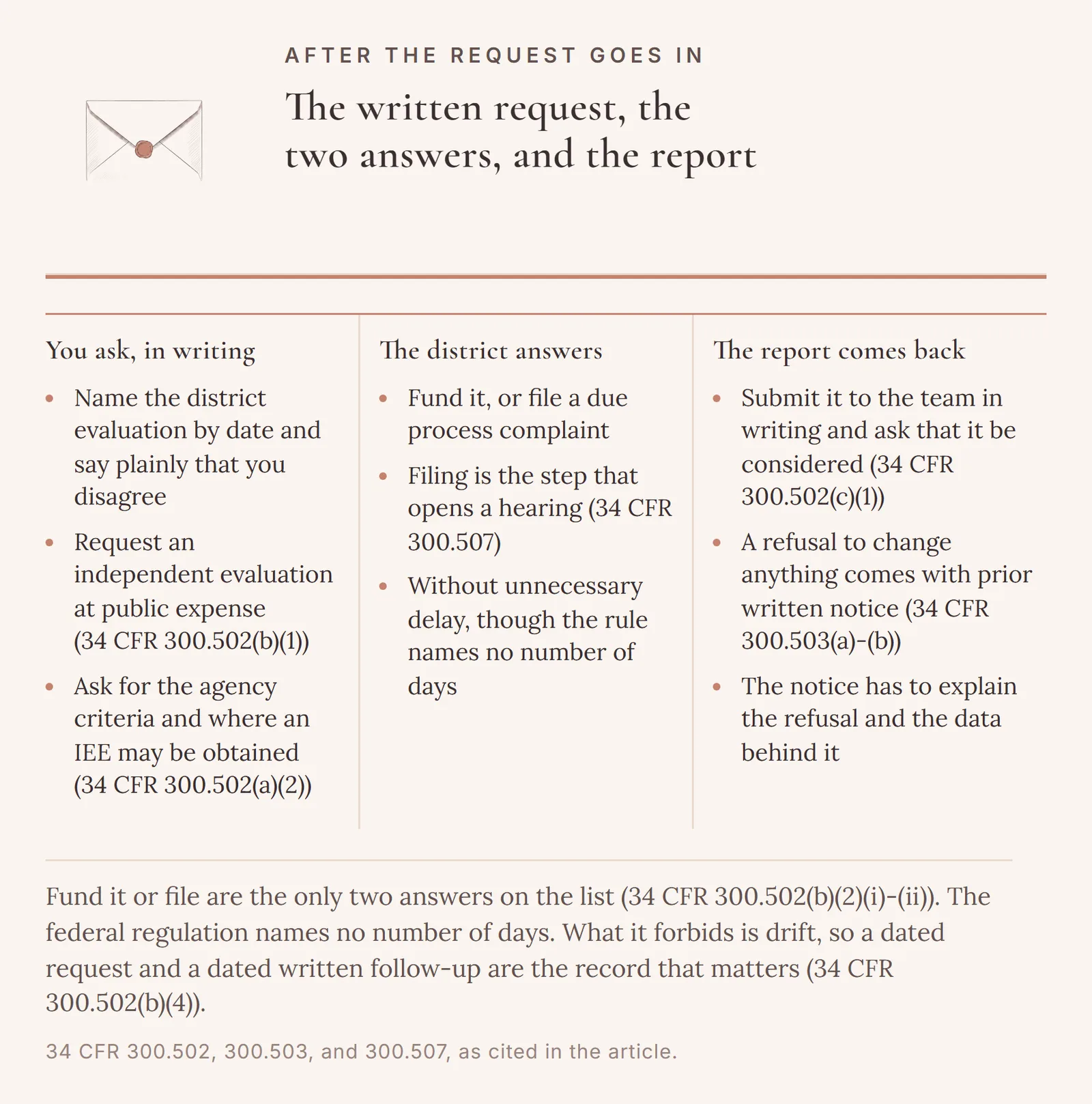
- Put the disagreement in writing, to someone who can act on it. Name the evaluation by date, state plainly that you disagree with it, and request an independent educational evaluation at public expense. Send it to the special education director or coordinator, copy the case manager, and keep a dated copy.
- Ask for the criteria and the list. On request for an IEE, the agency must provide information about where an independent evaluation may be obtained and the agency criteria that apply (34 CFR 300.502(a)(2)).
- Expect one of exactly two answers (34 CFR 300.502(b)(2)(i)-(ii)). If a third thing shows up instead, a new form, a required waiting period, one named clinic and no other, hold it up against the criteria rule in 34 CFR 300.502(e).
- Track "without unnecessary delay" without inventing a deadline. The federal regulation names no number of days. What it forbids is drift (34 CFR 300.502(b)(4)). In practice that looks like a dated request, a dated written follow-up when nothing comes back, and a record of the dates. Some states publish their own response window in state regulation, so check your state education agency's rules and the procedural safeguards notice you were given.
- When the independent report is finished, submit it to the team in writing and ask that it be considered at the next meeting (34 CFR 300.502(c)(1)).
Mistakes and edge cases
Paying first and asking later. This is the costly one. "At public expense" means the agency pays the full cost or otherwise ensures the evaluation is at no cost to the parent (34 CFR 300.502(a)(3)(ii)), not that it reimburses testing a parent already bought. The district's lawful response to a request is to fund it or to file (34 CFR 300.502(b)(2)(i)-(ii)), and if a hearing ends with a decision that the district's evaluation was appropriate, the parent still has the right to an independent evaluation, but not at public expense (34 CFR 300.502(b)(3)). Both halves of this are true at once: the right is real, and it is a right to be answered rather than a guarantee of a check. Asking first, in writing, costs nothing and keeps both answers in play.
Treating one IEE as an open account. A parent is entitled to only one IEE at public expense each time the public agency conducts an evaluation the parent disagrees with (34 CFR 300.502(b)(5)). A later district evaluation can open a new one; disagreeing twice with the same report does not.
Assuming consideration means agreement. If the team considers an independent evaluation and then declines to change the identification, evaluation, placement, or provision of FAPE, that refusal comes with prior written notice under 34 CFR 300.503(a)-(b), which has to explain the refusal and the data behind it.
FAQ
Does the district have to tell me where to get an independent evaluation
Yes. On request for an IEE, the public agency must provide information about where an independent educational evaluation may be obtained and the agency criteria that apply (34 CFR 300.502(a)(2)). A list is information, not an assignment: the criteria bind, the list does not.
Can the district make me explain why I disagree
It can ask. It cannot require an answer, and it cannot use the question to stall payment or a filing (34 CFR 300.502(b)(4)). Some parents answer anyway, because naming a specific gap, an area never assessed or a measure used outside its range, tends to move faster than a hearing.
What happens if the district files and the hearing goes its way
The parent still has the right to an independent educational evaluation, at private expense (34 CFR 300.502(b)(3)). That report can still be shared with the team, and if it meets agency criteria it still has to be considered in decisions about FAPE (34 CFR 300.502(c)(1)).
Is there free help with any of this
Yes. Every state has a federally funded Parent Training and Information Center, free to families, staffed by people who read these regulations and their state's rules for a living. Find the center for your state at parentcenterhub.org.
Sources
- Electronic Code of Federal Regulations, 34 CFR 300.502, Independent educational evaluation (https://www.ecfr.gov/current/title-34/subtitle-B/chapter-III/part-300/subpart-E/section-300.502)
- US Department of Education, IDEA regulations, Sec. 300.502 Independent educational evaluation (https://sites.ed.gov/idea/regs/b/e/300.502)
- Electronic Code of Federal Regulations, 34 CFR 300.503, Prior written notice by the public agency (https://www.ecfr.gov/current/title-34/subtitle-B/chapter-III/part-300/subpart-E/section-300.503)
- US Department of Education, IDEA regulations, Sec. 300.507 Filing a due process complaint (https://sites.ed.gov/idea/regs/b/e/300.507)