The short answer
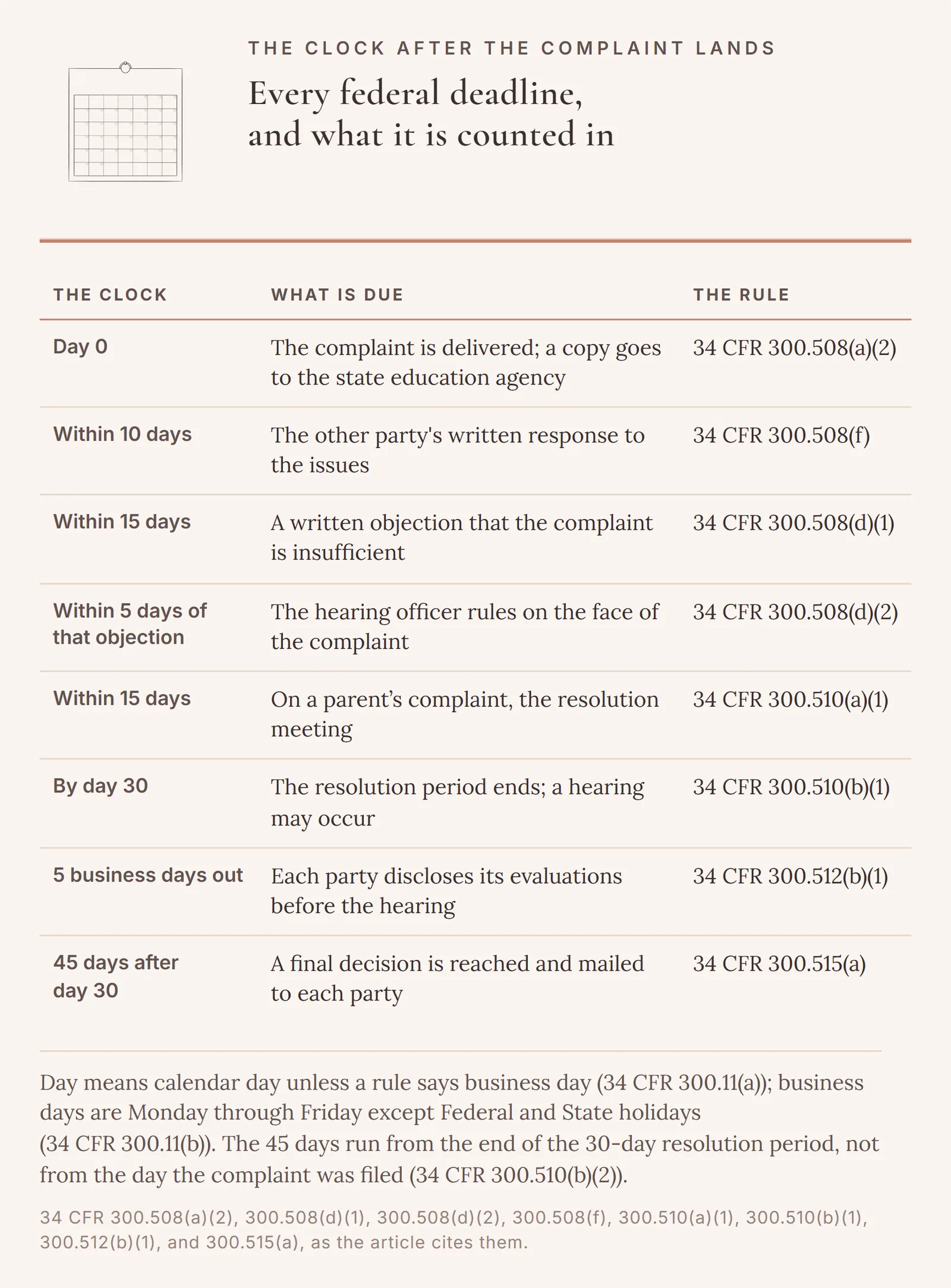
Filing a due process complaint starts a clock, not a hearing. The district has 15 days to convene a resolution meeting (34 CFR 300.510(a)(1)) and 30 days from receipt to resolve the complaint (34 CFR 300.510(b)(1)). Only then may a hearing occur, with a decision due 45 days after that period ends (34 CFR 300.515(a)).
What filing actually starts
A due process complaint is the written filing that opens the route to a hearing before a hearing officer, the impartial person who writes the decision. A parent or a public agency may file one on a child's identification, evaluation, or educational placement, or on the provision of FAPE, a free appropriate public education (34 CFR 300.507(a)(1)). The complaint must allege a violation that occurred not more than two years before the parent knew or should have known of it (34 CFR 300.507(a)(2)).
Your state may set its own explicit limit instead. Two narrow exceptions apply where the district misrepresented that it had resolved the problem or withheld information it owed the parent, and a hearing officer decides whether one applies (34 CFR 300.511(f)).
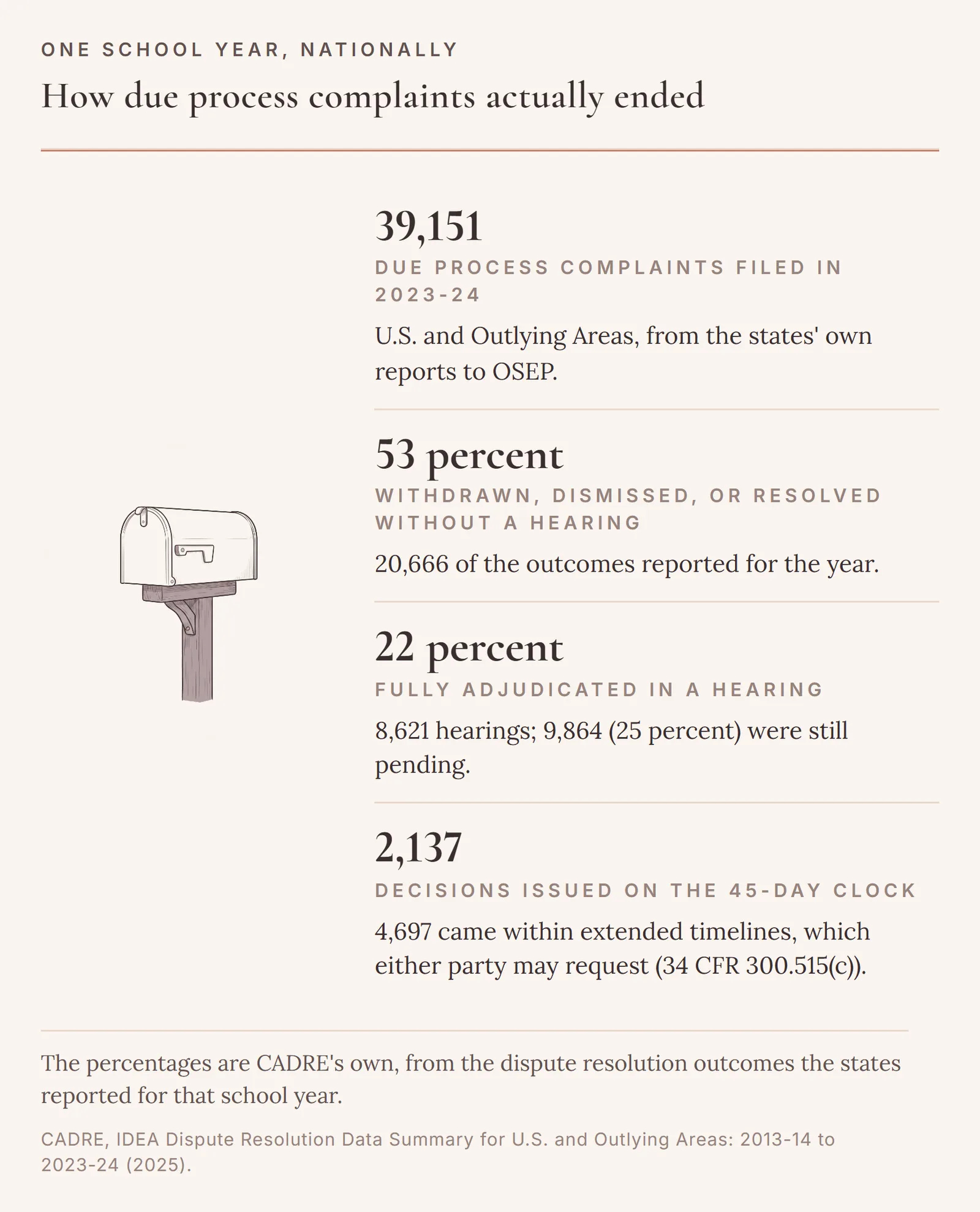
In the 2023-24 school year, 39,151 due process complaints were filed in the U.S. and Outlying Areas (CADRE, IDEA Dispute Resolution Data Summary). Almost all of what follows happens on paper, on a schedule.
How the clock works
What the complaint has to say, and what comes back
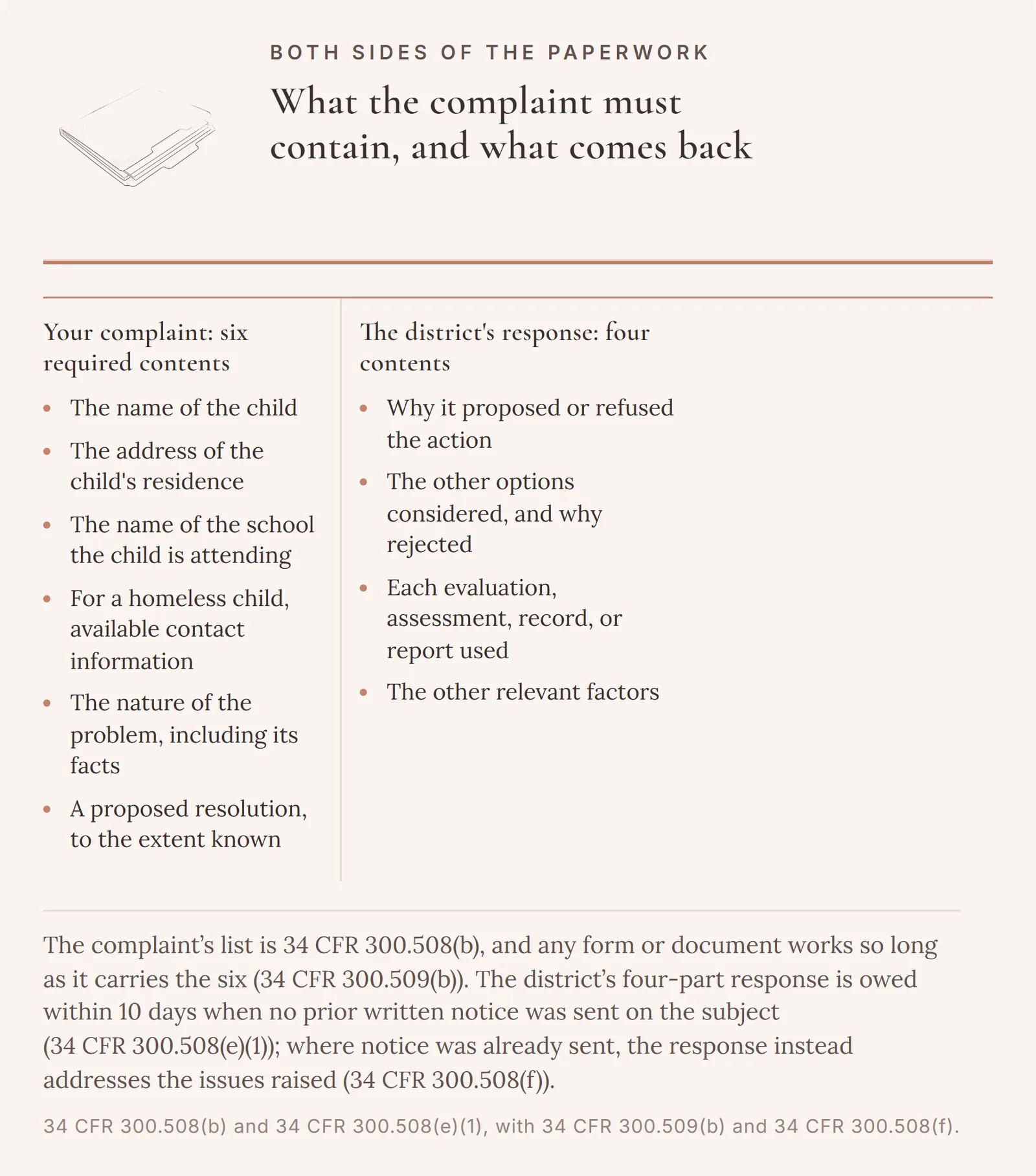
The complaint goes to the other party, and a copy to the state education agency (34 CFR 300.508(a)(2)). Six things have to be in it, and there is no hearing until a complaint carrying them is filed (34 CFR 300.508(b) and 34 CFR 300.508(c)).
Within 10 days, the party that received the complaint sends a response addressing the issues raised (34 CFR 300.508(f)). Prior written notice is the written explanation a district owes before it proposes or refuses a change. Where none was sent on the subject of the complaint, the district sends a four-part response instead, inside the same 10 days (34 CFR 300.508(e)(1)).
A second clock runs beside that one. The complaint is deemed sufficient unless the receiving party objects in writing within 15 days of receipt (34 CFR 300.508(d)(1)), and a hearing officer then has five days to rule on its face (34 CFR 300.508(d)(2)).
Who is in the room at the resolution meeting
Within 15 days of receiving notice of a parent's complaint, the district must convene a resolution meeting (34 CFR 300.510(a)(1)), where the parent lays out the complaint and the district gets its chance to resolve it (34 CFR 300.510(a)(2)). The parent and the district decide together which members of the IEP Team, the Individualized Education Program team, attend (34 CFR 300.510(a)(4)). Someone with decision-making authority for the agency has to be there (34 CFR 300.510(a)(1)(i)). The district's attorney may not attend unless the parent is accompanied by an attorney (34 CFR 300.510(a)(1)(ii)). OSEP's 2013 questions and answers on dispute resolution read that limit as triggered by an attorney only, so a non-attorney advocate does not open the door.
Unlike mediation, nothing said there is confidential by law: either side may introduce those discussions later unless the parties agree otherwise, OSEP's reading in the same questions and answers (Questions D-17 and D-18). I think that one difference should shape how a parent speaks in that room.
When the 45-day decision clock actually starts
Not on the day you file. If the district has not resolved the complaint to the parent's satisfaction within 30 days of receipt, the hearing may occur (34 CFR 300.510(b)(1)), and the decision timeline begins at the expiration of that 30-day period (34 CFR 300.510(b)(2)). A final decision is due not later than 45 days after that, and mailed to each party (34 CFR 300.515(a)). A hearing or reviewing officer may grant a specific extension at either party's request (34 CFR 300.515(c)).
Three written events can move that start date. Both parties agree in writing to waive the resolution meeting (34 CFR 300.510(c)(1)). Or, after mediation or the meeting has started but before the 30 days end, they agree in writing that no agreement is possible (34 CFR 300.510(c)(2)). Or one withdraws from a mediation both had agreed in writing to continue past day 30 (34 CFR 300.510(c)(3)). Day means calendar day unless a rule says business day (34 CFR 300.11(a)).
What happens, step by step
- Note the date the district received the complaint. The 15-day meeting clock runs from the district's receipt of a parent's complaint (34 CFR 300.510(a)(1)).
- Watch for the response inside 10 days (34 CFR 300.508(f)), or for the four-part response if no prior written notice was sent on the subject (34 CFR 300.508(e)(1)).
- Expect the resolution meeting inside 15 days, settle which IEP Team members will be there (34 CFR 300.510(a)(4)), and treat it as on the record.
- If it ends in a resolution, the agreement is signed by the parent and by an agency representative with authority to bind the agency (34 CFR 300.510(d)). Either party may void it within 3 business days (34 CFR 300.510(e)), and business days run Monday through Friday except Federal and State holidays (34 CFR 300.11(b)).
- If day 30 passes without one, the decision clock starts (34 CFR 300.510(b)(2)). Two five-business-day rules then sit before any hearing: undisclosed evidence may be barred (34 CFR 300.512(a)(3)), and each party discloses the evaluations completed by then and the recommendations based on them (34 CFR 300.512(b)(1)).
- Keep the case inside what the complaint says: the party requesting the hearing may not raise issues at the hearing that were not raised in the complaint, unless the other party agrees (34 CFR 300.511(d)). Amending it takes the other party's written consent or the hearing officer's permission (34 CFR 300.508(d)(3)), and an amended complaint restarts the resolution timelines (34 CFR 300.508(d)(4)).
Mistakes and edge cases
Of the outcomes reported for 2023-24, 20,666 (53 percent) were withdrawn, dismissed, or resolved without a hearing, 8,621 (22 percent) were fully adjudicated, and 9,864 (25 percent) were still pending. Of the decisions reported for the year, 2,137 were issued within the 45-day timeline and 4,697 within extended timelines (CADRE). That is one year of national data, not a forecast for any one complaint.
Missing the resolution meeting. A parent's failure to participate delays both timelines until it is held (34 CFR 300.510(b)(3)), and after reasonable documented efforts the district may ask a hearing officer to dismiss the complaint (34 CFR 300.510(b)(4)). If the district does not hold the meeting within 15 days, the parent may ask a hearing officer to start the hearing timeline (34 CFR 300.510(b)(5)).
Running a written state complaint on the same issue. That route is decided in writing without a hearing (34 CFR 300.152(a)(5)), and the state sets aside any part of it that a due process hearing is also addressing, until that hearing ends (34 CFR 300.152(c)(1)).
Filing carries one more duty: the public agency must inform the parent of any free or low-cost legal and other relevant services in the area (34 CFR 300.507(b)(2)). Ask for that list. Every state also has a federally funded Parent Training and Information Center, whose staff walk parents through these clocks at no cost, at parentcenterhub.org.
FAQ
Do I have to use my state's form
No. Each state education agency must develop model forms, but neither the state nor the district may require their use, and any document meeting the content requirements works (34 CFR 300.509(a); 34 CFR 300.509(b)).
Does my child's program change while this is pending
Not by default. During the pendency of the proceeding, unless the agency and the parents agree otherwise, the child remains in his or her current educational placement (34 CFR 300.518(a)).
What if we choose mediation instead of the resolution meeting
The meeting need not be held if both sides agree in writing to waive it, or if both agree to use mediation (34 CFR 300.510(a)(3)). A written waiver starts the 45-day hearing clock the day after (34 CFR 300.510(c)(1)). If you mediate instead, the 30-day period still runs and the clock starts when it expires (34 CFR 300.510(b)(2)), unless one of the other written events moves it (34 CFR 300.510(c)). Mediation has rules of its own, and the Mediation and Due Process Playbook covers that route.
Sources
- eCFR, 34 CFR 300.507, filing a complaint (https://www.ecfr.gov/current/title-34/section-300.507)
- eCFR, 34 CFR 300.508, the complaint and responses (https://www.ecfr.gov/current/title-34/section-300.508)
- eCFR, 34 CFR 300.509, model forms (https://www.ecfr.gov/current/title-34/section-300.509)
- eCFR, 34 CFR 300.510, the resolution process (https://www.ecfr.gov/current/title-34/section-300.510)
- eCFR, 34 CFR 300.511, the hearing, its subject matter, and the filing exceptions (https://www.ecfr.gov/current/title-34/section-300.511)
- eCFR, 34 CFR 300.512, hearing rights and disclosure (https://www.ecfr.gov/current/title-34/section-300.512)
- eCFR, 34 CFR 300.515, decision timelines (https://www.ecfr.gov/current/title-34/section-300.515)
- eCFR, 34 CFR 300.518, the child's status (https://www.ecfr.gov/current/title-34/section-300.518)
- eCFR, 34 CFR 300.152, state complaint procedures and hearings (https://www.ecfr.gov/current/title-34/section-300.152)
- eCFR, 34 CFR 300.11, day and business day (https://www.ecfr.gov/current/title-34/section-300.11)
- Department of Education, OSEP Memo 13-08, dispute resolution questions and answers (https://sites.ed.gov/idea/files/policy_speced_guid_idea_memosdcltrs_acccombinedosersdisputeresolutionqafinalmemo-7-23-13.pdf)
- CADRE, IDEA Dispute Resolution Data Summary for U.S. and Outlying Areas: 2013-14 to 2023-24 (2025) (https://www.cadreworks.org/resources/data-resources/national-data)
- Center for Parent Information and Resources, find your parent center (https://www.parentcenterhub.org/find-your-center/)