The short answer
The IEP (Individualized Education Program) Team must consider the concerns of the parents for enhancing the education of their child when it develops the program. It is one of four considerations at 34 CFR 300.324(a)(1). The team need not copy your words into the document, and a refused request is answered in prior written notice.
What the consideration duty is worth
Consideration is a real duty and a limited one. The team has to weigh what you bring; it does not have to agree with it. The duty puts your page where people who were not in the room can read it later.
A published analysis of 88 IEPs of students with intellectual and developmental disabilities identified 124 parent concerns recorded in those documents. For 83 of them, 67 percent, the reviewers found a matching goal or service. For 41, 33 percent, there was none (Kurth and colleagues, AAIDD). One study of one group is not every IEP, but the shape is worth knowing.
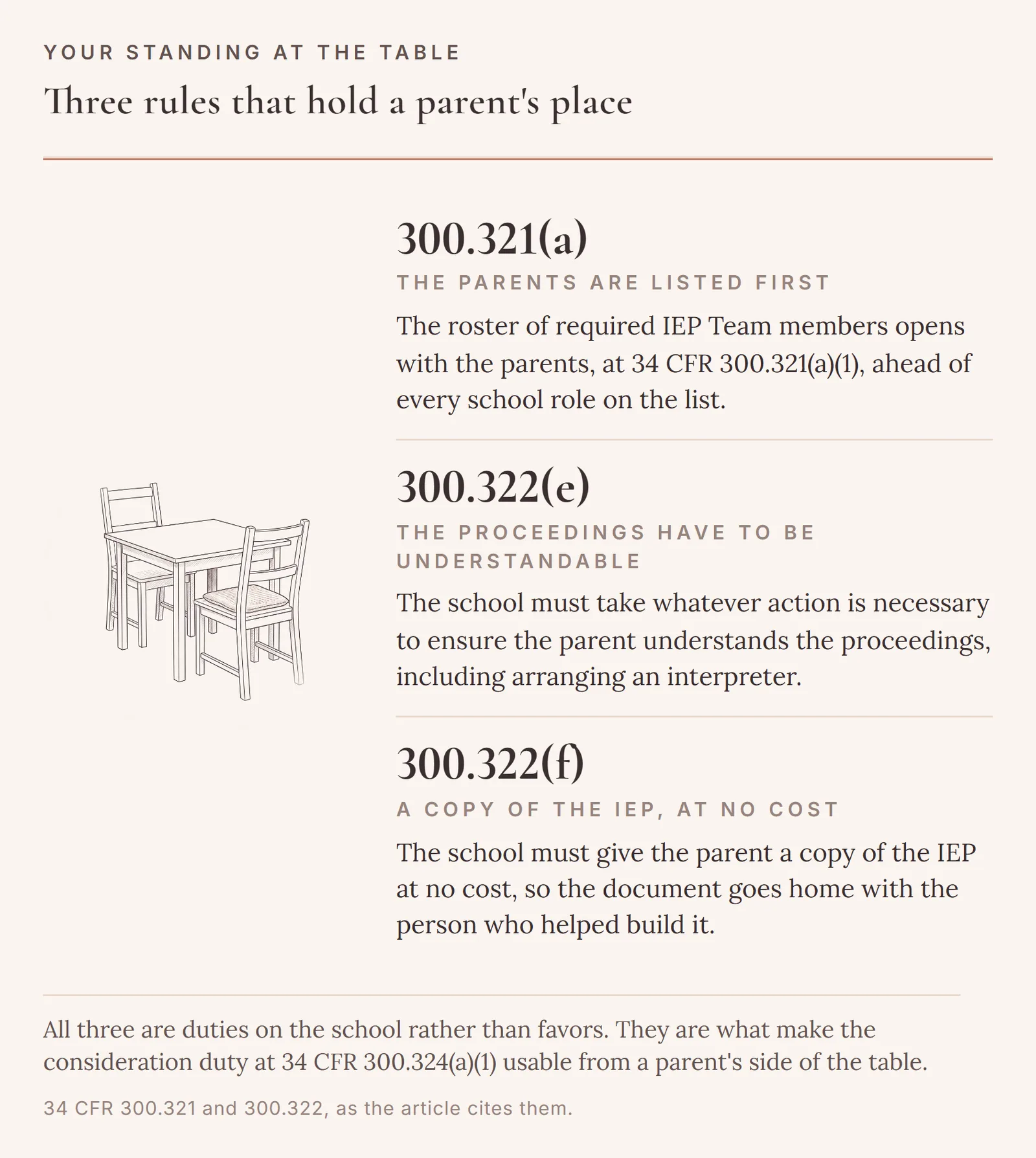
You are also not a guest at that table. The roster of required IEP Team members opens with the parents (34 CFR 300.321(a)(1)), and two more rules keep the seat usable.
How the duty works
What does the team have to consider
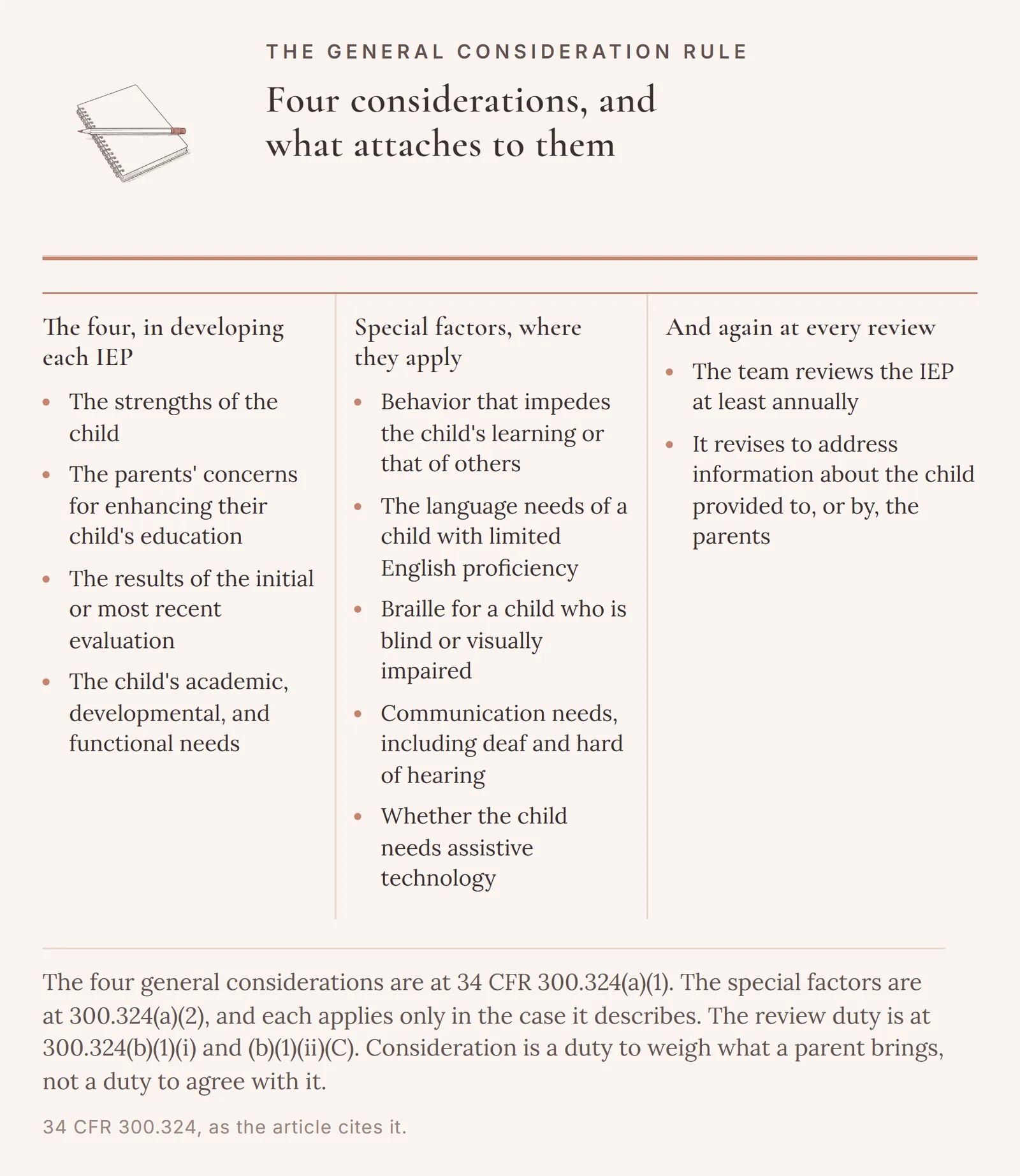
In developing each child's IEP, the team must consider four things: the strengths of the child, the concerns of the parents for enhancing the education of their child, the results of the initial or most recent evaluation, and the child's academic, developmental, and functional needs (34 CFR 300.324(a)(1)). An evaluation is the process that decides whether a child has a disability and what services follow (34 CFR 300.15). Three of those four are gathered by the school. One of them is yours.
Read the second item again. It is not "the concerns of the parents." It is "the concerns of the parents for enhancing the education of their child" (34 CFR 300.324(a)(1)(ii)). The duty attaches to concerns pointed at your child's education, which is why a paragraph about how a difficulty affects reading lands and a paragraph about how the year has felt usually does not.
The same section adds special factors where they apply, including behavior that impedes learning and assistive technology (34 CFR 300.324(a)(2)). The duty does not stop after the first meeting: the team reviews the IEP at least annually and revises it to address information about the child provided to, or by, the parents (34 CFR 300.324(b)(1)(i) and (b)(1)(ii)(C)).
Where do your words actually go
Every IEP must contain a statement of present levels of academic achievement and functional performance, the first component the regulation lists (34 CFR 300.320(a)(1)), including how the disability affects progress in the general education curriculum. The annual goals are written from that starting point (300.320(a)(2)(i)), and the services are written to make the goals reachable (300.320(a)(4)). Read in that order, the document answers its own opening section.
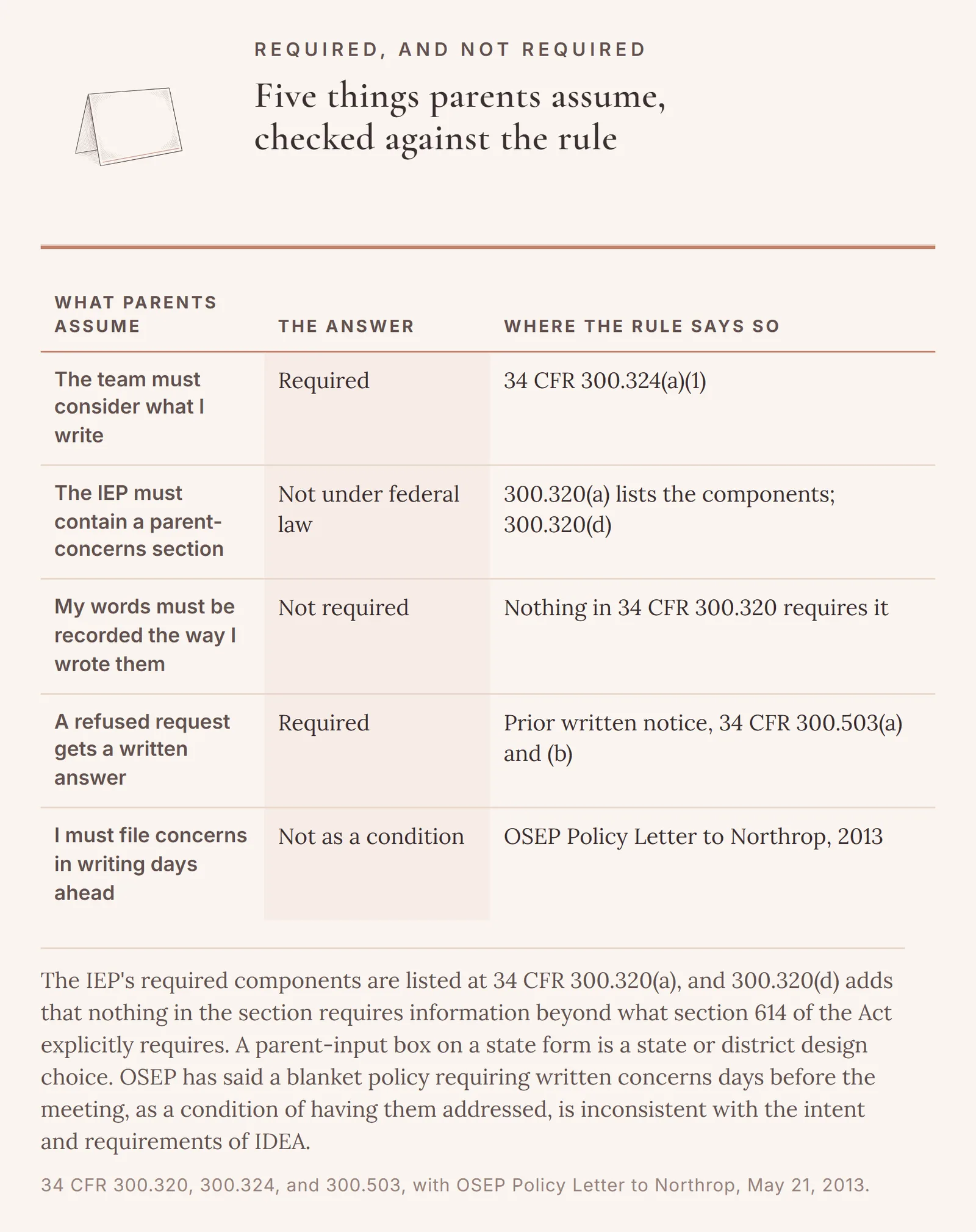
What federal law does not require is a place to put you. The components a written IEP must contain are listed at 34 CFR 300.320(a), and a parent-concerns section is not among them; 300.320(d) adds that nothing in the section requires information beyond what section 614 of the Act explicitly requires. The parent-input boxes come from the states, which design their own forms; Colorado's guidance, for one, folds parent input into present levels.
What does the meeting itself owe you
The school must notify you early enough that you have a real opportunity to attend, at a mutually agreed time and place (34 CFR 300.322(a)). It must ensure you understand the proceedings (300.322(e)) and hand you a copy of the IEP at no cost (300.322(f)). The right to participate attaches to meetings, and a meeting does not include an informal or unscheduled conversation with staff (34 CFR 300.501(b)(3)). A concern raised at pickup has no procedural existence. A written one does.
What happens when the school refuses what you asked for
Most concerns carry a request inside them. When the school refuses to initiate or change your child's identification, evaluation, or educational placement, or the provision of FAPE, it owes you prior written notice (34 CFR 300.503(a)(1) and (a)(2)). FAPE is a free appropriate public education: special education and related services at public expense, without charge, under an IEP (34 CFR 300.17).
Prior written notice is the written explanation of that decision, and it has seven required elements (34 CFR 300.503(b)). The one that matters most to a parent whose concern was set aside is the description of other options the team considered and why they were rejected.
The duty attaches to the substantive request, not to the wording. Declining to copy your sentences into the document is not itself a refusal that triggers the notice (34 CFR 300.503(a)(2)).
How to put your concerns in front of the team
- Read the present levels section of your child's current IEP first. Every goal and service is written against it (34 CFR 300.320(a)(1)).
- Write down what you have seen at home, with dates. No one else at the table has that.
- Point each observation at school: how the difficulty shows up in the school day. That is the wording the duty uses (34 CFR 300.324(a)(1)(ii)).
- Separate a concern from a request. A concern describes; a request asks for something specific, and a refusal is what prior written notice answers (34 CFR 300.503(a)(2)).
- Date the page, put your child's name on it, and send it to the case manager ahead of the meeting, asking that it be included with the IEP.
- When the IEP comes home, read present levels against what you sent, and ask in writing about anything you cannot find.
Mistakes and edge cases
Waiting to be asked in the right format. Sending your concerns ahead usually helps, and it is a choice rather than a condition. A blanket district policy requiring concerns in writing three days before the meeting, as a condition of having them addressed, is inconsistent with the intent and requirements of IDEA, the federal special education law (Office of Special Education Programs, or OSEP, Policy Letter to Northrop, May 21, 2013).
Expecting the words back verbatim. A team that paraphrases you has not broken a rule. What you can ask is that the substance reach present levels, which the rest of the document is written against.
Assuming a wrong record is permanent. Under the federal student records law (FERPA), a parent who believes an education record is inaccurate or misleading may ask the school to amend it, and a school that refuses must tell the parent about the right to a hearing (34 CFR 99.20).
None of this is work a parent has to do alone. Every state has a free, federally funded Parent Training and Information Center, and reading a draft IEP alongside a parent is ordinary work for them. Find yours at parentcenterhub.org.
FAQ
Does the school have to write my concerns into the IEP?
It has to consider them (34 CFR 300.324(a)(1)). It does not have to reproduce them: a parent-concerns section is not among the components a written IEP must contain (34 CFR 300.320(a)).
Do I have to send my concerns in before the meeting?
OSEP has said a blanket district policy requiring it as a condition of having concerns addressed is inconsistent with the intent and requirements of IDEA (OSEP Policy Letter to Northrop, 2013). Sending ahead still tends to help.
What if the team considers my concern and still says no?
That is a permitted outcome: consideration is a duty to weigh, not a duty to agree. If the no was a refusal to change evaluation, placement, or FAPE, prior written notice must explain why and name the options the team rejected (34 CFR 300.503(b)).
Sources
- eCFR, 34 CFR 300.324, IEP development and revision (https://www.ecfr.gov/current/title-34/section-300.324)
- eCFR, 34 CFR 300.320, IEP contents (https://www.ecfr.gov/current/title-34/section-300.320)
- eCFR, 34 CFR 300.321, IEP Team membership (https://www.ecfr.gov/current/title-34/section-300.321)
- eCFR, 34 CFR 300.322, parent participation (https://www.ecfr.gov/current/title-34/section-300.322)
- eCFR, 34 CFR 300.501, meetings (https://www.ecfr.gov/current/title-34/section-300.501)
- eCFR, 34 CFR 300.503, prior written notice (https://www.ecfr.gov/current/title-34/section-300.503)
- eCFR, 34 CFR 300.15, evaluation defined (https://www.ecfr.gov/current/title-34/section-300.15)
- eCFR, 34 CFR 300.17, FAPE defined (https://www.ecfr.gov/current/title-34/section-300.17)
- Legal Information Institute, 34 CFR 99.20, amending a record (https://www.law.cornell.edu/cfr/text/34/99.20)
- U.S. Department of Education, OSEP Policy Letter to Northrop, May 21, 2013 (https://sites.ed.gov/idea/idea-files/policy-letter-may-21-2013-to-christopher-northrop/)
- Colorado Department of Education, IEP Procedural Guidance (https://www.cde.state.co.us/sites/default/files/docs/cdesped/iep_proceduralguidance_0.pdf)
- Kurth, J., and colleagues, A Description of Parent Input in IEP Development, AAIDD (https://www.aaidd.org/docs/default-source/default-document-library/kurth-j.pdf)
- Center for Parent Information and Resources, state parent centers (https://www.parentcenterhub.org/find-your-center/)