The short answer
Federal law requires the school to have the Individualized Education Program (IEP) in effect and accessible to every teacher and provider who works with your child, each one informed of their own responsibilities, under 34 CFR 300.323. When it is not happening, compare the plan's wording to the classroom, ask in writing, and request a meeting.
What the plan already is, before you ask for anything
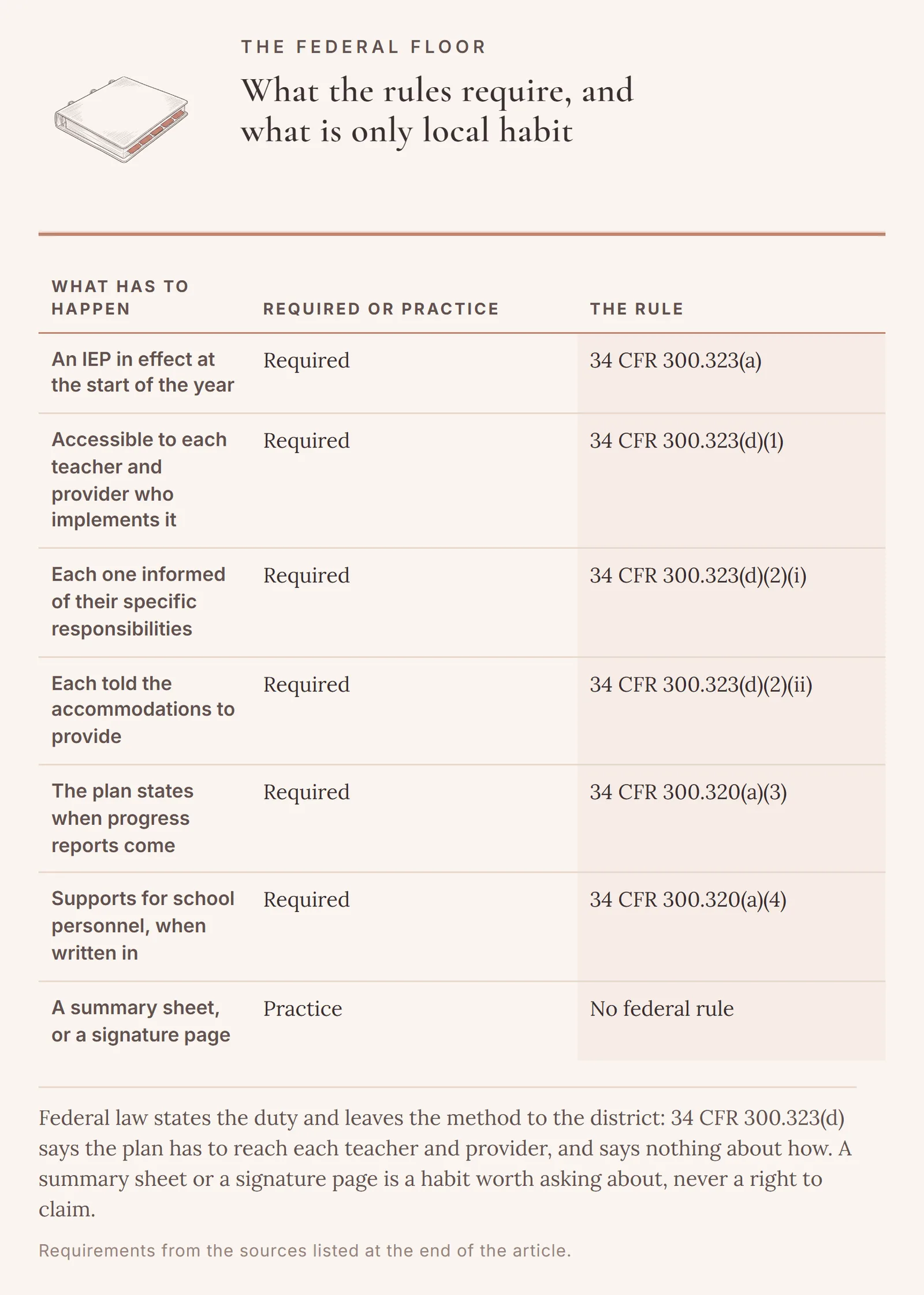
The IEP is not a proposal waiting for someone to act on it. Under 34 CFR 300.323(a), at the beginning of each school year the district must already have an IEP in effect for each eligible child in its jurisdiction. Where a first plan has just been written, services are made available as soon as possible after it is developed, under 300.323(c)(2), which covers initial IEPs. Both are duties on the district. Neither asks a parent to remind anyone.
That matters because of how the law defines a free appropriate public education (FAPE), which is the education a school owes a child with a disability. FAPE includes services provided in conformity with an IEP that meets the requirements of 300.320 through 300.324, under 34 CFR 300.17(d). In conformity with is the phrase doing the work. A plan that is excellent on paper and different in the classroom is not a filing problem. It is a question about the education itself.
How the implementation rules work
What does the school have to do once the IEP is written
Two duties sit side by side at 34 CFR 300.323(d), and are easy to read as one. The first is access. The district must ensure the IEP is accessible to each regular education teacher, special education teacher, related services provider, and any other provider responsible for implementing it, under 300.323(d)(1). That reaches the general education teachers, not only the special education staff.
The second is the briefing. Each of those people must be informed of their specific responsibilities for implementing the plan, under 300.323(d)(2)(i), and of the specific accommodations, modifications, and supports that must be provided, under 300.323(d)(2)(ii). A teacher who has the document but was never told which parts are hers is not yet where the regulation puts her.
Notice what the rule does not say. It sets the duty and leaves the method to the district. A summary sheet of accommodations, or a page teachers sign, is a local habit: worth asking about, not something a parent has standing to demand.
Who is responsible when it is not happening
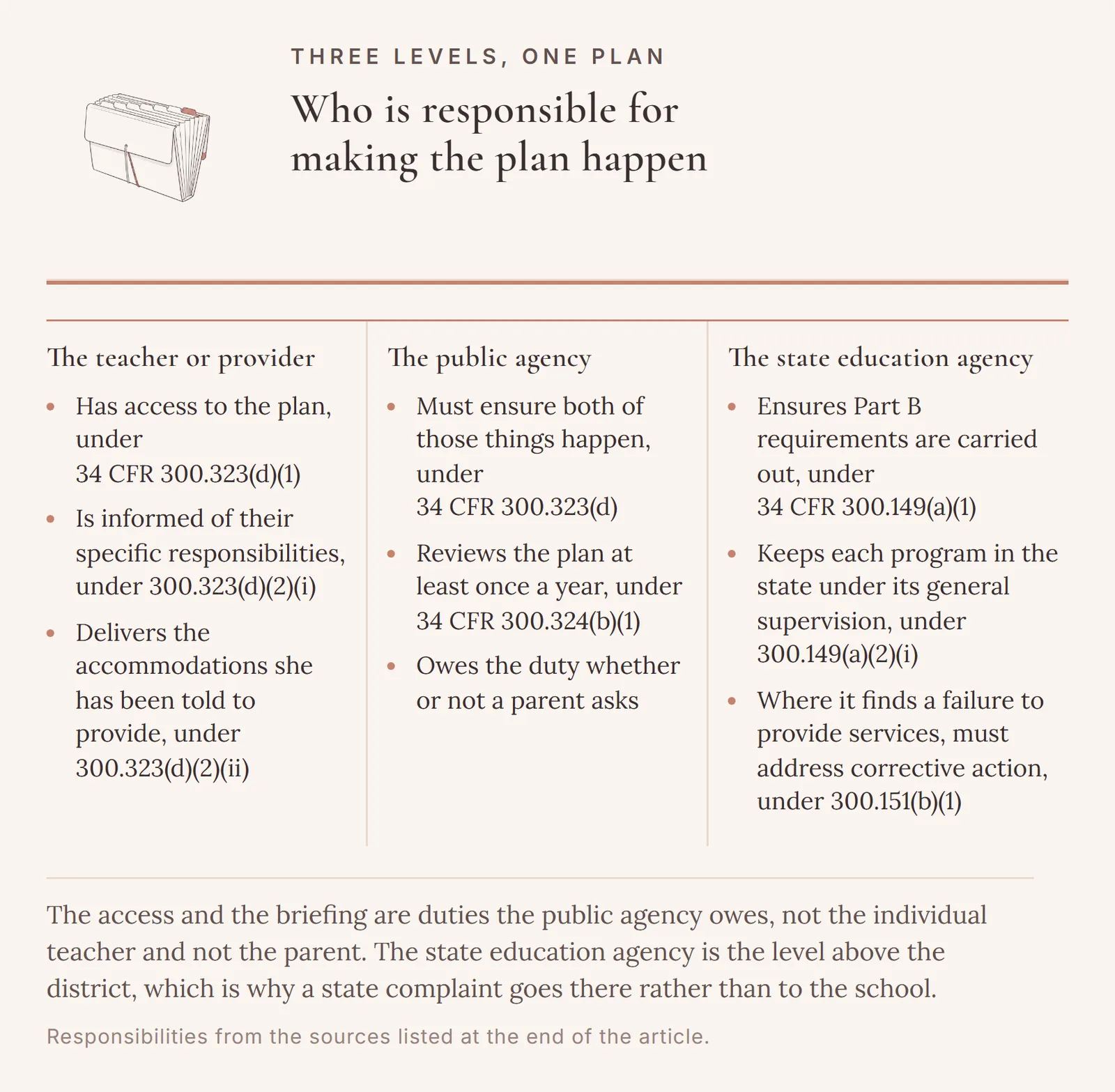
Both duties belong to the public agency, which in practice means the district. Not to the individual teacher, and not to you. Above the district sits the state education agency, which under 34 CFR 300.149(a)(1) is responsible for ensuring that the requirements of Part B are carried out, and which under 300.149(a)(2)(i) keeps each educational program for children with disabilities in the state under its general supervision. That is the structure a state complaint uses later.
What does the IEP itself commit to
Read the line you are worried about in the plan's own words first. For each service the plan must give the projected start date and the anticipated frequency, location, and duration, under 34 CFR 300.320(a)(7). Wording carries detail that memory smooths over: extended time on tests in all academic classes commits to something different from extended time as needed.
The plan also has to say how progress toward each annual goal will be measured, and when periodic reports on that progress will be provided, under 34 CFR 300.320(a)(3). Quarterly reports issued with report cards appear in the regulation as an example, introduced by the words such as. The binding schedule is the one your child's plan states.
One line is easy to miss. The IEP carries a statement of the supports for school personnel that will be provided, under 300.320(a)(4), so training or consultation written into the plan is owed the way a service to the child is owed.
How to check what is actually happening
- Read the plan's wording for the service you are worried about, and copy that sentence out. That tells you whether the gap is between the paper and the classroom, or the paper and your memory.
- Write down what you saw, with the date. A handful of dated entries says something a general impression never will.
- Ask the teacher a question instead of making a statement. The plan says this, my child tells me that, can you help me find out what is happening in your class.
- Put the same question in writing to the case manager named on the plan, and keep a copy.
- Read the next progress report against each goal's own measure, next to the report card. A fine report card is not proof the accommodations were delivered.
- Ask for an IEP Team meeting in writing. The Department of Education states that parents have the right to request an IEP Team meeting at any time, and that a district refusing must say why in Prior Written Notice, the written explanation required at 34 CFR 300.503(a)(2).
Mistakes and edge cases
Escalating before reading the plan. The wording sometimes promises less than memory does, which is a different conversation with a different fix.
Grading single days. One missed session is a data point with a date on it. A pattern is what a team can act on, and the regulation is built the same way: the IEP Team must review the plan at least once a year and revise it for any lack of expected progress, and for information about the child provided by the parents, under 34 CFR 300.324(b)(1). Your own record is an express basis for revision.
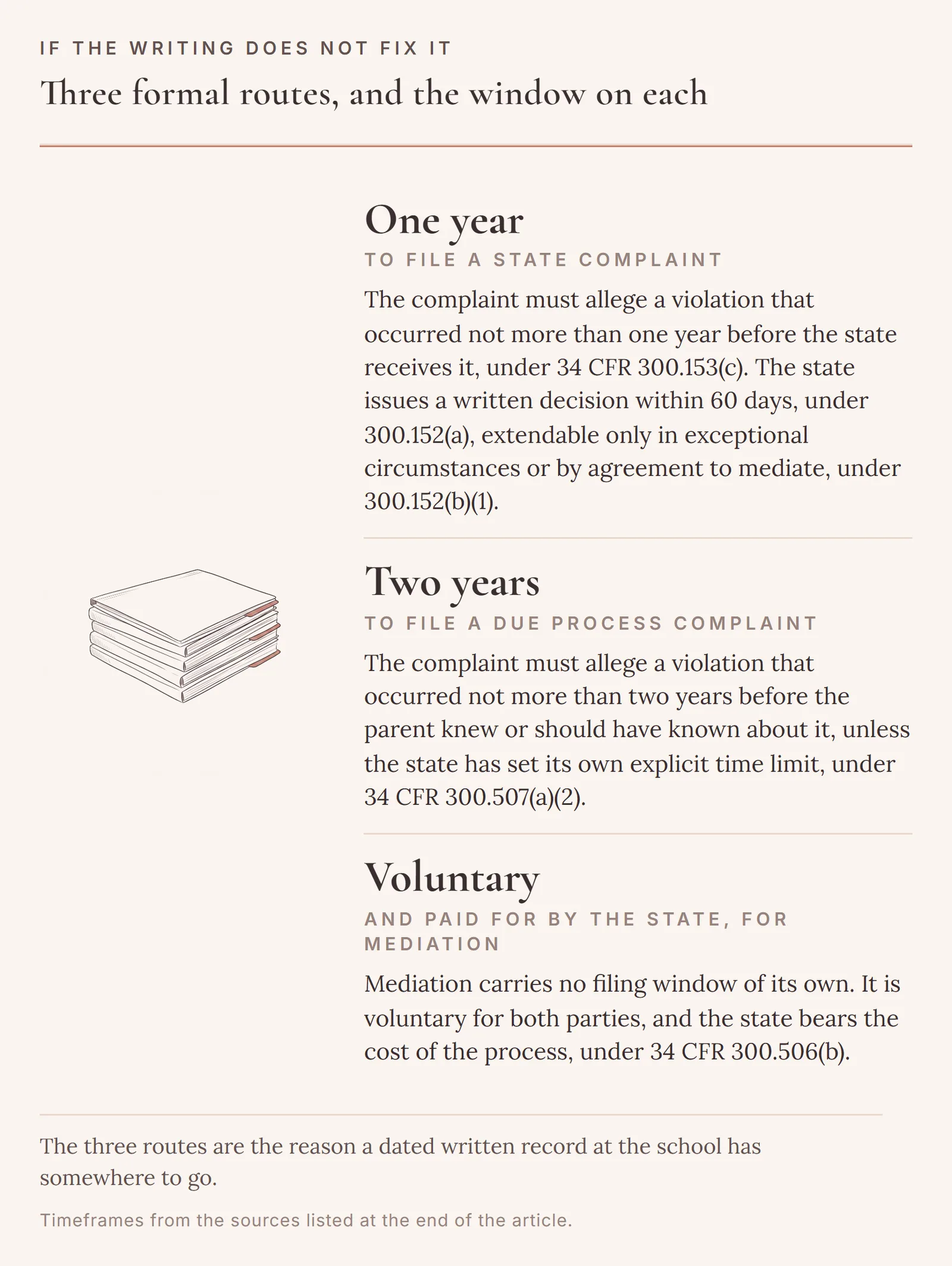
Treating a formal complaint as step one. The formal routes exist, and knowing they are there is steadying. A state complaint to the state education agency must allege a violation that occurred not more than one year before it is received, under 34 CFR 300.153(c). The state issues a written decision within 60 days, under 300.152(a), extendable only under 300.152(b)(1).
Mediation is voluntary for both parties and the state bears its cost, under 300.506(b)(1)(i) and 300.506(b)(4). A due process complaint must allege a violation that occurred not more than two years before the parent knew or should have known about it, unless the state has set its own explicit time limit, under 300.507(a)(2). Where a state finds a failure to provide appropriate services, its complaint procedures must address corrective action for the child, which the regulation illustrates with compensatory services, under 300.151(b)(1).
None of that is a first move, and it is not where these conversations start. Every state also has a free, federally funded Parent Training and Information Center, and reading a plan alongside a parent is ordinary work for them. Find yours at parentcenterhub.org.
FAQ
Does every teacher have to get a copy of my child's IEP?
The regulation requires access rather than a personal copy. Under 34 CFR 300.323(d)(1), the district must ensure the IEP is accessible to every teacher and provider responsible for implementing it. How that access is delivered is left to the district.
How often is the school supposed to send a progress report?
As often as your child's own IEP says. Under 34 CFR 300.320(a)(3), the plan must state how progress toward the annual goals will be measured and when periodic reports will be provided. Quarterly reports with report cards appear only as an example.
What if the teacher says she never received the plan?
That points at the district rather than the teacher. Access and the briefing are duties the public agency owes under 34 CFR 300.323(d), so the next message goes to the case manager or the building administrator.
Sources
- eCFR, 34 CFR 300.323, IEPs in effect, access, and who is informed (https://www.ecfr.gov/current/title-34/section-300.323)
- eCFR, 34 CFR 300.320, what an IEP must contain (https://www.ecfr.gov/current/title-34/section-300.320)
- eCFR, 34 CFR 300.324, review and revision of the IEP (https://www.ecfr.gov/current/title-34/section-300.324)
- eCFR, 34 CFR 300.17, free appropriate public education (https://www.ecfr.gov/current/title-34/section-300.17)
- eCFR, 34 CFR 300.149, state general supervision (https://www.ecfr.gov/current/title-34/section-300.149)
- eCFR, 34 CFR 300.151 through 300.153, state complaint procedures (https://www.ecfr.gov/current/title-34/section-300.151)
- eCFR, 34 CFR 300.503, prior written notice (https://www.ecfr.gov/current/title-34/section-300.503)
- eCFR, 34 CFR 300.506, mediation, and 300.507, due process complaints (https://www.ecfr.gov/current/title-34/section-300.506)
- U.S. Department of Education, Return to School Roadmap: Development and Implementation of IEPs (https://sites.ed.gov/idea/idea-files/return-to-school-roadmap-development-and-implementation-of-ieps/)
- Center for Parent Information and Resources, state Parent Training and Information Centers (https://www.parentcenterhub.org/find-your-center/)