The short answer
A school may refuse a parent's request for a special education evaluation, but it may not refuse quietly. Under 34 CFR 300.503(a), a refusal requires prior written notice, and 300.503(b)(1) through (b)(7) lists the seven things that notice has to contain. That document is what every route after a no is built on.
Why a written refusal changes what happens next
Most of these conversations end the same way. A parent asks about testing and hears some version of "we are still working through interventions, let us give it more time." Nothing is written down, so as far as the record goes, nothing has happened.
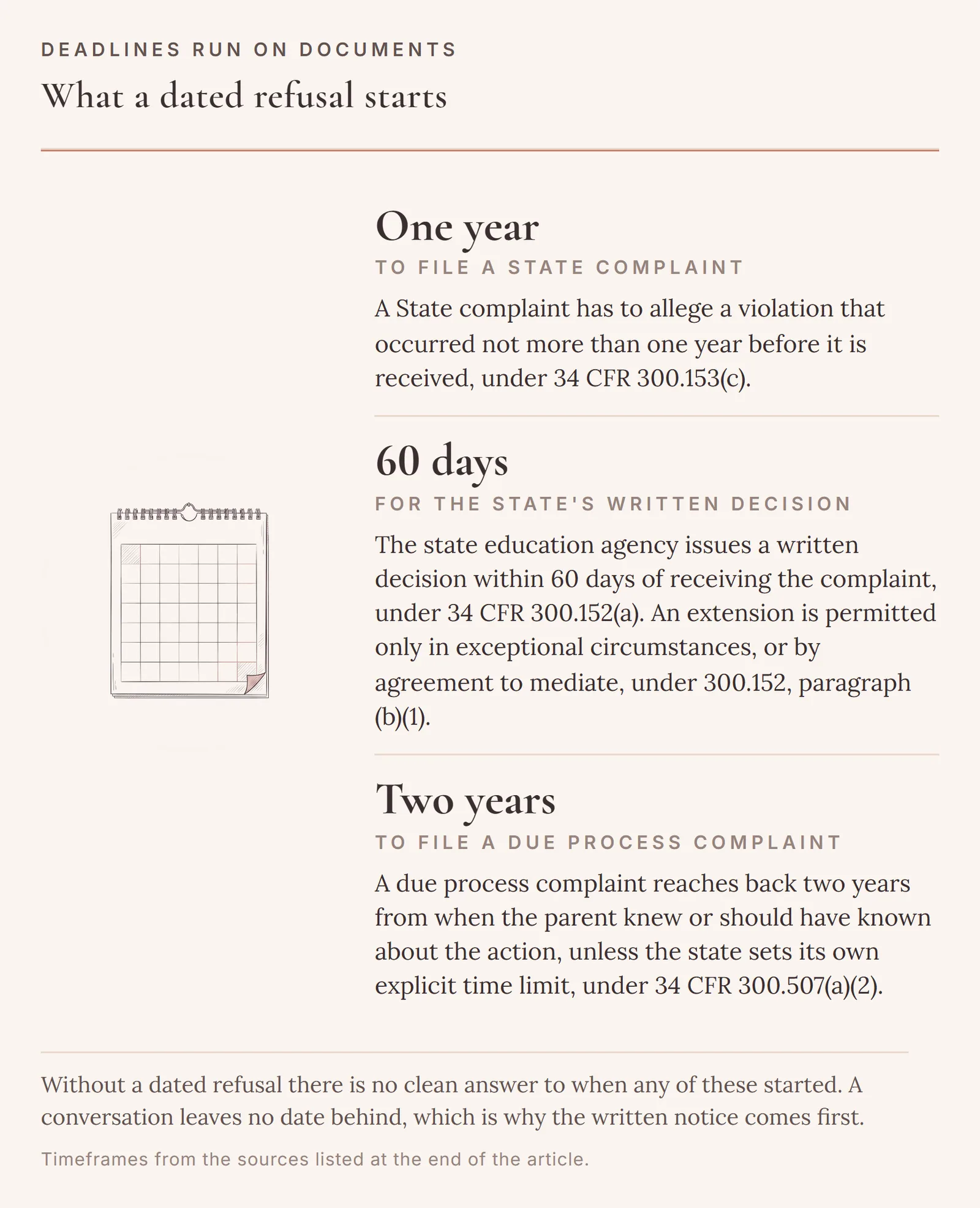
The deadlines attached to a disagreement run on documents, not conversations. A State complaint has to allege a violation that occurred not more than one year before it is received (34 CFR 300.153(c)), and the state education agency then has 60 days to issue a written decision (34 CFR 300.152(a)). A due process complaint reaches back two years from when the parent knew or should have known about the action (34 CFR 300.507(a)(2)). Without a dated refusal, there is no clean answer to when any of those clocks started.
One document is supposed to arrive on its own. The procedural safeguards notice, the plain-language summary of parent rights under IDEA, has to be given upon initial referral or parent request for evaluation (34 CFR 300.504(a)(1)).
How a refusal is supposed to work
What is MTSS or RTI actually for
A Multi-Tiered System of Supports (MTSS), and the academic version usually called Response to Intervention (RTI), is a general education framework: screen everyone, teach in tiers, watch the progress data, add support for students who are not responding. It gets help to a child quickly, without waiting for a label.
What it is not is a gate in front of special education. A parent may request an initial evaluation at any time under 34 CFR 300.301(b), and the district's duty to identify, locate, and evaluate children suspected of having a disability, called child find, runs on its own under 34 CFR 300.111. OSEP Memorandum 11-07 (January 21, 2011) says plainly that an RTI process cannot be used to delay or deny an evaluation under IDEA.
Keep the other half in view. None of it means the school has to agree. A district can read a request, decide it does not suspect a disability, and say no. Refusing is a decision the regulations allow. What they do not allow is a refusal that never gets written down.
What does a refusal have to look like on paper
Prior written notice, often shortened to PWN, is required a reasonable time before a public agency proposes or refuses to initiate or change the identification, evaluation, or educational placement of a child, or the provision of a free appropriate public education (34 CFR 300.503(a)). The refusal half of that sentence is the part parents rarely hear about: a no is a covered action, exactly like a yes. The rule reaches a first request on its own terms, since 300.503(b)(4) sets out what the notice says "if this notice is not an initial referral for evaluation."
What are the seven elements the notice has to contain
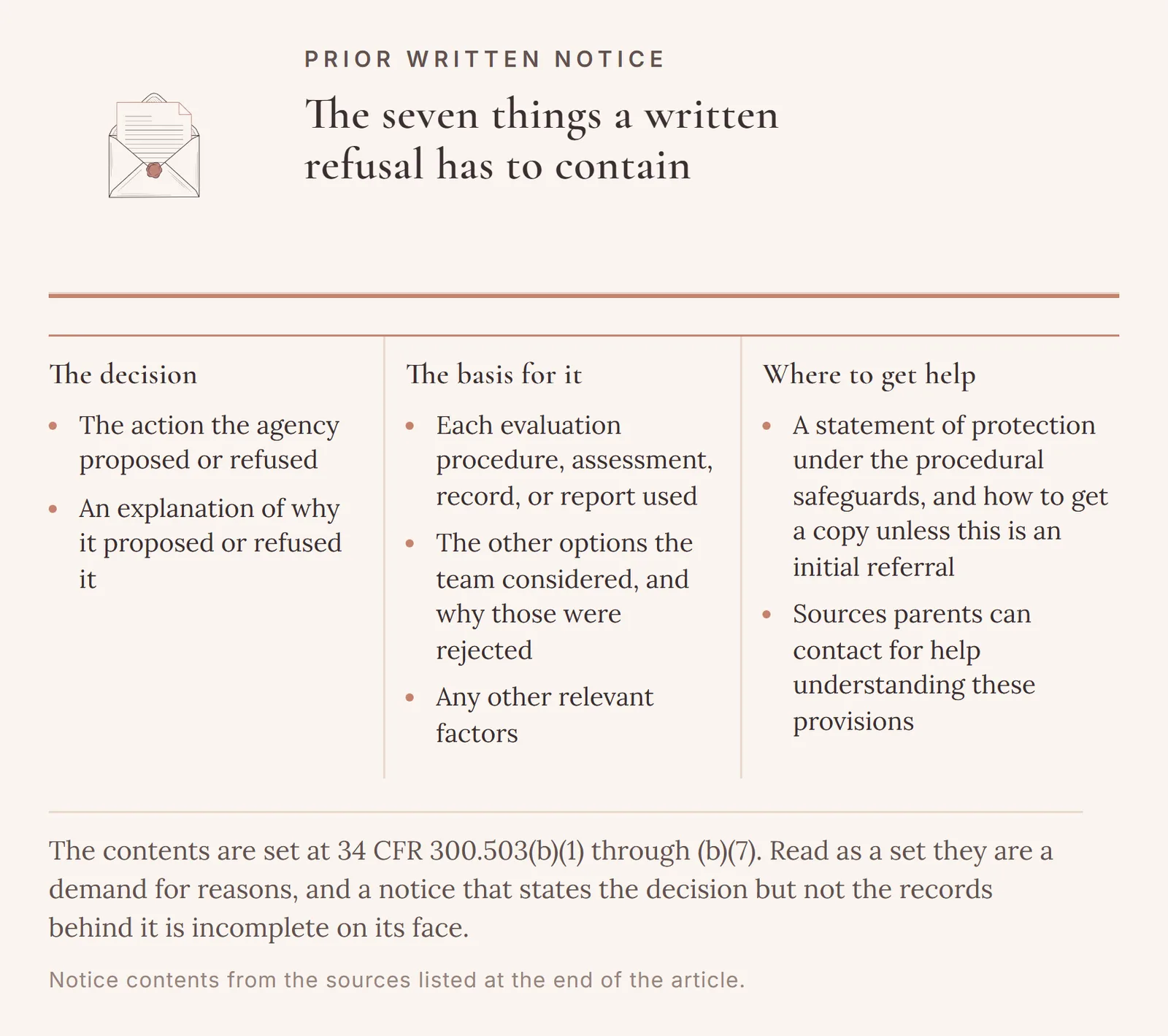
34 CFR 300.503(b)(1) through (b)(7) sets the contents. The notice has to include:
- the action the agency proposed or refused
- an explanation of why
- a description of each evaluation procedure, assessment, record, or report used as a basis for the decision
- a statement that parents have protection under the procedural safeguards, and, unless this is an initial referral for evaluation, how to get a copy
- sources parents can contact for help understanding these provisions
- the other options the team considered, and why those were rejected
- any other relevant factors
Read as a set, they are a demand for reasons. The third item usually shows the most: if the answer rests on tiered intervention data, that data has to be named.
What to do after a no
- Put the request in writing, with a date on it. A spoken request counts under 34 CFR 300.301(b), but a dated email is what anyone reviewing the file later can see. Keep a copy of what went out and when.
- Ask for the answer in writing, and name what you are asking for. The phrase is prior written notice under 34 CFR 300.503. Districts recognize it, and asking is a routine administrative request rather than an escalation.
- Read the notice against the seven elements. One that states the decision but not the records behind it, or that skips the options considered, is incomplete on its face, and that gap is itself something a complaint can be about.
- Let the tiered supports keep running while you decide. Interventions and an evaluation are not alternatives, which is the point of OSEP Memorandum 11-07. Taking the help on offer does not settle the evaluation question.
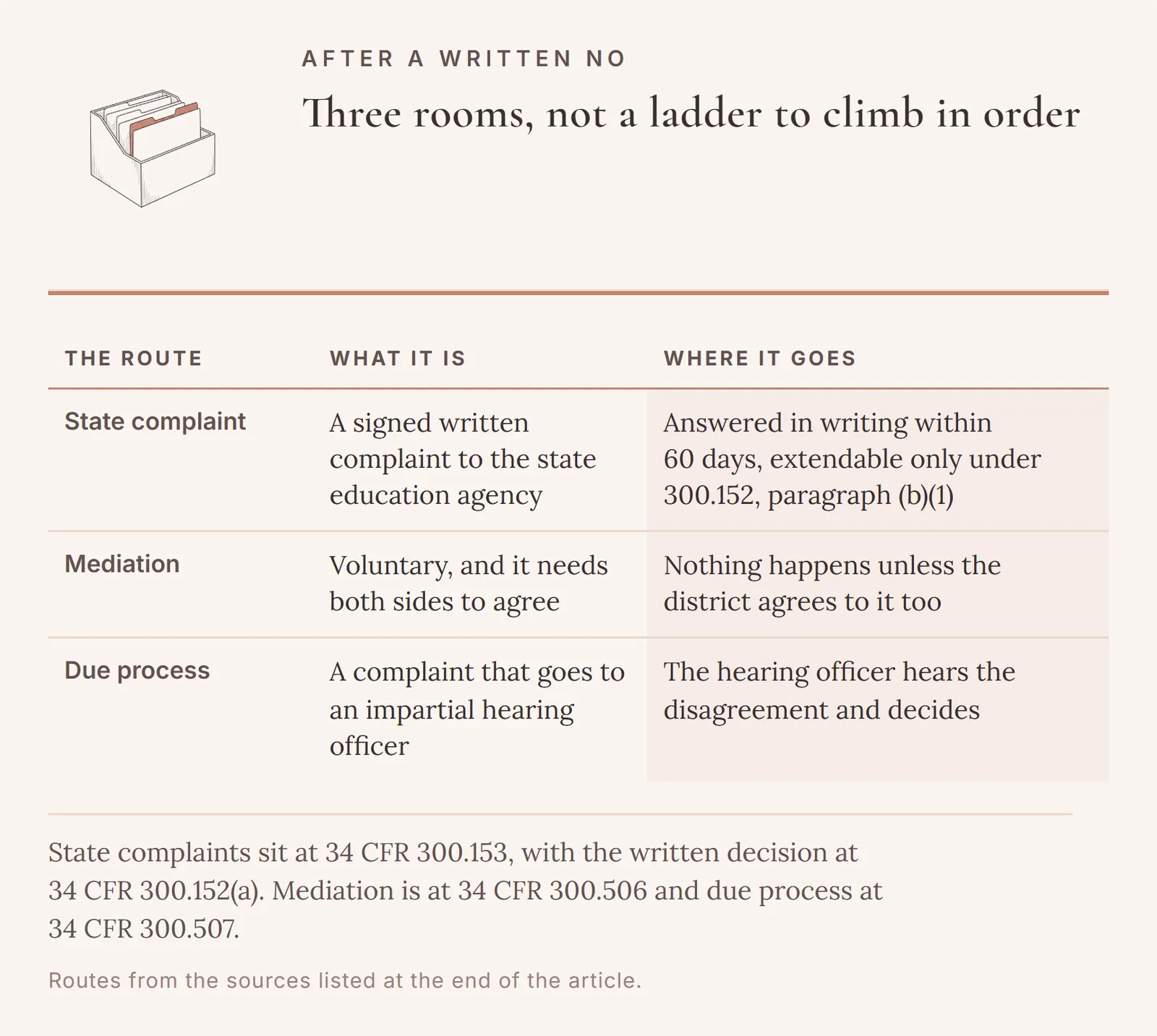
- Pick a route, within the time that route allows. A State complaint is a signed written complaint to the state education agency (34 CFR 300.153), answered in writing within 60 days (34 CFR 300.152(a)). Mediation is voluntary and needs both sides to agree (34 CFR 300.506). A due process complaint (34 CFR 300.507) puts the disagreement in front of an impartial hearing officer. Three different rooms, not a ladder to climb in order.
Mistakes and edge cases
The most common mistake is treating a spoken no as the end of it. It is not a refusal in the regulatory sense until it is written, and asking for the written version is the ordinary next step.
The opposite error is reading OSEP 11-07 to mean the school has to evaluate whenever a parent asks. It does not say that. It says a tiered process cannot be the reason for a delay or a denial. The district still reaches its own conclusion, in writing, with reasons that can be examined.
A yes has its own timing question. Agreeing to evaluate does not start the evaluation clock; consent does. The federal default is 60 days from the date the agency receives parental consent, or the state's own timeframe where it has set one, and many have (34 CFR 300.301(c)(1)).
Then there is the notice that answers a different question. A letter reporting progress in Tier 2 describes intervention results. It does not name the action refused, the records relied on, or the options rejected, which are three of the seven elements.
FAQ
Can a school require RTI or MTSS before it will evaluate?
No. OSEP Memorandum 11-07 (January 21, 2011) states that an RTI process cannot be used to delay or deny an evaluation for a child suspected of having a disability, and 34 CFR 300.301(b) lets a parent request one at any time. A district can still decline a request. It cannot make unfinished tiers the reason.
Does the school have to evaluate if I ask in writing?
No, and sources that say otherwise are overstating it. The right in 34 CFR 300.301(b) is a right to ask and to get the decision on the record. If the answer is no, 34 CFR 300.503(a) requires prior written notice with all seven contents, and that notice is what a State complaint or a due process complaint is built on.
Is there free help with this?
Yes. Every state has at least one Parent Training and Information Center, federally funded under IDEA to help parents at no charge, and they can explain what a prior written notice should contain and how the state's complaint procedures work. The directory is at parentcenterhub.org.
Sources
- Legal Information Institute, 34 CFR 300.111, child find (https://www.law.cornell.edu/cfr/text/34/300.111)
- Legal Information Institute, 34 CFR 300.152, State complaint procedures, 60-day decision (https://www.law.cornell.edu/cfr/text/34/300.152)
- Legal Information Institute, 34 CFR 300.153, filing a State complaint (https://www.law.cornell.edu/cfr/text/34/300.153)
- Legal Information Institute, 34 CFR 300.301, initial evaluations and the parent request right (https://www.law.cornell.edu/cfr/text/34/300.301)
- Legal Information Institute, 34 CFR 300.503, prior written notice and its seven contents (https://www.law.cornell.edu/cfr/text/34/300.503)
- Legal Information Institute, 34 CFR 300.504, procedural safeguards notice (https://www.law.cornell.edu/cfr/text/34/300.504)
- Legal Information Institute, 34 CFR 300.506, mediation (https://www.law.cornell.edu/cfr/text/34/300.506)
- Legal Information Institute, 34 CFR 300.507, due process complaint (https://www.law.cornell.edu/cfr/text/34/300.507)
- U.S. Department of Education, OSEP Memorandum 11-07, an RTI process cannot be used to delay or deny an evaluation, January 21, 2011 (https://sites.ed.gov/idea/files/osep11-07rtimemo.pdf)
- Center for Parent Information and Resources, find your state's Parent Training and Information Center (https://www.parentcenterhub.org/find-your-center/)