The short answer
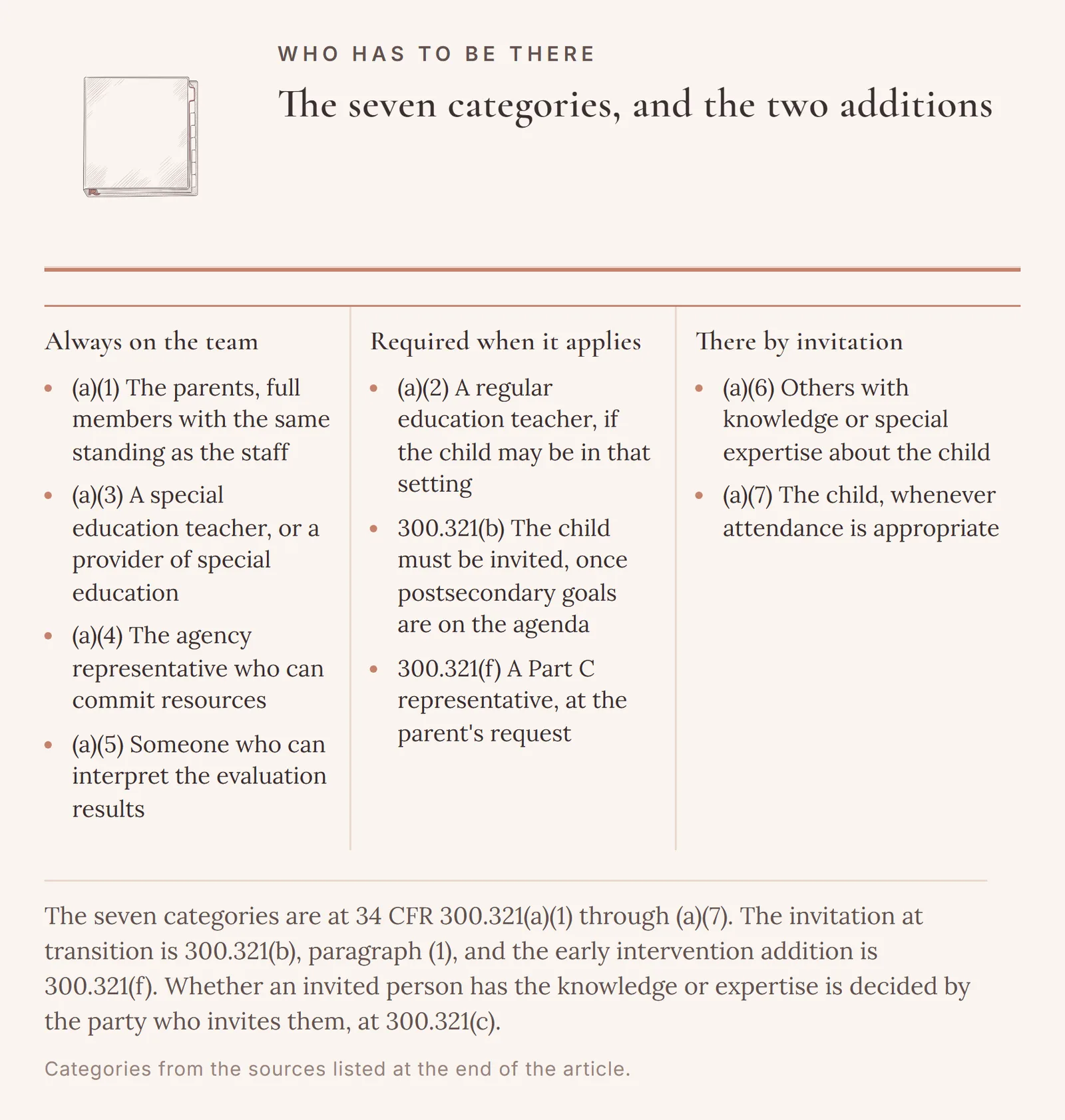
Federal law lists seven categories of member for an IEP (Individualized Education Program) Team at 34 CFR 300.321(a): the parents, a regular education teacher, a special education teacher or provider, an agency representative, someone who can interpret evaluation results, anyone the parent or school invites, and the child when appropriate. A required member can be excused only in writing.
Why the attendee list is the first thing to read
The IEP meeting is where the document gets written, and the rule that decides who writes it is short. 34 CFR 300.321(a)(1) through (a)(7) names seven categories of required IEP Team member, and the school district has to make sure the team includes each one that applies. That is a list you can hold a meeting notice up against before you ever sit down.
Two of those seats do more work than parents expect. The public agency representative at 300.321(a)(4) has to be qualified to provide or supervise specially designed instruction, knowledgeable about the general education curriculum, and knowledgeable about the availability of agency resources. That last piece is what lets the team commit to something in the room. And 300.321(a)(5) requires an individual who can interpret the instructional implications of evaluation results, which is the difference between a score being read aloud and a score being explained.
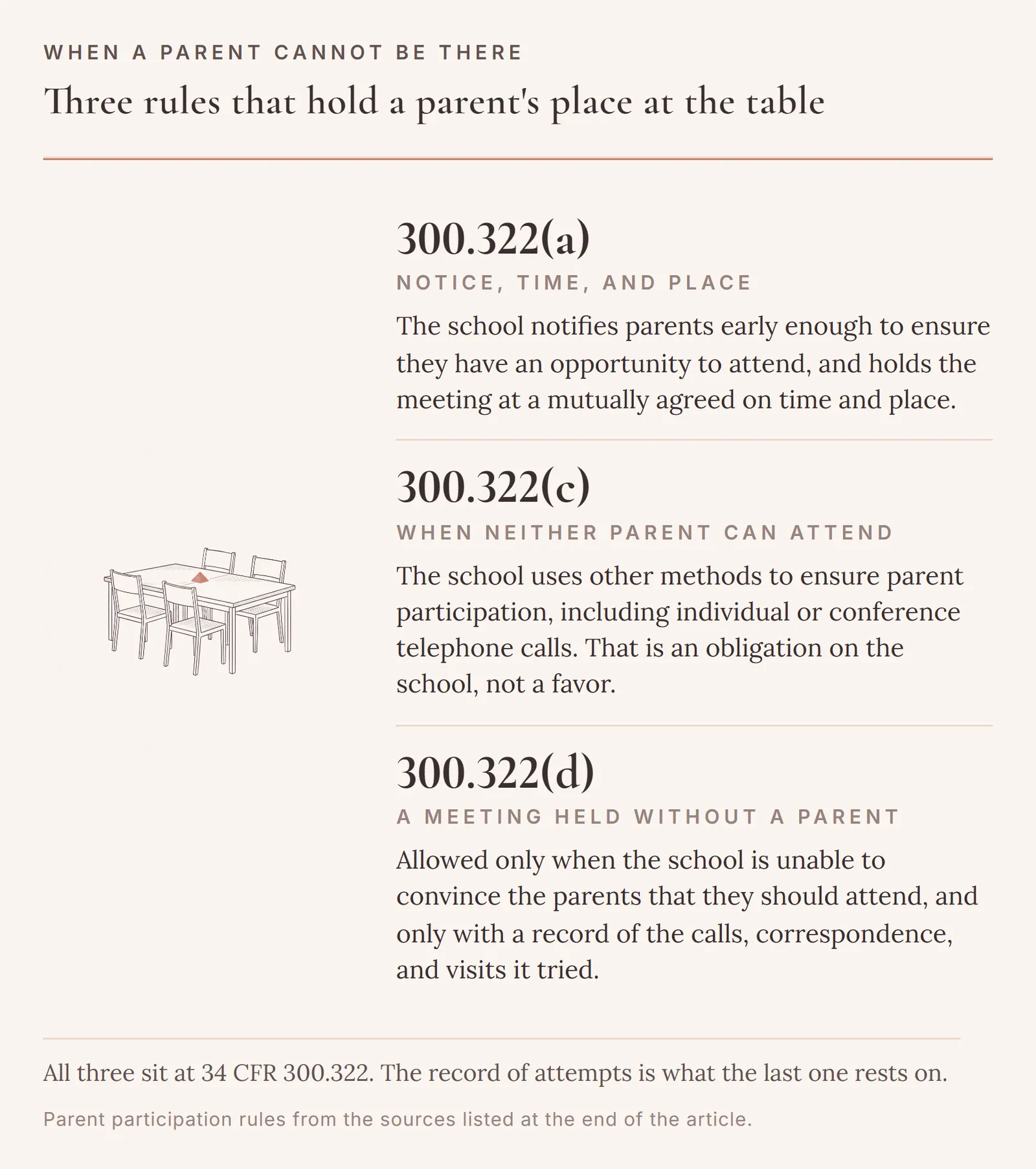
Timing is the other half. Under 300.322(a), the school must notify parents early enough to ensure they have an opportunity to attend, and hold the meeting at a mutually agreed on time and place.
How the required-member rules work
Who has to be in the room, and what is each seat for
300.321(a) lists them in order:
- The parents (a)(1), who are full team members and not guests.
- Not less than one regular education teacher of the child, if the child is, or may be, participating in the regular education environment (a)(2).
- Not less than one special education teacher, or where appropriate, one special education provider (a)(3).
- The public agency representative described above (a)(4).
- An individual who can interpret the instructional implications of evaluation results (a)(5).
- Other individuals with knowledge or special expertise regarding the child, at the discretion of the parent or the agency (a)(6).
- The child, whenever appropriate (a)(7).
Two additions change the roster. When the meeting will consider postsecondary goals and the transition services needed to reach them, 300.321(b) requires the school to invite the child, and, with parental consent, a representative of any participating agency likely to provide or pay for those services. For a child leaving early intervention, 300.321(f) requires the Part C service coordinator or another Part C representative to be invited to the initial IEP meeting at the parent's request.
What does excusing a required member actually mean
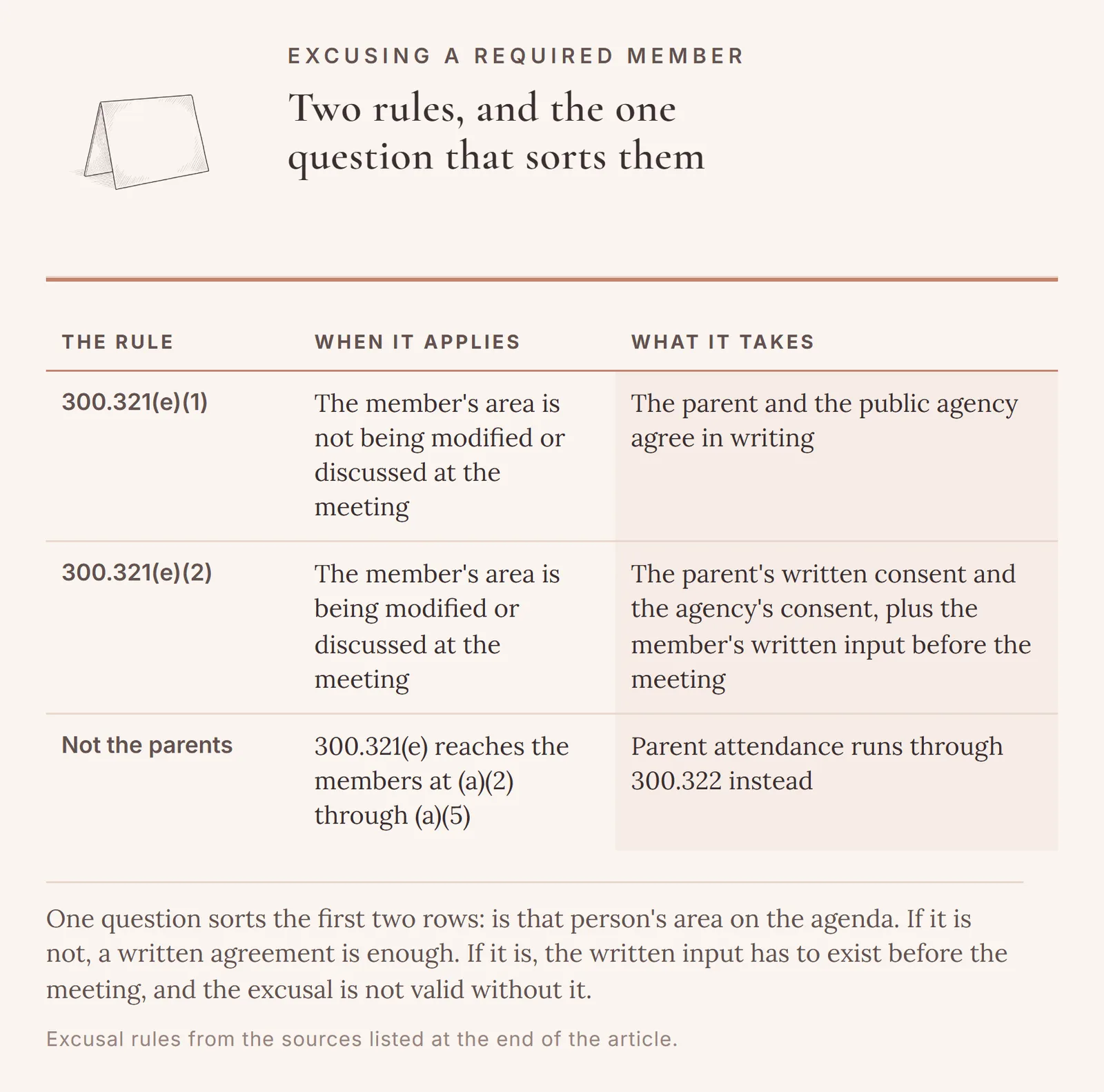
This is where parent-facing writing usually goes wrong, because there are two rules, not one.
Under 300.321(e)(1), a required member does not have to attend, in whole or in part, when the parent and the school agree in writing that attendance is not necessary because that member's area of the curriculum or related services is not being modified or discussed at the meeting.
Under 300.321(e)(2), the standard is higher. If the meeting does involve a modification to or a discussion of that member's area, the member may be excused only if the parent, in writing, and the public agency consent to the excusal, and the member submits written input into the development of the IEP to the parent and the team before the meeting.
One question sorts them: is this person's area on the agenda. If it is not, a written agreement is enough. If it is, the written input has to exist before the meeting, and the excusal is not valid without it.
What does the meeting notice have to say
300.322(b) sets the contents. The notice must state the purpose, the time, and the location of the meeting, and who will be in attendance. It must also tell parents about the right under 300.321(a)(6) to bring other individuals with knowledge or special expertise, and, for a child previously served under Part C, about 300.321(f). For a transition meeting, it must add that postsecondary goals are a purpose, that the child will be invited, and which other agency was invited.
What happens if a parent cannot attend
Two provisions cover this. If neither parent can attend in person, 300.322(c) requires the school to use other methods to ensure parent participation, including individual or conference telephone calls. That is an obligation on the school, not a favor.
Separately, 300.322(d) allows a meeting to be held without a parent present only if the school is unable to convince the parents that they should attend. If it proceeds on that basis, it must keep a record of its attempts to arrange a mutually agreed on time and place: calls made or attempted, correspondence sent and responses received, and visits to the home or workplace. "The school can hold the meeting without you" is accurate only after that.
How to read a meeting notice before you reply
- Check the notice against 300.322(b). Purpose, time, location, and who will attend. If a role or name is missing, ask for it in writing.
- Match the attendee list to 300.321(a)(1) through (a)(7). Put each name next to a category, then see which categories nobody covers.
- If an excusal is proposed, work out which rule applies. Is that member's area being modified or discussed at this meeting. The answer decides whether 300.321(e)(1) or 300.321(e)(2) governs.
- Answer in writing either way. Both rules require the parent's written agreement or consent, so a short email naming the member, the meeting date, and your answer creates the record.
- If the time or the place does not work, propose another. 300.322(a) calls for a mutually agreed on time and place, which means the first offer is an offer.
- If you cannot be there in person, ask in writing for a conference call under 300.322(c).
Mistakes and edge cases
Treating the two excusal rules as one. A written agreement between the parent and the public agency is the 300.321(e)(1) standard, and it applies only when the member's area is not being modified or discussed. When it is, 300.321(e)(2) requires the parent's consent in writing and the public agency's consent, and it adds the piece (e)(1) does not have: the member's written input, submitted to the parent and the team before the meeting.
Assuming the excusal rule covers the parents. It does not. 300.321(e) applies to the members described in (a)(2) through (a)(5). Parent attendance runs through 300.322 instead.
Assuming one person means one seat. Under 300.321(a)(5) the individual who interprets evaluation results may already be another member of the team, and 300.321(d) lets a district designate an existing member to also serve as the public agency representative when the (a)(4) criteria are met. Still worth knowing who is wearing which hat.
The child's invitation is not discretionary at transition. 300.321(a)(7) leaves attendance to judgment. Once postsecondary goals are on the agenda, 300.321(b) makes the invitation required.
Every state has a free, federally funded Parent Training and Information Center, and reading a meeting notice with a parent is ordinary work for them. Find yours at parentcenterhub.org.
FAQ
Can the school hold the meeting if I do not come?
Only under one condition. 300.322(d) permits a meeting without a parent in attendance when the school is unable to convince the parents that they should attend, and it requires a record of the school's attempts to arrange a mutually agreed on time and place: calls, correspondence, and visits.
Do I have to agree to excuse someone?
No. 300.321(e)(1) requires the parent and the public agency to agree in writing. 300.321(e)(2) requires the parent's written consent, the public agency's consent, and the member's written input before the meeting. Without the parent's part, the member remains a required attendee.
Can I bring someone with me?
Yes. 300.321(a)(6) allows the parent to invite other individuals with knowledge or special expertise regarding the child, and 300.321(c) leaves that determination to the inviting party. Under 300.322(b), the notice itself has to inform parents about the right.
Does my child have to attend?
300.321(a)(7) includes the child whenever appropriate, which leaves room for judgment. That changes at transition: 300.321(b) requires the school to invite the child to any meeting where postsecondary goals will be considered.
Sources
- eCFR, 34 CFR 300.321, IEP Team and excusal (https://www.ecfr.gov/current/title-34/section-300.321)
- eCFR, 34 CFR 300.322, parent participation and meeting notice (https://www.ecfr.gov/current/title-34/section-300.322)
- eCFR, 34 CFR 300.328, alternative means of meeting participation (https://www.ecfr.gov/current/title-34/section-300.328)
- U.S. Department of Education, IDEA regulations, Sec. 300.321 (https://sites.ed.gov/idea/regs/b/d/300.321)
- U.S. Department of Education, IDEA regulations, Sec. 300.322 (https://sites.ed.gov/idea/regs/b/d/300.322)
- Center for Parent Information and Resources, state Parent Training and Information Centers (https://www.parentcenterhub.org/find-your-center/)