The short answer
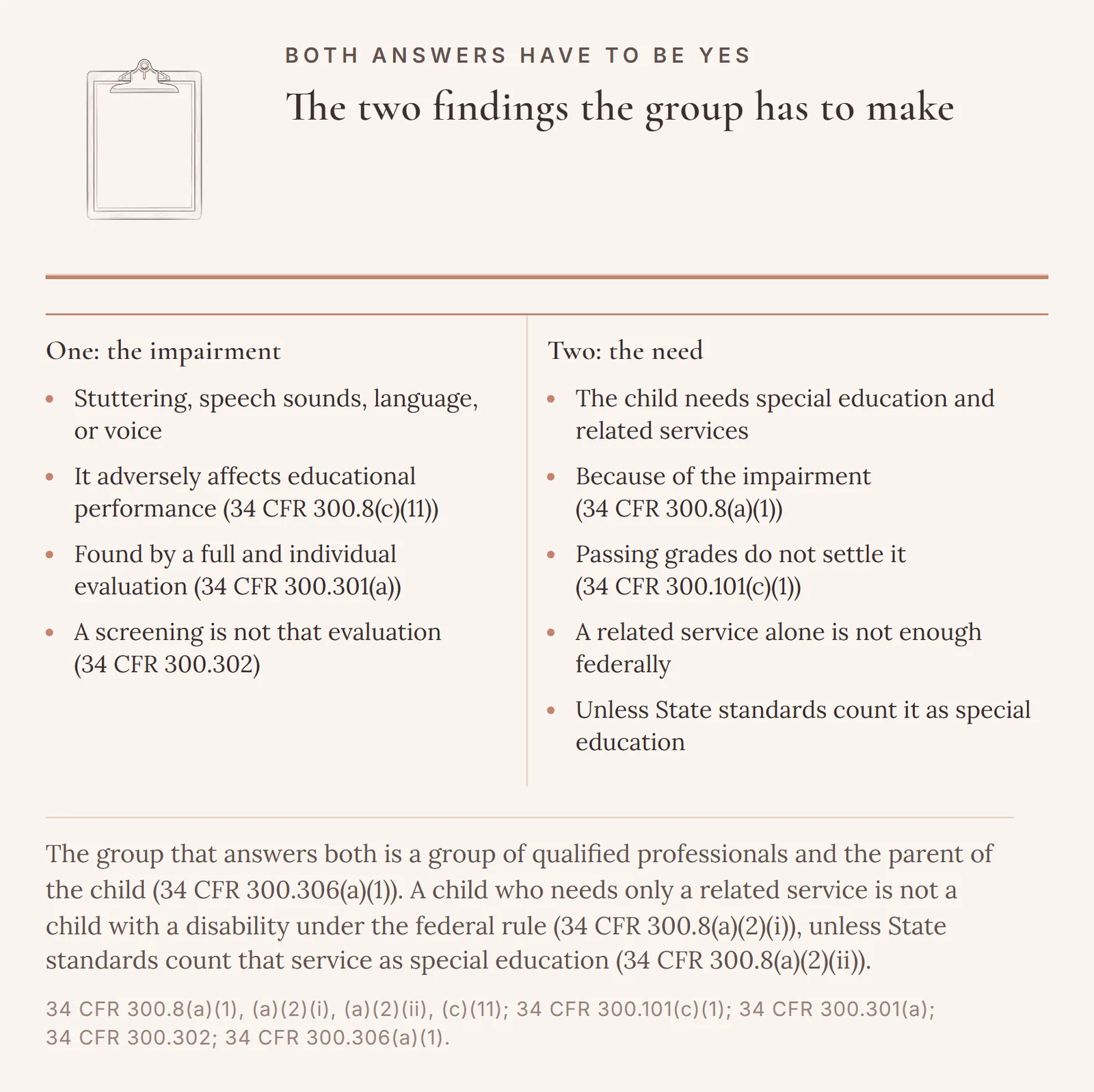
Federal law asks two questions, not one (34 CFR 300.8(a)(1)). The first is whether a speech or language impairment adversely affects the child's educational performance, found through a full and individual evaluation. The second is whether the child needs special education and related services because of it. Passing grades settle neither question, and a screening is not the evaluation.
What the speech category covers, and how many children are in it
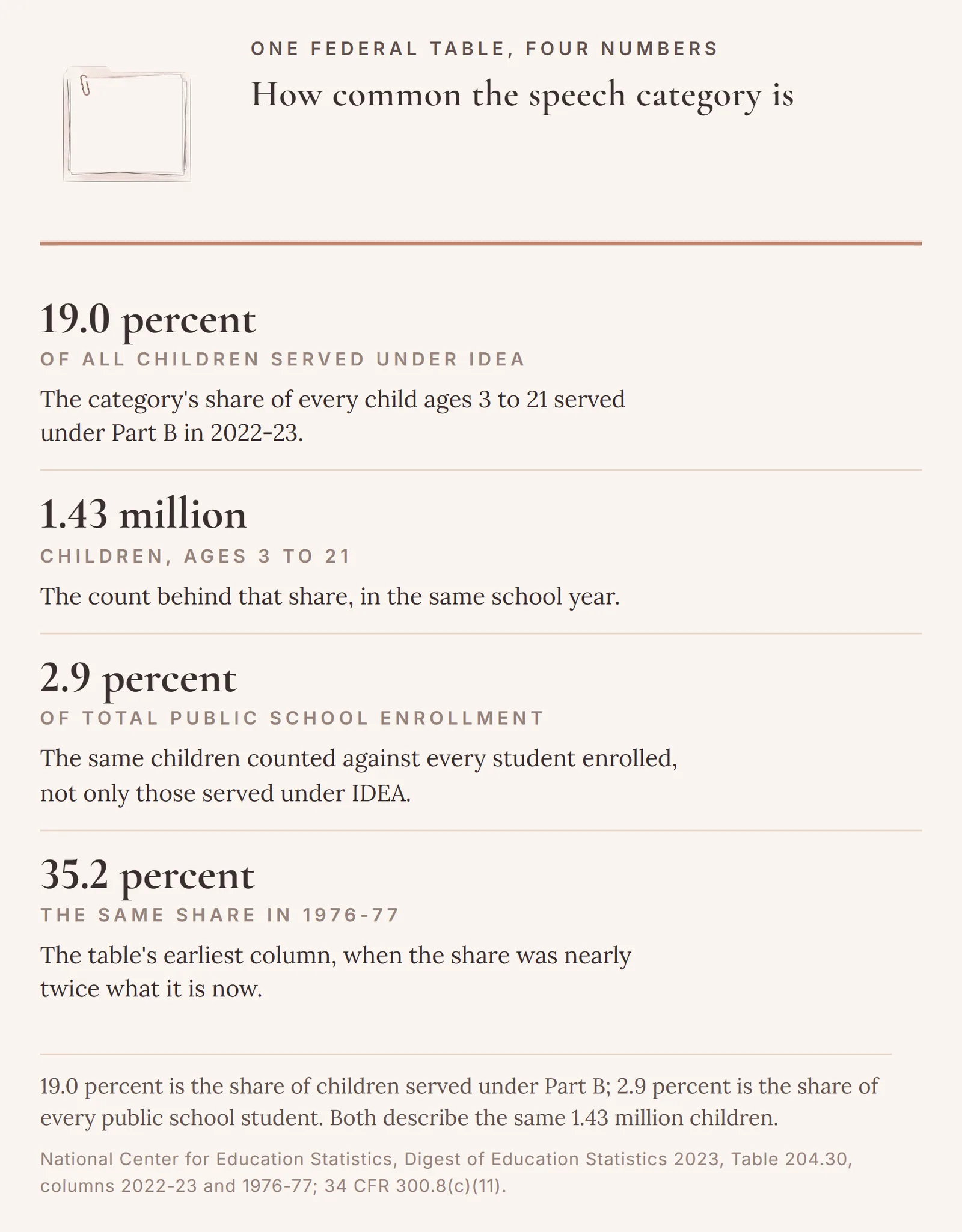
In 2022-23, 1.43 million children ages 3 to 21 were served under the Individuals with Disabilities Education Act (IDEA), Part B, under the category speech or language impairment. That was 19.0 percent of all children served, and 2.9 percent of total public school enrollment (National Center for Education Statistics, Digest of Education Statistics 2023, Table 204.30). The same row read 35.2 percent in 1976-77.
The category itself is one sentence long. Speech or language impairment means a communication disorder, such as stuttering, impaired articulation, a language impairment, or a voice impairment, that adversely affects a child's educational performance (34 CFR 300.8(c)(11)). "Such as" is doing work there. The four are examples rather than a closed list, and each carries the same single test.
How the two questions work
What does the school have to find before a child qualifies
A child with a disability is a child who is evaluated and found to have one of the listed impairments, speech or language impairment among them, and who by reason of that impairment needs special education and related services (34 CFR 300.8(a)(1)). Two findings, joined by an "and". A diagnosis from a private clinic meets neither one by itself.
The second finding is where "speech only" lives. A related service is a supportive service required to help a child benefit from special education, and speech-language pathology is on the regulation's list (34 CFR 300.34(a)). If an evaluation shows a child needs only a related service and not special education, the federal rule says the child is not a child with a disability (34 CFR 300.8(a)(2)(i)). That turns the other way where the State's own standards count the service as special education instead (34 CFR 300.8(a)(2)(ii)), a provision that names speech-language pathology services first (34 CFR 300.39(a)(2)(i)). It is why a child can hold an IEP (Individualized Education Program) for speech alone in one state and not in another.
What does "adversely affects educational performance" mean
Part 300 never defines "educational performance", so be careful with anyone who says it has one settled meaning. The regulation's own contribution is narrower. FAPE, a free appropriate public education, must be available to a child who needs special education and related services even though the child has not failed or been retained in a course or grade and is advancing from grade to grade (34 CFR 300.101(c)(1)).
Explaining that rule in 2006, the Department added that a child is not ineligible just because the child is progressing from grade to grade with the support of individually designed services (71 FR 46580).
The broader statement is guidance rather than law. In its Letter to Clarke, March 8, 2007, the Department's Office of Special Education Programs wrote that "educational performance" is not limited to academic performance, and that whether a speech and language impairment adversely affects it is decided case by case on the child's unique needs, "not based only on discrepancies in age or grade performance in academic subject areas". OSEP labels its letters informal guidance that is not legally binding.
What does the evaluation have to be
A full and individual initial evaluation (34 CFR 300.301(a)). A screening by a teacher or specialist to work out instructional strategies is not one (34 CFR 300.302). It uses a variety of assessment tools, including what the parent provides, and no single measure may be the sole criterion (34 CFR 300.304(b)(1), (b)(2)). A group of qualified professionals and the parent then decides both questions (34 CFR 300.306(a)(1)).
How the question moves, step by step
- Write down what your child cannot say or do that classmates the same age can, and where it shows during the school day. Parent input is on the regulation's own list of sources the group must document and consider (34 CFR 300.306(c)(1)(i)).
- Put the request in writing. Either a parent or the school may start an initial evaluation (34 CFR 300.301(b)), and a dated letter fixes when you asked.
- Sign the consent form when it comes. The school must have informed parental consent before it evaluates (34 CFR 300.300(a)(1)(i)).
- Keep the date you signed. The initial evaluation must be conducted within 60 days of the school receiving that consent, or within your State's own timeframe if it has set one (34 CFR 300.301(c)(1)(i), (c)(1)(ii)).
- Ask in writing which areas will be assessed. The child is assessed in all areas related to the suspected disability, including, if appropriate, communicative status and hearing (34 CFR 300.304(c)(4)).
- Ask for the evaluation report before the eligibility meeting rather than at it. The copy is yours at no cost (34 CFR 300.306(a)(2)), and reading it early is the difference between listening and taking part.
- Take the two questions in order at the meeting. You are inside the group that answers them.
- Read the written answer against both findings. Whether the school refuses to evaluate or finds your child not eligible, it owes you written notice a reasonable time before it acts, with an explanation of why (34 CFR 300.503(a)(2), (b)(2)), and Prior Written Notice, Decoded covers how to read one.
Mistakes and edge cases
Five sentences come up again and again at this stage, and the table pairs each with its rule. The paragraphs that follow take up the ones that cost parents the most.
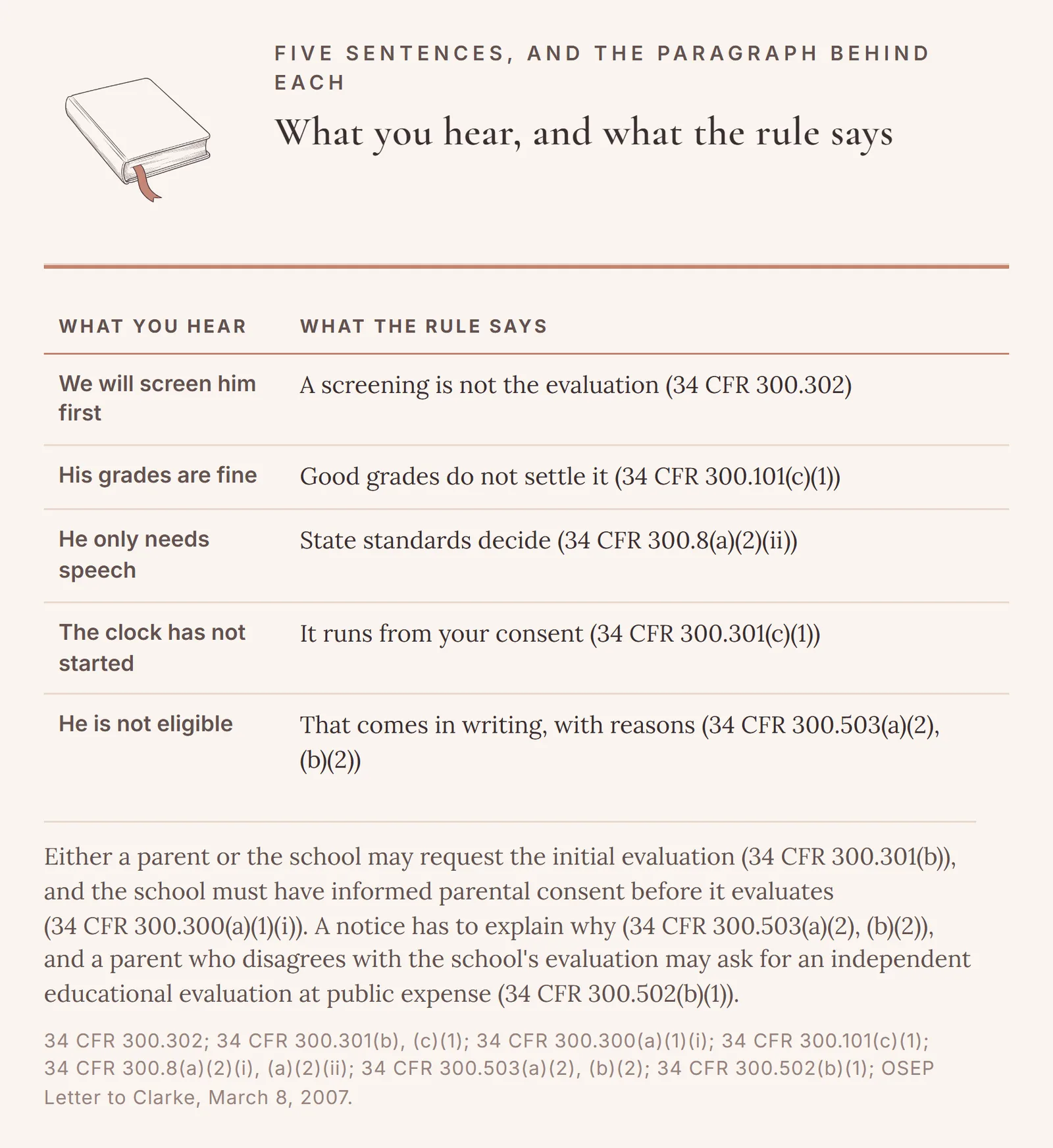
Hearing "he only needs speech" as a federal no. It is a State question before it is a no. The federal definition stops at a child who needs only a related service (34 CFR 300.8(a)(2)(i)), then hands the decision to State standards (34 CFR 300.8(a)(2)(ii)). Your State's own standards answer that question (34 CFR 300.8(a)(2)(ii)), and your State may also have set its own evaluation timeframe in place of the 60 days (34 CFR 300.301(c)(1)(ii)). Speech Therapy at School, Decoded works through ten states' answers.
Reading a cutoff score as the decision. A State's criteria are applied inside an evaluation that uses a variety of tools, because no single measure may be the sole criterion (34 CFR 300.304(b)(2)).
Letting a second language do the deciding. A child must not be found to be a child with a disability if the determinant factor is limited English proficiency (34 CFR 300.306(b)(1)(iii)).
Treating a not-eligible finding as the last word. A parent who disagrees with an evaluation the school obtained has the right to an independent educational evaluation at public expense (34 CFR 300.502(b)(1)).
Every state has a free, federally funded Parent Training and Information Center, and sitting with a parent over an eligibility report is ordinary work for them. Find yours at parentcenterhub.org.
FAQ
My child's grades are fine. Does that end it?
No, and the sentence that says so is a regulation rather than an argument. FAPE must be available to a child who needs special education and related services even though the child is advancing from grade to grade (34 CFR 300.101(c)(1)). Good grades do not close the question, and they do not open it either.
Does a private speech diagnosis qualify a child?
Not by itself. The group has to find a listed impairment through its own evaluation, and a need for special education and related services because of it (34 CFR 300.8(a)(1)). A private report is evidence the group must draw on, since the regulation names parent input among its sources (34 CFR 300.306(c)(1)(i)).
Can a child have an IEP for speech alone?
In some states. The federal definition leaves that answer to the State's own standards (34 CFR 300.8(a)(2)(ii)), so it sits in your State's rules rather than in Part 300, and it can change at a state line.
Sources
- eCFR, 34 CFR 300.8, child with a disability (https://www.ecfr.gov/current/title-34/section-300.8)
- eCFR, 34 CFR 300.39, special education (https://www.ecfr.gov/current/title-34/section-300.39)
- eCFR, 34 CFR 300.34, related services (https://www.ecfr.gov/current/title-34/section-300.34)
- eCFR, 34 CFR 300.101, children advancing from grade to grade (https://www.ecfr.gov/current/title-34/section-300.101)
- eCFR, 34 CFR 300.300, parental consent (https://www.ecfr.gov/current/title-34/section-300.300)
- eCFR, 34 CFR 300.301, initial evaluations (https://www.ecfr.gov/current/title-34/section-300.301)
- eCFR, 34 CFR 300.302, screening is not evaluation (https://www.ecfr.gov/current/title-34/section-300.302)
- eCFR, 34 CFR 300.304, evaluation procedures (https://www.ecfr.gov/current/title-34/section-300.304)
- eCFR, 34 CFR 300.306, determination of eligibility (https://www.ecfr.gov/current/title-34/section-300.306)
- eCFR, 34 CFR 300.502, independent educational evaluation (https://www.ecfr.gov/current/title-34/section-300.502)
- eCFR, 34 CFR 300.503, prior notice and its content (https://www.ecfr.gov/current/title-34/section-300.503)
- U.S. Department of Education, Analysis of Comments and Changes, 71 FR 46580 (https://www.govinfo.gov/content/pkg/FR-2006-08-14/pdf/06-6656.pdf)
- U.S. Department of Education, OSEP Letter to Clarke, March 8, 2007 (https://sites.ed.gov/idea/files/clarke_030807_educational_performance.pdf)
- National Center for Education Statistics, Digest of Education Statistics 2023, Table 204.30 (https://nces.ed.gov/programs/digest/d23/tables/dt23_204.30.asp)
- Center for Parent Information and Resources, state Parent Training and Information Centers (https://www.parentcenterhub.org/find-your-center/)