The short answer
The Individualized Education Program (IEP) team must consider whether your child needs assistive technology when it writes the IEP and at every review (34 CFR 300.324(a)(2)(v), (b)(2)). Ask in writing, with a record of what your child cannot do without a tool. What the team finds necessary is written in with its frequency, location, and duration (300.320(a)(4), (a)(7)).
The box on the form, and the duty behind it
Most of these requests end the same way. The team says it considered assistive technology, and the IEP comes home reading "access to assistive technology as appropriate". That line tells a substitute teacher nothing.
The consideration itself is required. In developing the IEP, the team must consider whether the child needs assistive technology devices and services (34 CFR 300.324(a)(2)(v)), and it weighs the same special factors again at every review (34 CFR 300.324(b)(2)). A special factor is a question every team asks, whatever the disability.
Consider is not provide. What it produces is a determination, and a determination of need brings the duty into play. The agency must ensure devices or services, or both, are made available if required as part of the child's special education, a related service, or supplementary aids and services (34 CFR 300.105(a)(1), (a)(2), (a)(3)). That third one means the supports that let a child be educated alongside children without disabilities, in the regular class and in the settings around it (34 CFR 300.42). Assistive technology is not itself a listed related service (34 CFR 300.34(a)); it arrives through one of those three doors.
Through any of them, a free appropriate public education, or FAPE, is provided at public expense and without charge (34 CFR 300.17(a)). The Department of Education's January 2024 guidance says teams must provide and fully fund assistive technology if the IEP team determines it is "necessary to provide FAPE for the child" (Myth 2). Guidance, not a regulation.
How the decision is supposed to work
What counts as assistive technology, and what counts as a service
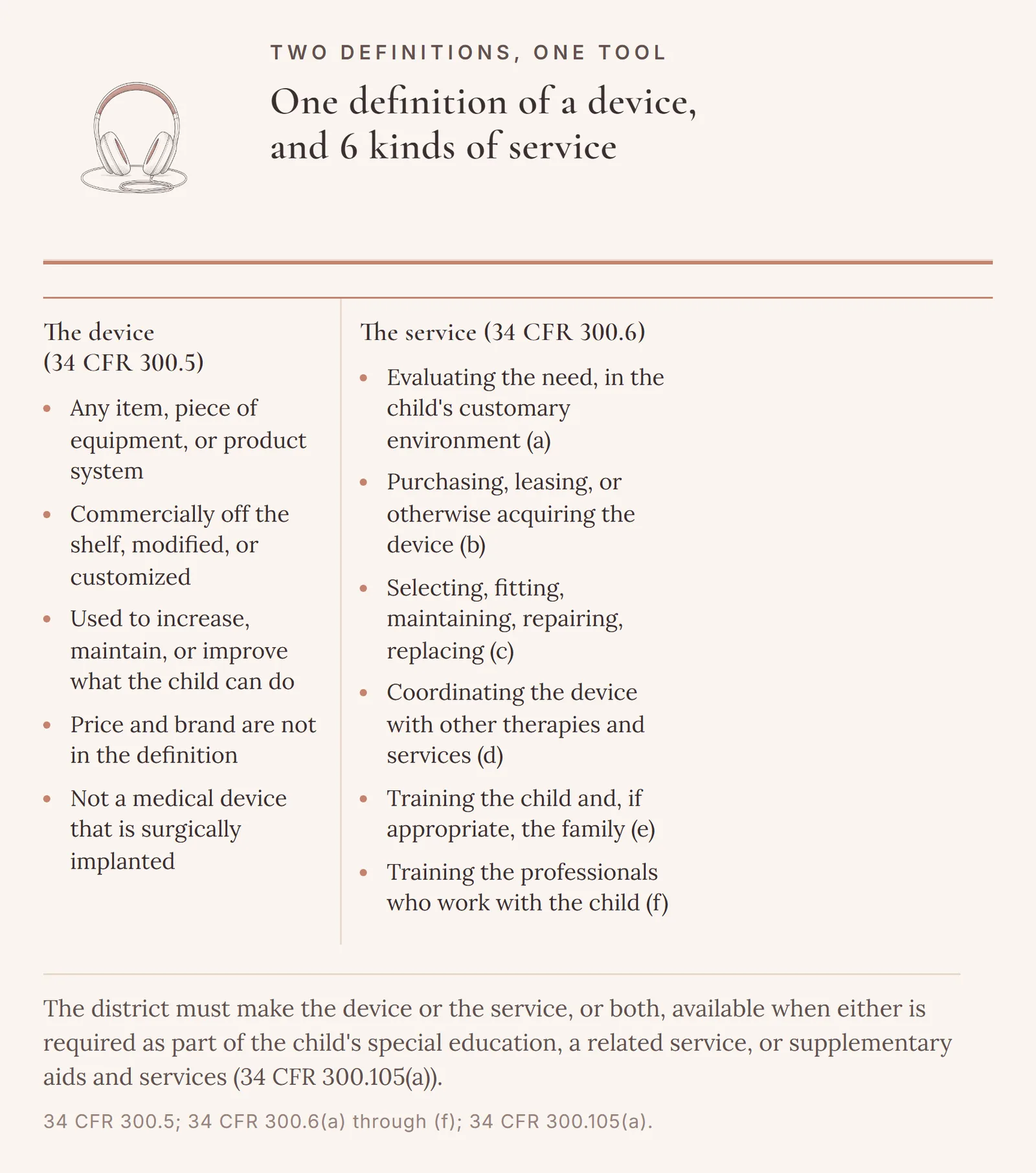
An assistive technology device is any item, piece of equipment, or product system, whether acquired commercially off the shelf, modified, or customized, that is used to increase, maintain, or improve a child's functional capabilities (34 CFR 300.5). No regulation names a device, an app, or a brand. Price is not in the definition: a setting built into the school laptop can meet it (Myth 27).
The other half is the service: anything that directly assists a child in selecting, acquiring, or using a device (34 CFR 300.6). Six kinds are listed, from the evaluation of the child's needs in the child's customary environment (34 CFR 300.6(a)) to training for the child and the family (34 CFR 300.6(e)), and training for the adults at school (34 CFR 300.6(f)). A tool nobody has been shown how to run is what those last two prevent.
What does the IEP have to say for a tool to be real
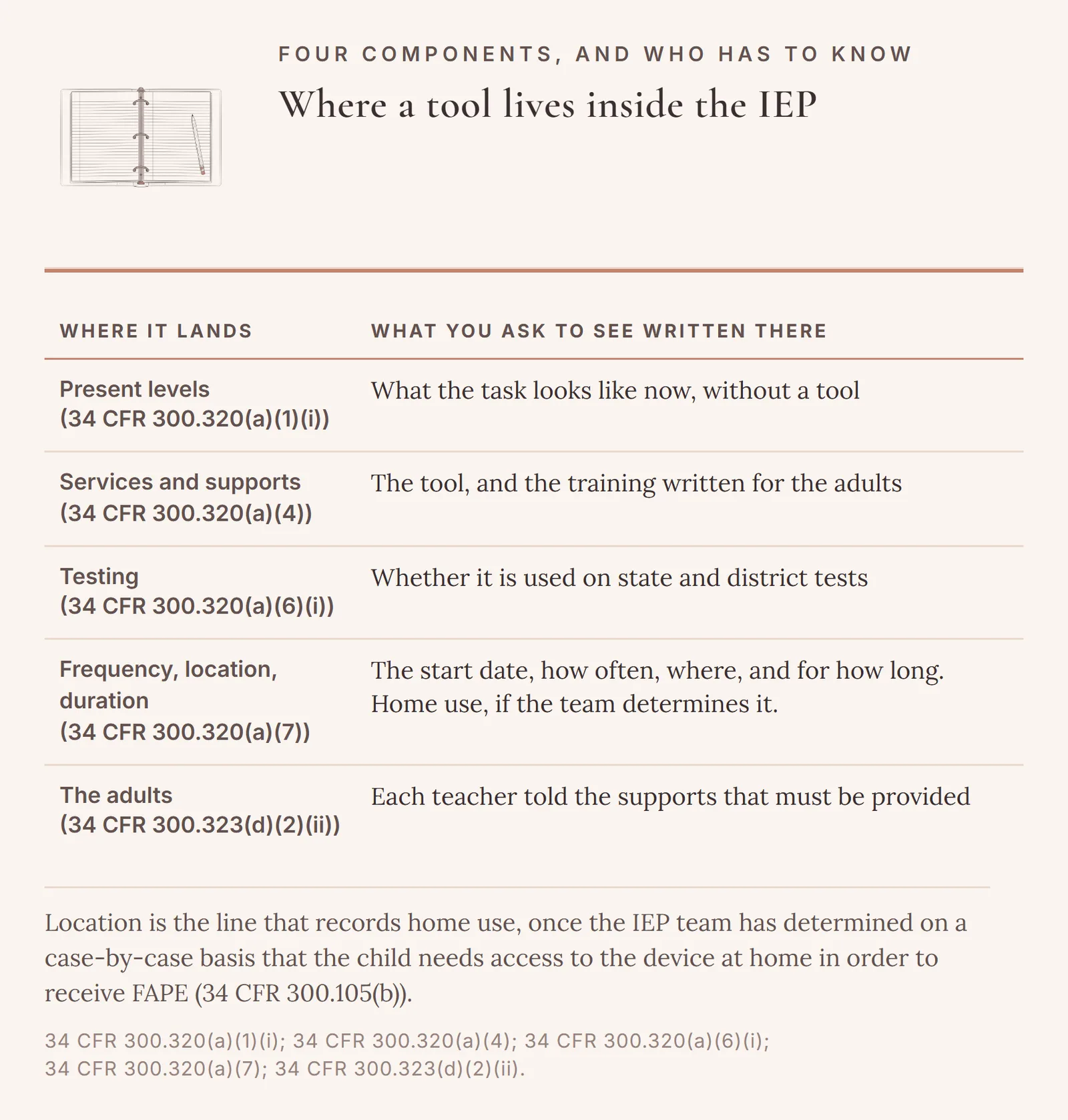
Four parts of the document carry most of a tool decision, and the tool goes missing in whichever one was left blank. The need belongs in the present levels, the part of the IEP that says where your child is now and how the disability affects progress in the general education curriculum (34 CFR 300.320(a)(1)(i)). The tool and the adults' training belong in the statement of services and supports for school personnel (34 CFR 300.320(a)(4)).
A tool used on state and districtwide tests belongs in the testing accommodations (34 CFR 300.320(a)(6)(i)). The start date and the anticipated frequency, location, and duration sit in the next component (34 CFR 300.320(a)(7)). Location is the line that records where the tool is used. Each teacher and provider is then informed of the specific accommodations, modifications, and supports that must be provided (34 CFR 300.323(d)(2)(ii)).
How to ask, step by step
- Write down the task, not the product: what happens now, how long it takes, what an adult does instead. A review of existing data has to include the information parents provide (34 CFR 300.305(a)(1)(i)).
- Send it in writing to the case manager and the special education director, and keep a dated copy.
- Ask for the consideration by name (34 CFR 300.324(a)(2)(v)), and ask that your concerns be weighed with it (34 CFR 300.324(a)(1)(ii)).
- If the team needs more than it has, request a reevaluation covering assistive technology needs, including a functional evaluation where the work happens (34 CFR 300.303(a)(2), 300.6(a)). A reevaluation happens not more than once a year unless you and the district agree otherwise (34 CFR 300.303(b)(1)).
- Ask to try something before the team commits to it.
- Ask for the decision as a function: a tool that reads text aloud, turns speech into text, predicts words, or produces speech output.
- Ask what the IEP will say: the service, the adults' training, the testing line, and the start date with the frequency, location, and duration (34 CFR 300.320(a)(4), (a)(7)).
- Expect one of two routes: a meeting, or, after the annual meeting for that year, a written amendment you and the district agree to (34 CFR 300.324(a)(4)(i)).
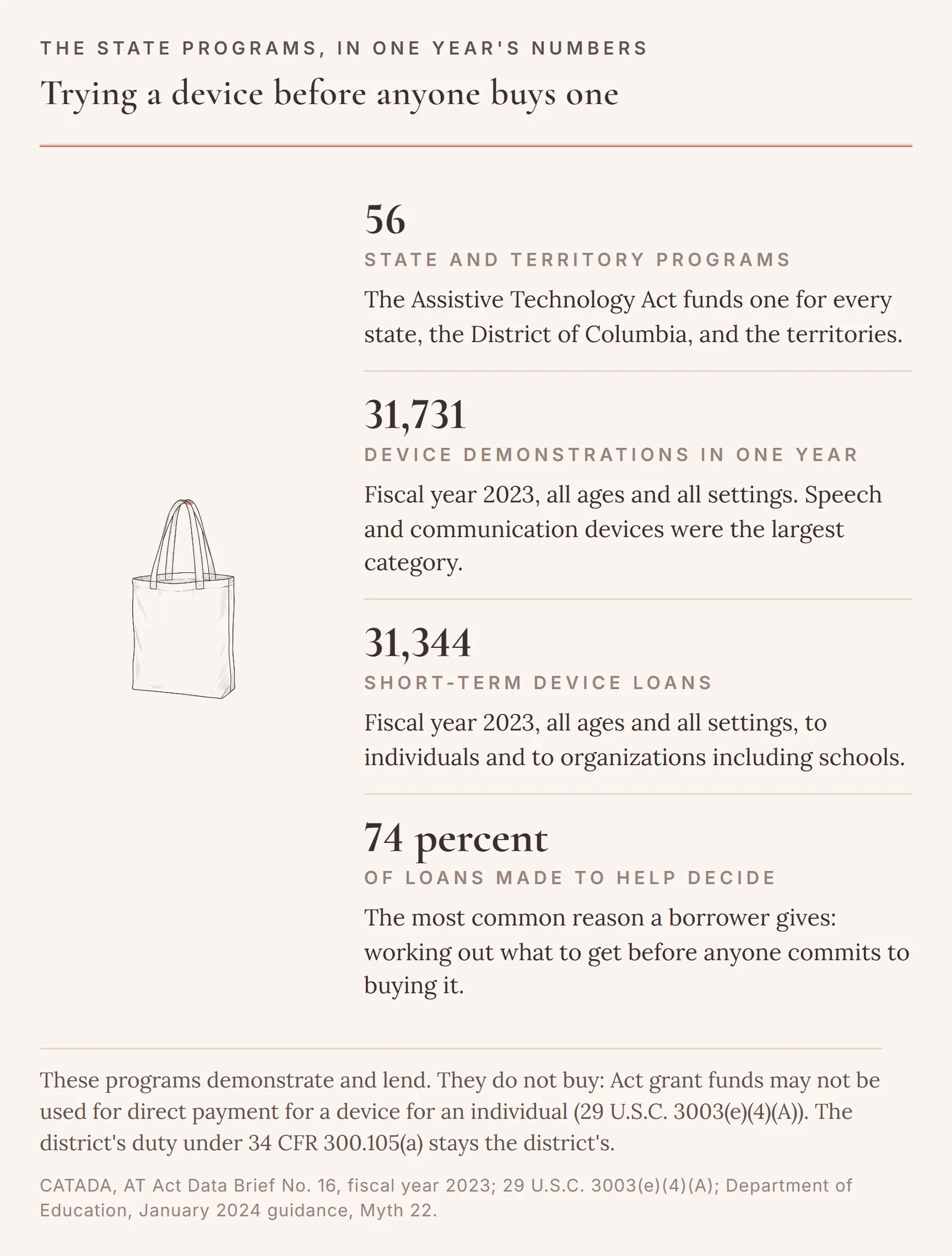
Step five has a door most families never hear about. The Assistive Technology Act funds 56 state and territory programs. The Department's guidance sends families and districts to them to try a device before it is bought (Myth 22). In the 2023 fiscal year, across all ages and settings, they ran 31,731 device demonstrations and 31,344 short-term loans, about 74 percent of the loans to help the borrower decide what to get. The directory is at at3center.net/state-at-programs/. They lend and demonstrate. Act grant funds may not be used for direct payment for a device for an individual (29 U.S.C. 3003(e)(4)(A)).
Mistakes and edge cases
Treating "try the free app first" as a decision. A trial is one option among others, and the options a team considered and rejected belong in its written answer (34 CFR 300.503(b)(6)). The Department's guidance says a child's devices and services "should be determined by the child's needs rather than the cost" (Myth 27). The verb there is should.
Expecting the device to go home on its own. On a case-by-case basis, the use of school-purchased devices at home or in other settings is required if the IEP team determines the child needs access in order to receive FAPE (34 CFR 300.105(b)). It is a determination to ask for, recorded in the location line.
Letting a no stay verbal. Written notice must be given a reasonable time before an agency refuses to change the provision of FAPE, with an explanation of why (34 CFR 300.503(a)(2), (b)(2)). That document is prior written notice, and Prior Written Notice, Decoded reads it line by line.
Every state also has a federally funded Parent Training and Information Center, whose staff help with a request like this at no cost, at parentcenterhub.org.
FAQ
Does the school have to do an assistive technology evaluation first
The Department's January 2024 guidance says such an evaluation can be included as a service but "is not required under the IDEA" (Myth 4). The routes that do exist run through the reevaluation a parent may request (34 CFR 300.303(a)(2)) and the right to request an assessment when the team says it has enough data (34 CFR 300.305(d)(1)(ii)).
What if nobody on the team knows anything about these tools
The Department's guidance says team members who lack knowledge of the options must bring in others who have it (Myth 2). The regulation's route is a member added, at the parent's or the agency's discretion, for knowledge or special expertise about the child (34 CFR 300.321(a)(6)).
How soon does a tool written into the IEP have to arrive
As soon as possible following development of the IEP, services are made available in accordance with it (34 CFR 300.323(c)(2)). No federal paragraph sets a day count for a device that has to be ordered. Assistive Technology, Decoded covers what to ask for while it is on order.
Sources
- eCFR, 34 CFR 300.5 (https://www.ecfr.gov/current/title-34/section-300.5)
- eCFR, 34 CFR 300.6 (https://www.ecfr.gov/current/title-34/section-300.6)
- eCFR, 34 CFR 300.17 (https://www.ecfr.gov/current/title-34/section-300.17)
- eCFR, 34 CFR 300.34 (https://www.ecfr.gov/current/title-34/section-300.34)
- eCFR, 34 CFR 300.42 (https://www.ecfr.gov/current/title-34/section-300.42)
- eCFR, 34 CFR 300.105 (https://www.ecfr.gov/current/title-34/section-300.105)
- eCFR, 34 CFR 300.303 (https://www.ecfr.gov/current/title-34/section-300.303)
- eCFR, 34 CFR 300.305 (https://www.ecfr.gov/current/title-34/section-300.305)
- eCFR, 34 CFR 300.320 (https://www.ecfr.gov/current/title-34/section-300.320)
- eCFR, 34 CFR 300.321 (https://www.ecfr.gov/current/title-34/section-300.321)
- eCFR, 34 CFR 300.323 (https://www.ecfr.gov/current/title-34/section-300.323)
- eCFR, 34 CFR 300.324 (https://www.ecfr.gov/current/title-34/section-300.324)
- eCFR, 34 CFR 300.503 (https://www.ecfr.gov/current/title-34/section-300.503)
- Department of Education, Myths and Facts Surrounding Assistive Technology Devices and Services, January 2024 (https://sites.ed.gov/idea/files/Myths-and-Facts-Surrounding-Assistive-Technology-Devices-01-22-2024.pdf)
- Legal Information Institute, 29 U.S.C. 3003 (https://www.law.cornell.edu/uscode/text/29/3003)
- CATADA, AT Act Data Brief No. 16, fiscal year 2023 (https://catada.info/assets/2024/ATAP_2024_R.pdf)
- AT3 Center, State AT Programs directory (https://at3center.net/state-at-programs/)
- Center for Parent Information and Resources, parent centers (https://www.parentcenterhub.org/considering-at/)