The short answer
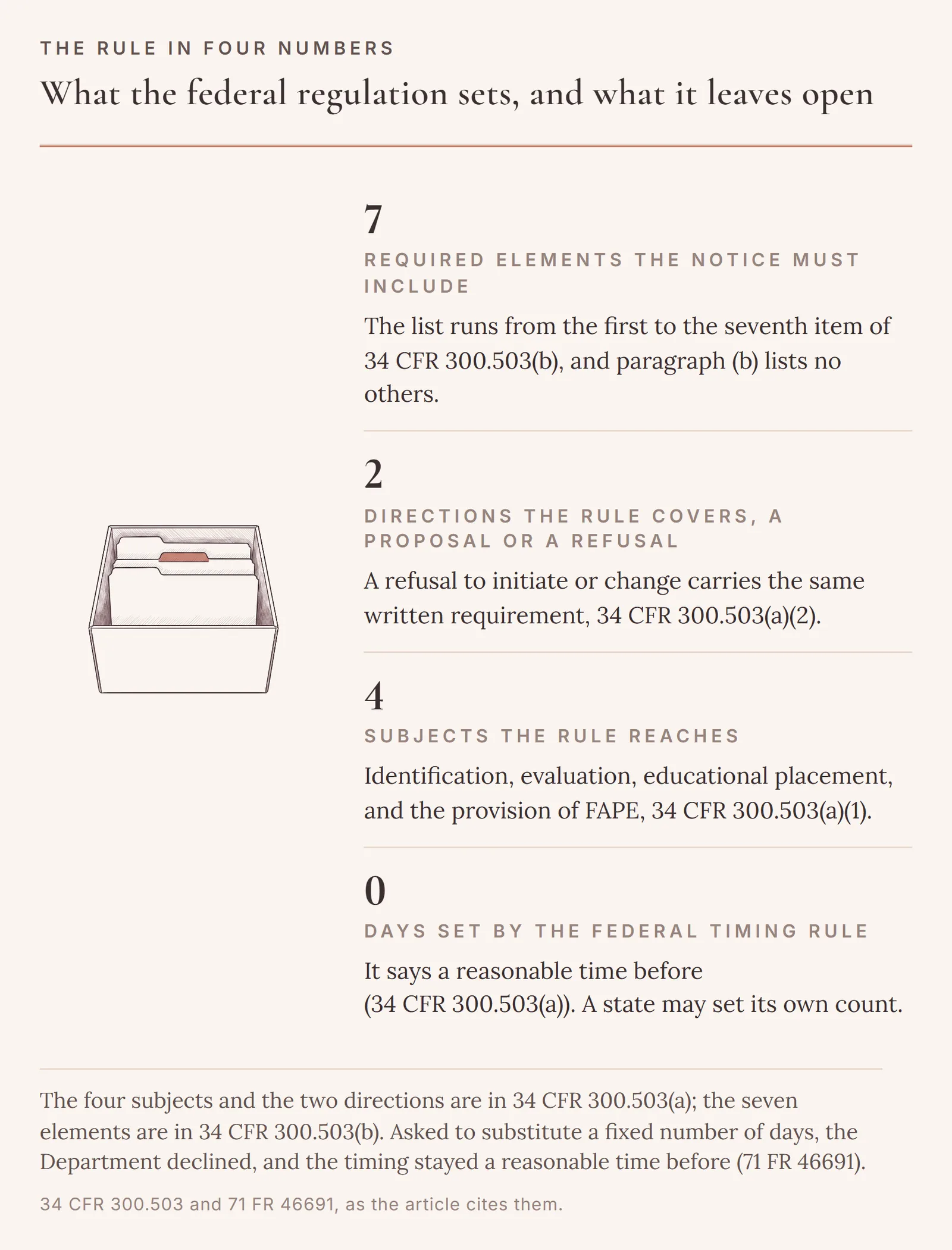
Prior written notice is a school district's written record of one decision. Federal law requires it a reasonable time before the district proposes or refuses to start or change a child's identification, evaluation, educational placement, or the free appropriate public education it provides (34 CFR 300.503(a)). The regulation lists seven things that notice must contain.
Why this one page carries so much
Most of what a school sends home explains something. One document decides something.
The rule is short. Written notice must be given to the parents of a child with a disability a reasonable time before the public agency proposes to initiate or change (34 CFR 300.503(a)(1)), or refuses to initiate or change (34 CFR 300.503(a)(2)), the identification, evaluation, or educational placement of the child, or the provision of FAPE. FAPE is the free appropriate public education, the special education and related services a child with a disability receives at public expense (34 CFR 300.17).
Two halves of that sentence do the work. The first is proposes or refuses: a no is a decision, and it carries the same written requirement as a proposal. The second is the four subjects. Identification is whether your child is a child with a disability who needs special education. Evaluation is the testing behind that question. Educational placement is where your child is taught. The provision of FAPE is the services themselves.
How the rule works
What does a prior written notice have to contain
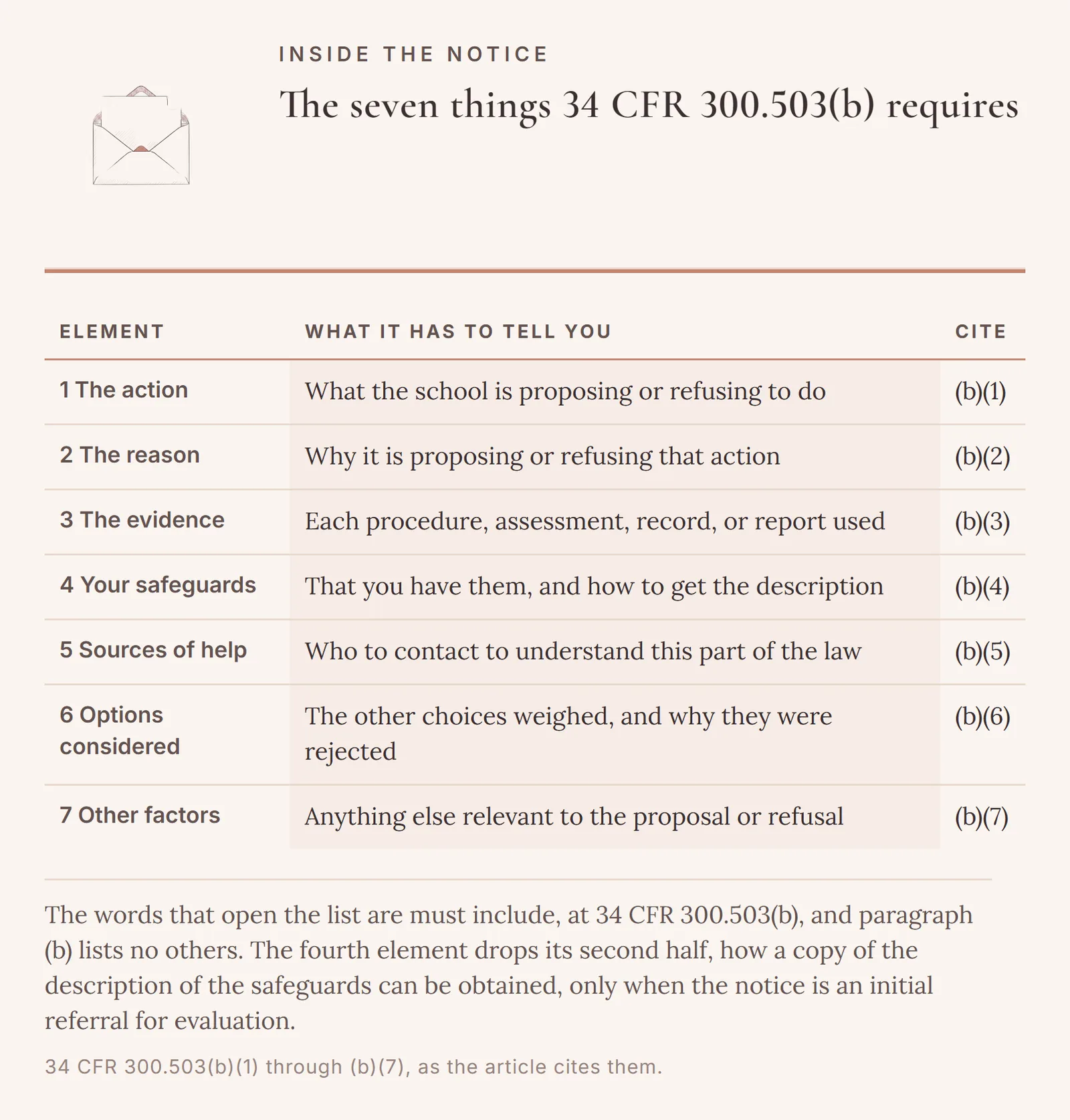
A notice that arrives is not automatically complete. The words that open the list of contents are must include (34 CFR 300.503(b)), and the seven run from 34 CFR 300.503(b)(1) through (b)(7):
- The action the school proposes or refuses (b)(1).
- Why it proposes or refuses it (b)(2).
- Each evaluation procedure, assessment, record, or report used as a basis for the action (b)(3).
- That you have protection under the procedural safeguards, the protections this law gives parents, and how to get a copy of the description (b)(4).
- Sources you can contact for help understanding this part of the law (b)(5).
- The other options the Individualized Education Program (IEP) Team considered, and why they were rejected (b)(6).
- Other factors relevant to the proposal or refusal (b)(7).
The sixth is the one to learn first, and I think it is why this document is worth learning to read. A complete notice says what else was on the table and why the team set it aside (34 CFR 300.503(b)(6)).
When is the notice actually due
The federal timing is a phrase, not a number: a reasonable time before (34 CFR 300.503(a)). No federal day count attaches to it. The Department of Education declined to set one in 2006, saying the notice comes in a wide variety of circumstances for which any one timeline would be too rigid (the Department's explanation of the 2006 regulations, 71 FR 46691).
What before is measured against matters more than a count. In a 2012 policy letter, the Department's Office of Special Education Programs read the rule to mean the notice is owed whether or not the decision is made at an IEP Team meeting, and that no point is fixed for it as long as it comes a reasonable time before the district implements the action (OSEP Letter to Chandler, April 26, 2012). That letter is informal guidance, not regulation. A notice handed to you as a meeting ends is not late for that alone.
Some states do set a number. Texas requires it at least five school days before the district proposes or refuses the action, unless the parent agrees to a shorter timeframe (19 Tex. Admin. Code 89.1050(g)). Your state may set its own timeframe.
Which of the three notices am I holding
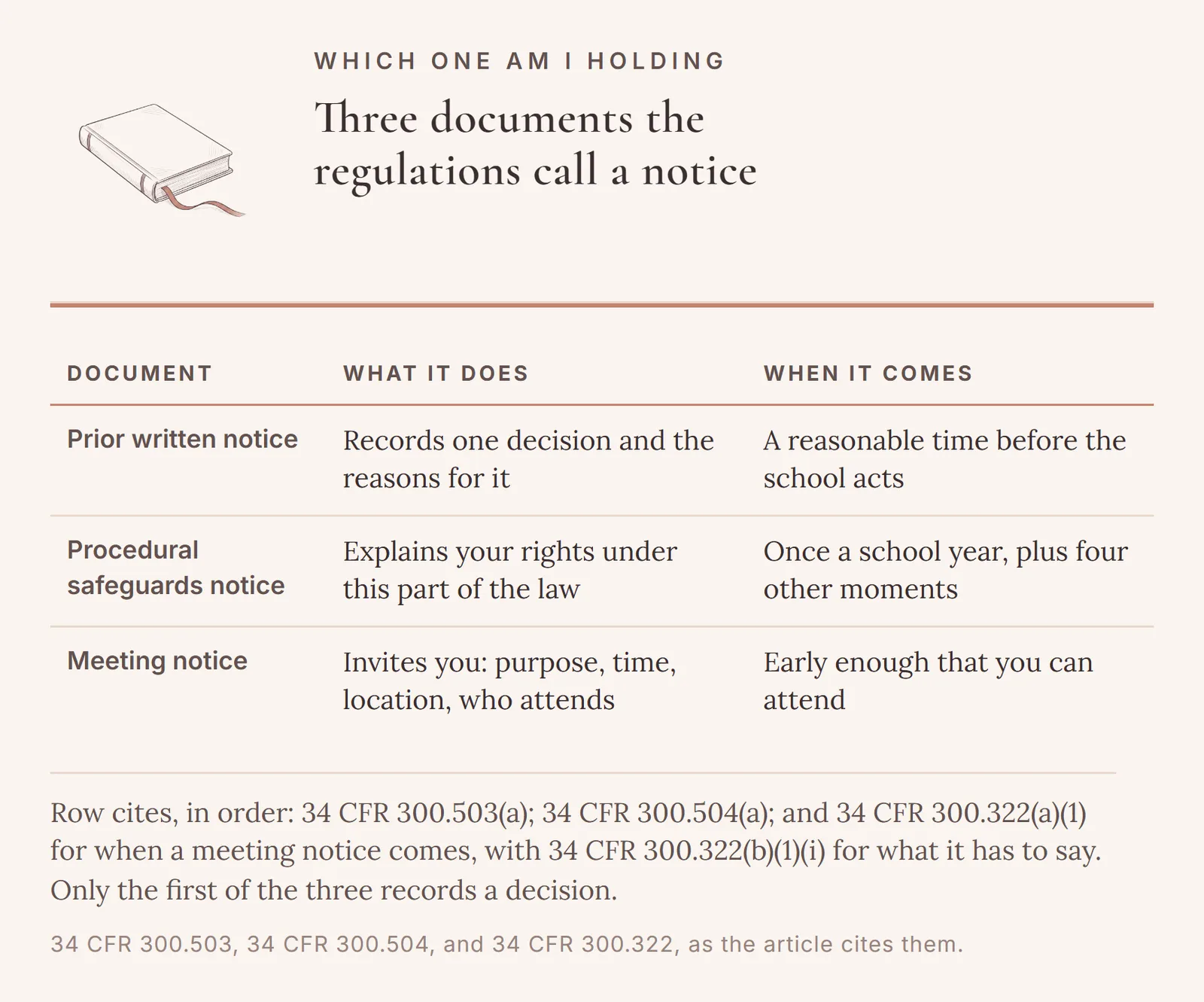
Three documents in these regulations are called a notice, which is why they get mixed up.
The procedural safeguards notice is the booklet of rights. A copy must be given only one time a school year, plus four other moments: on initial referral or a request for evaluation, on a first State complaint and a first due process complaint, under the discipline procedures, and on request (34 CFR 300.504(a)).
The meeting notice is the invitation. The school must notify parents early enough to ensure they will have an opportunity to attend (34 CFR 300.322(a)(1)), and it must indicate the purpose, time, and location of the meeting and who will be in attendance (34 CFR 300.322(b)(1)(i)).
Prior written notice is the only one of the three that records a decision, and its fourth element points you at the booklet (34 CFR 300.503(b)(4)).
How to read the notice you were handed
- Work out which document it is.
- Read it against the seven. Take 34 CFR 300.503(b)(1) through (b)(7) one at a time and mark which are answered.
- Look hardest at the sixth. Read what the notice says about the other options considered and why they were rejected, and note anything it leaves out (34 CFR 300.503(b)(6)).
- Write down two dates: the day it arrived, and the day the change takes effect. The gap is your reading time.
- Ask in writing about anything it leaves unanswered, naming the notice, its date, and the element you mean.
- Ask for the paper it names. The third element lists each evaluation procedure, assessment, record, or report the school relied on (34 CFR 300.503(b)(3)), and those live in your child's school file.
- If a decision was made and nothing came in writing, ask for it in writing, naming the decision, the date you were told about it, and 34 CFR 300.503. Write down what you asked for, when, and who you asked; the parent centers' own guidance says a parent who did not get a notice she was owed can ask for one (Center for Parent Information and Resources).
Mistakes and edge cases
Taking a notice for a consent form. A notice informs you. Consent is your written yes, and the two stay separate even when one form carries both. A school proposing an initial evaluation must, after providing notice, obtain informed consent before it evaluates (34 CFR 300.300(a)(1)(i)), and that consent is not consent for the initial provision of services (34 CFR 300.300(a)(1)(ii)).
Counting six elements instead of seven. Look this up in the statute and you will count six: 20 U.S.C. 1415(c)(1) sets out the same content as six lettered items, (A) through (F), one of which combines the explanation of why with the records relied on.
Assuming a 504 plan comes with the same seven elements. Section 504 of the Rehabilitation Act requires notice for actions on identification, evaluation, or educational placement and lists no contents for it; following the IDEA procedures is one means of meeting that requirement (34 CFR 104.36).
Every state has a free, federally funded Parent Training and Information Center, and reading a notice with a parent is ordinary work for them. Find yours at parentcenterhub.org.
FAQ
Does the notice have to arrive before the IEP meeting?
No. The Department's explanation of the 2006 regulations says the requirement is met so long as the notice comes a reasonable time before the agency implements the proposal or refusal, and that notice in advance of a meeting could suggest, in some circumstances, that the proposal was improperly arrived at before the meeting and without parent input (71 FR 46691).
Can I get these notices by email?
If your district offers it. A parent may elect to receive the notices required by 34 CFR 300.503, 300.504, and 300.508 by electronic mail, if the public agency makes that option available (34 CFR 300.505).
Do I have to sign a prior written notice?
Nothing in 34 CFR 300.503 asks for a parent's signature. Some state and district forms put a response block on the same sheet, which is form design, not federal law.
Sources
- eCFR, 34 CFR 300.503, prior notice (https://www.ecfr.gov/current/title-34/section-300.503)
- eCFR, 34 CFR 300.504, procedural safeguards notice (https://www.ecfr.gov/current/title-34/section-300.504)
- eCFR, 34 CFR 300.322, parent participation (https://www.ecfr.gov/current/title-34/section-300.322)
- eCFR, 34 CFR 300.300, parental consent (https://www.ecfr.gov/current/title-34/section-300.300)
- eCFR, 34 CFR 300.505, electronic mail (https://www.ecfr.gov/current/title-34/section-300.505)
- eCFR, 34 CFR 104.36, Section 504 safeguards (https://www.ecfr.gov/current/title-34/section-104.36)
- Federal Register, 71 FR 46540 at 46691, on section 300.503 (https://www.govinfo.gov/content/pkg/FR-2006-08-14/pdf/06-6656.pdf)
- U.S. Department of Education, OSEP letter to Cindy Chandler, 2012 (https://sites.ed.gov/idea/idea-files/policy-letter-april-26-2012-to-family-soup-executive-director-cindy-e-chandler/)
- Legal Information Institute, 20 U.S.C. 1415 (https://www.law.cornell.edu/uscode/text/20/1415)
- Legal Information Institute, 19 Tex. Admin. Code 89.1050 (https://www.law.cornell.edu/regulations/texas/19-Tex-Admin-Code-SS-89-1050)
- Center for Parent Information and Resources, prior written notice (https://www.parentcenterhub.org/notice-prior/)
- Center for Parent Information and Resources, find your parent center (https://www.parentcenterhub.org/find-your-center/)