The short answer
A placement change is decided by a group that includes the parents, based on the IEP (Individualized Education Program), and explained in writing a reasonable time before it happens (34 CFR 300.116(a)(1), 300.503(a)(1)). You can ask for the data and the notice, take your seat, answer in writing, and use the dispute routes if you still disagree.
What placement means, and where most students spend the day
It rarely arrives with the word "placement" attached. "We think the STAR room is a better fit." "A shorter day until he settles." Each is a proposal to change a child's education.
The regulations never define placement. The U.S. Department of Education's longstanding position is that it refers to the provision of special education and related services rather than a specific place, such as a specific classroom or school (71 FR 46687). The question is what program he receives, not which door he walks through.
The least restrictive environment rule (LRE) says children with disabilities are educated with nondisabled children to the maximum extent appropriate (34 CFR 300.114(a)(2)(i)), and removal happens only if education in regular classes with supplementary aids and services cannot be achieved satisfactorily (34 CFR 300.114(a)(2)(ii)).
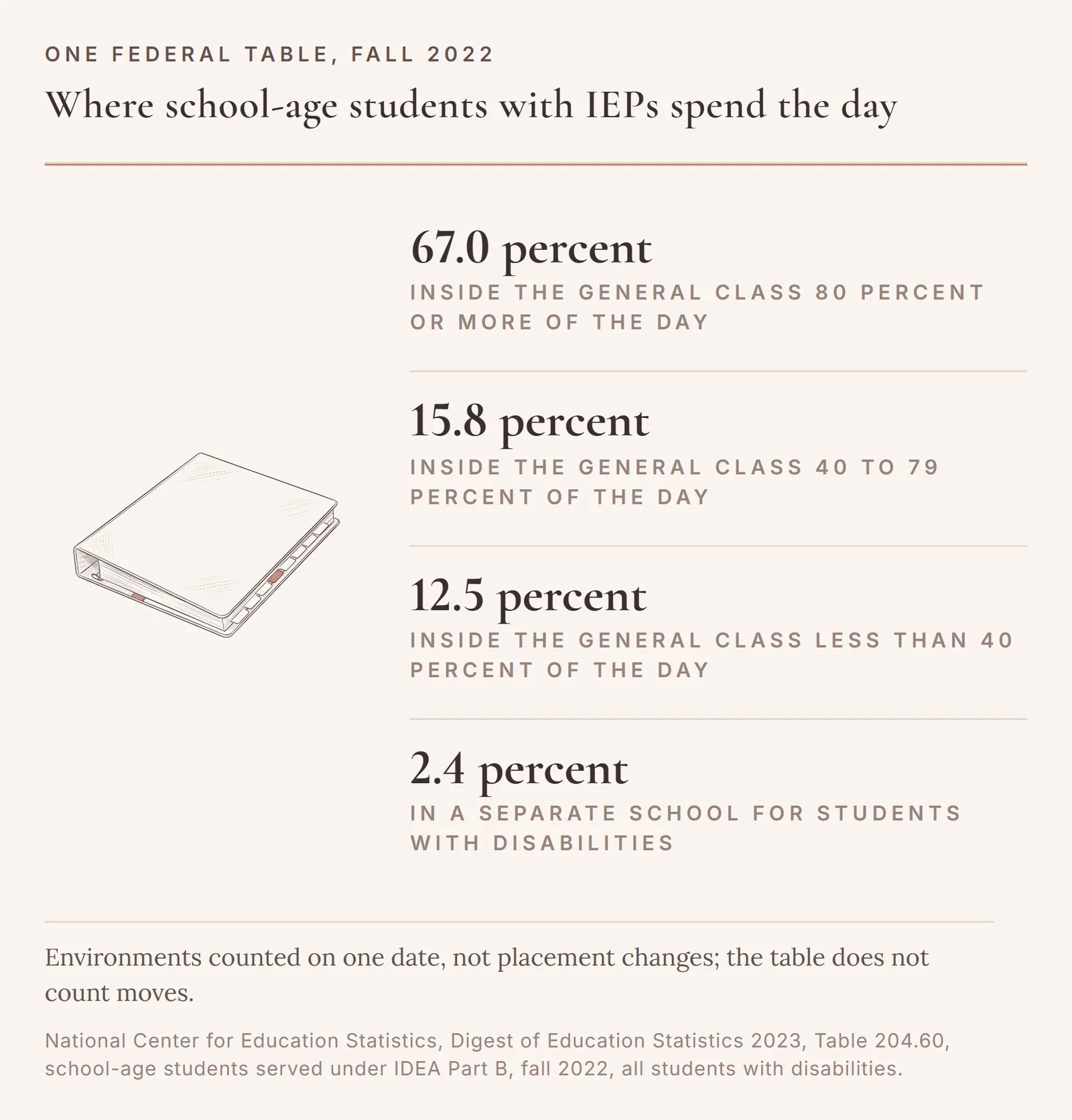
In fall 2022, 67.0 percent of school-age students served under the Individuals with Disabilities Education Act (IDEA) spent 80 percent or more of the day inside the general class. Another 15.8 percent spent 40 to 79 percent there, 12.5 percent spent less than 40 percent, and 2.4 percent attended a separate school for students with disabilities (NCES, Digest of Education Statistics 2023, Table 204.60). The table counts where students are on one date, not how often they move.
How a placement decision works
Is this a change of placement, or a change of room?
The Department calls placement a point on the continuum of options, and location the physical surrounding, such as the classroom. Where two locations are equally appropriate, administrators may assign one, consistent with the placement group's decision, and a program substantially and materially similar to the old one is not a change in placement (71 FR 46588-46589).
Guidance from the Office of Special Education Programs (OSEP) asks whether a move would substantially or materially alter the child's program (Policy Letter 22-03 to Tymeson, 2022). It looks at whether the IEP was revised, time with nondisabled children, nonacademic and extracurricular opportunities, and the option on the continuum.
Who decides, and by what rules?
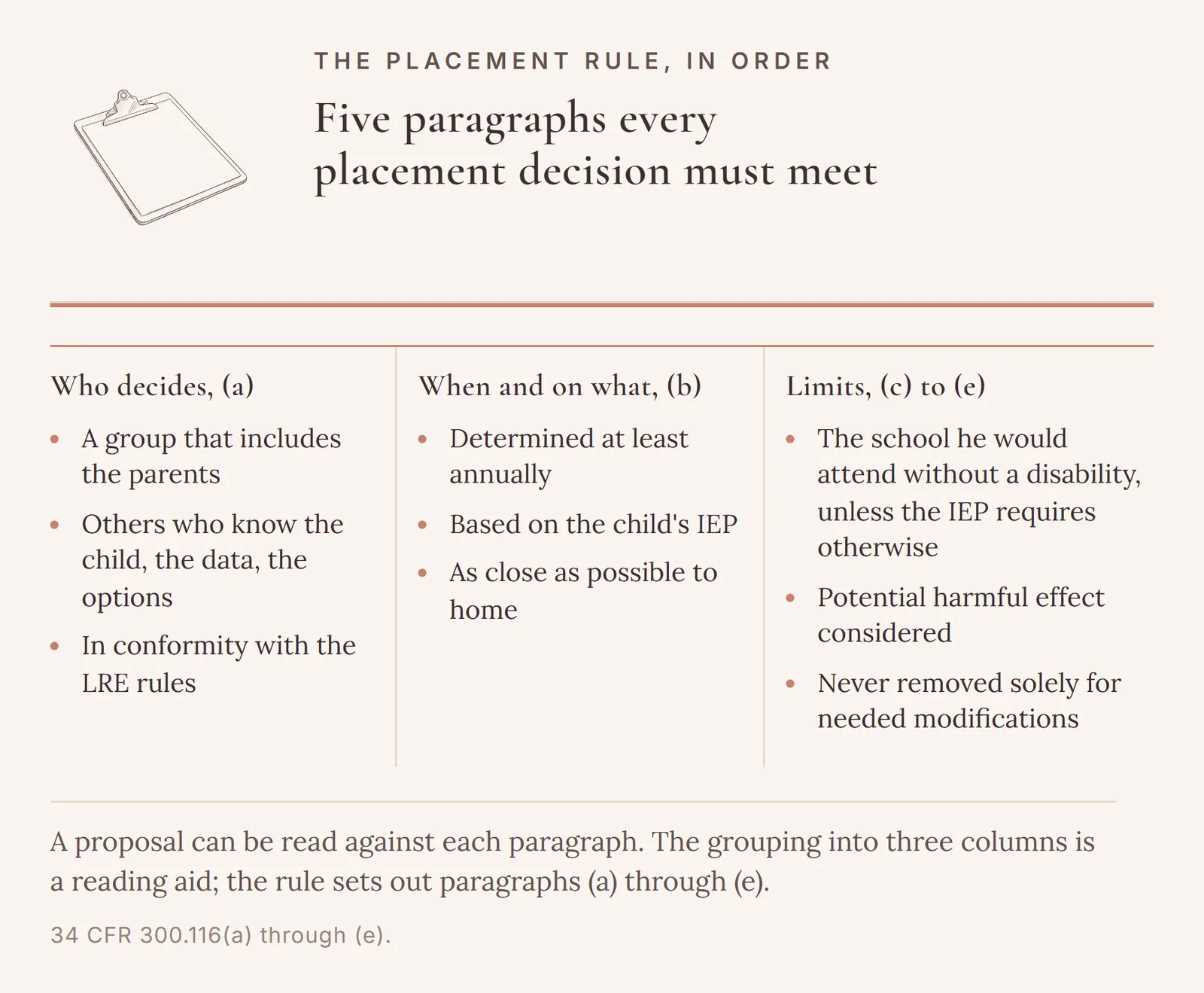
The decision belongs to a group that includes the parents and others who know the child, the evaluation data (the results of the school's assessments), and the options (34 CFR 300.116(a)(1)). It follows the LRE rules (34 CFR 300.116(a)(2)). The parents are members of any group that decides placement (34 CFR 300.327, 300.501(c)(1)).
The placement is determined at least annually, based on the IEP, and as close as possible to home (34 CFR 300.116(b)(1), (b)(2), (b)(3)). He is educated in the school he would attend if he did not have a disability, unless the IEP requires another arrangement (34 CFR 300.116(c)). Potential harmful effect is considered (34 CFR 300.116(d)), and he is never removed from regular classrooms solely because of needed modifications in the curriculum (34 CFR 300.116(e)). Category, availability of space, and administrative convenience cannot be the basis on their own (71 FR 46588).
What does the school owe you in writing?
Prior written notice is the school's written explanation of a decision, owed a reasonable time before it proposes to change the placement (34 CFR 300.503(a)(1)). It has seven required contents (34 CFR 300.503(b)). Two carry the weight for a move: each evaluation, record, or report relied on (34 CFR 300.503(b)(3)), and the other options considered and why they were rejected (34 CFR 300.503(b)(6)).
You can see the records first: before any meeting regarding an IEP, and in no case more than 45 days after you ask (34 CFR 300.613(a)).
What happens if you say no?
The federal rule requires consent before the initial evaluation and the initial provision of services (34 CFR 300.300(a)(1)(i), (b)(1)), not before a later change of placement.
Membership is a seat, not a veto. The Department struck "unless the parent agrees otherwise" from the placement rule because it could be read as a parent veto (71 FR 46588), and a group may decide without a parent it could not involve, if it records its attempts (34 CFR 300.501(c)(4)).
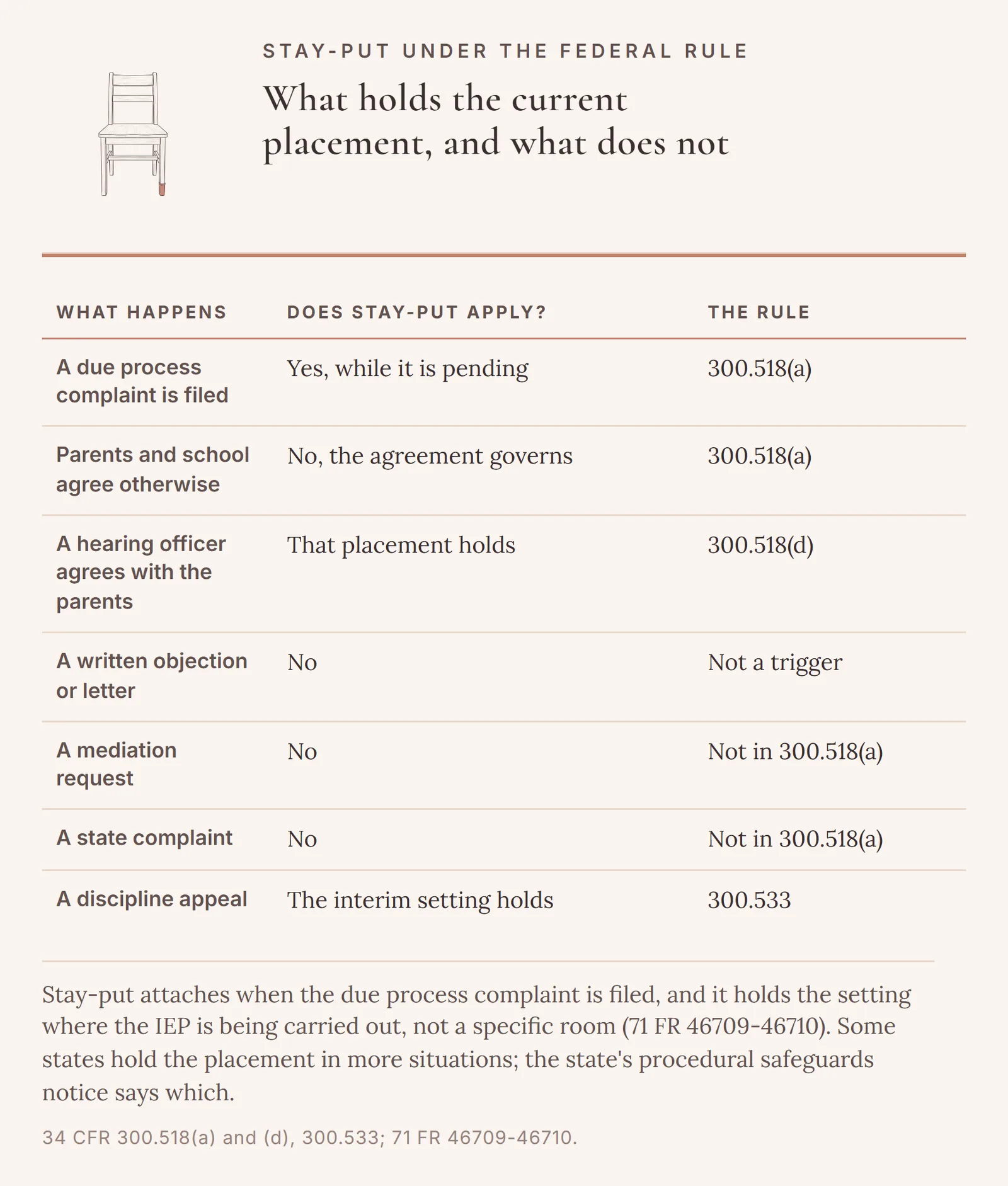
Stay-put keeps a child in his current educational placement while a due process complaint is pending (34 CFR 300.518(a)). Both sides can agree otherwise, and a discipline appeal is the exception (34 CFR 300.518(a), 300.533). It attaches when the complaint is filed (71 FR 46710) and holds the setting, not a specific room (71 FR 46709).
A letter, a mediation request (34 CFR 300.506), or a state complaint (34 CFR 300.151) does not start it. That is the federal rule. Some states hold the placement in more situations, such as during mediation, so check your procedural safeguards notice. If a hearing officer agrees with the parents that a change is appropriate, that placement holds (34 CFR 300.518(d)).
What to do when a change is proposed, step by step
- Write the proposal down as it reached you: who, when, and the exact words.
- Ask in writing for prior written notice with all seven contents (34 CFR 300.503(b)), and to inspect the records behind the proposal (34 CFR 300.613(a)).
- Ask the school to confirm placement is a purpose of the meeting; the meeting notice must state its purpose (34 CFR 300.322(b)(1)(i), 300.501(c)(2)).
- At the meeting, ask which part of the IEP requires the new setting (34 CFR 300.116(b)(2)) and which supplementary aids and services were tried in the regular class (34 CFR 300.114(a)(2)(ii)). Bring your concerns in writing; the team must consider them (34 CFR 300.324(a)(1)(ii)).
- Answer in writing, with a date: you agree, agree in part, or do not agree.
- If you still disagree, pick a route. Mediation is voluntary (34 CFR 300.506(b)(1)(i)). A state complaint has a 60-day time limit, with extensions allowed in some cases (34 CFR 300.152(a), (b)(1)). A due process complaint on placement has a two-year limit from when you knew or should have known, unless your state sets its own (34 CFR 300.507(a)(1), (a)(2)); a resolution meeting follows within 15 days (34 CFR 300.510(a)(1)), and a hearing decision is due 45 days after the 30-day resolution period (34 CFR 300.515(a)).
Mistakes and edge cases
Revoking consent to stop one move. Revocation ends all special education and related services, not one placement, and the school may not continue them (34 CFR 300.300(b)(4), (b)(4)(i)).
Missing a move that goes by another name. A shortened day and a behavior-driven move have their own rules. OSEP's 2022 discipline guidance says an administrator telling a parent a child may attend only shortened days because of behavior could be a removal and an improper change in placement, and that a shorter day is the IEP Team's decision (Q&A 22-02, Questions C-1 and C-6).
Under the discipline rules, a removal of more than 10 consecutive school days is a change of placement (34 CFR 300.536(a)(1)). So is a series of removals that forms a pattern: more than 10 school days in a school year, substantially similar behavior, and factors such as the length and proximity of the removals (34 CFR 300.536(a)(2)). The school decides case by case whether a pattern is a change of placement (34 CFR 300.536(b)(1)).
Every state has a free, federally funded Parent Training and Information Center, and reading a placement notice with a parent is ordinary work for them. Find yours at parentcenterhub.org.
FAQ
Does the school need my signature to change my child's placement?
Not under the federal rule, which asks for consent before the initial evaluation and initial services (34 CFR 300.300(a)(1)(i), (b)(1)). Your state may add a rule, so check your procedural safeguards notice, the written summary of your rights.
Does telling the school I disagree keep my child where he is?
Not under the federal rule: stay-put starts when a due process complaint is filed (34 CFR 300.518(a)), though some states go further. A written answer still matters: it puts your position on the record with a date.
How often is placement reviewed?
At least annually (34 CFR 300.116(b)(1)).
Sources
- eCFR, 34 CFR 300.114, LRE (https://www.ecfr.gov/current/title-34/section-300.114)
- eCFR, 34 CFR 300.116, placements (https://www.ecfr.gov/current/title-34/section-300.116)
- eCFR, 34 CFR 300.300, consent (https://www.ecfr.gov/current/title-34/section-300.300)
- eCFR, 34 CFR 300.322, meeting notice (https://www.ecfr.gov/current/title-34/section-300.322)
- eCFR, 34 CFR 300.324, IEP development (https://www.ecfr.gov/current/title-34/section-300.324)
- eCFR, 34 CFR 300.327, placement decisions (https://www.ecfr.gov/current/title-34/section-300.327)
- eCFR, 34 CFR 300.501, parent participation (https://www.ecfr.gov/current/title-34/section-300.501)
- eCFR, 34 CFR 300.503, prior notice (https://www.ecfr.gov/current/title-34/section-300.503)
- eCFR, 34 CFR 300.506, mediation (https://www.ecfr.gov/current/title-34/section-300.506)
- eCFR, 34 CFR 300.151 and 300.152, state complaints (https://www.ecfr.gov/current/title-34/section-300.152)
- eCFR, 34 CFR 300.507, 300.510, 300.515, due process (https://www.ecfr.gov/current/title-34/section-300.507)
- eCFR, 34 CFR 300.518 and 300.533, stay-put (https://www.ecfr.gov/current/title-34/section-300.518)
- eCFR, 34 CFR 300.536, discipline (https://www.ecfr.gov/current/title-34/section-300.536)
- eCFR, 34 CFR 300.613, records (https://www.ecfr.gov/current/title-34/section-300.613)
- Department of Education, 71 FR 46588-46589, 46687, 46709-46710 (https://www.govinfo.gov/content/pkg/FR-2006-08-14/pdf/06-6656.pdf)
- OSEP Policy Letter 22-03 to Tymeson, 2022 (https://sites.ed.gov/idea/files/osep-policy-letter-22-03-to-tymeson-04-07-2022.pdf)
- OSEP Q&A 22-02, discipline, 2022 (https://sites.ed.gov/idea/files/qa-addressing-the-needs-of-children-with-disabilities-and-idea-discipline-provisions.pdf)
- NCES, Digest of Education Statistics 2023, Table 204.60 (https://nces.ed.gov/programs/digest/d23/tables/dt23_204.60.asp)
- Center for Parent Information and Resources (https://www.parentcenterhub.org/find-your-center/)